
Kookaburra Identification Guide
Australia's giant, chunky-headed kingfisher is unmistakable for its oversized bill, brown-and-white plumage, and famous cackling, laughing call.
Read the full Kookaburra encyclopedia entry →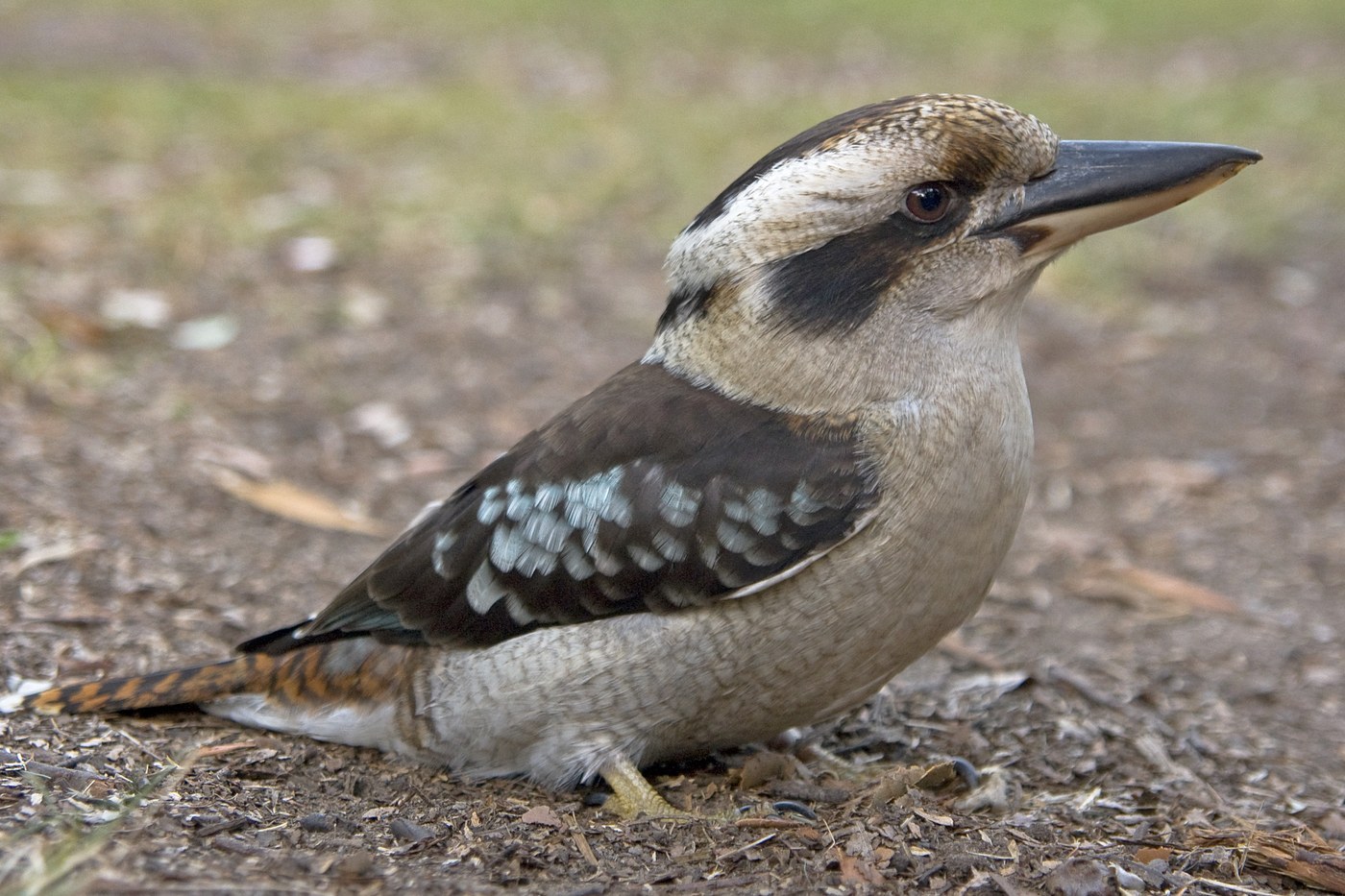
Key Field Marks
- Size & shape: A large, stocky kingfisher, around 40–47 cm long, with a big, blocky head, short neck, and a heavy, dagger-like bill that looks oversized for the body.
- Plumage: Predominantly off-white to cream on the head, neck, and underparts, with a dark brown eye-stripe/cap and mottled brown-and-blue wings and back (blue is more extensive in Blue-winged Kookaburra).
- Bill: Massive, straight, and blackish, one of the largest bills relative to body size of any kingfisher.
- Tail: Rufous-barred with dark bands, often held cocked or flicked when perched.
- Behavior: Sits upright and motionless on an exposed branch, wire, or post scanning the ground, then drops to seize prey; often seen in small family groups.
Separating Kookaburra from Similar Species
- Laughing Kookaburra vs. Blue-winged Kookaburra: The two main species overlap in northern Australia. Blue-winged Kookaburra shows much more extensive sky-blue on the wings and a pale (not dark) eye, plus a paler overall look and a harsher, less musical laughing call; Laughing Kookaburra has only a small blue patch on the wing coverts, a dark eye, and the classic rollicking "laugh."
- Other Australian kingfishers (e.g., Sacred Kingfisher, Forest Kingfisher): Much smaller and slimmer with proportionally smaller bills and brighter turquoise-blue backs, lacking the kookaburra's bulky, brown-and-cream, big-headed build.
- Overall body shape and size alone usually separate kookaburras from all other Australian birds — nothing else combines the huge head, massive bill, and chunky compact body.
Where & When to See
- Habitat: Open eucalypt woodland, forest edges, farmland with scattered trees, parks, and suburban gardens; readily adapts to human-modified landscapes.
- Range: Laughing Kookaburra is native to eastern Australia and has been introduced to parts of Western Australia, Tasmania, and New Zealand; Blue-winged Kookaburra occupies northern Australia and southern New Guinea.
- Season: Resident and non-migratory; visible year-round, with breeding pairs and helper offspring often staying together in family groups.
- Best viewing: Look for a bulky bird perched motionless on a bare branch, fence, or wire at woodland edges, especially around dawn and dusk when calling activity peaks.
Voice & Sound Cues
- The classic "laugh" is a loud, chuckling, cackling call rising to a maniacal crescendo, often given communally by a family group at dawn and dusk (territorial chorusing).
- Blue-winged Kookaburra's call is harsher, more manic and cackling, less "musical" than the Laughing Kookaburra's rounded laugh.
- The call carries a long distance through woodland and is frequently used to confirm presence even when the bird is hidden in foliage.
Frequently asked questions
How many kookaburra species are there?
There are four species overall, but the two most widely encountered and confused are the Laughing Kookaburra of eastern/southern Australia and the Blue-winged Kookaburra of northern Australia and New Guinea.
What is the best way to tell Laughing and Blue-winged Kookaburra apart?
Check the eye color (dark in Laughing, pale in Blue-winged), the amount of blue in the wing (limited patch vs. extensive blue), and the call (musical laugh vs. harsher cackle).
Is the kookaburra's laugh really a call, not a warning of danger?
Yes, the laughing call is a territorial and contact call, often performed as a dawn/dusk chorus by family groups to advertise and defend territory, not a distress signal.
Do kookaburras live near water like other kingfishers?
Not necessarily; despite being kingfishers, they are largely terrestrial hunters of woodland and farmland, feeding on insects, small reptiles, and other prey away from water.
Can kookaburras be found outside Australia?
The Laughing Kookaburra has been introduced to Tasmania, southwestern Australia, and New Zealand; the Blue-winged Kookaburra also occurs naturally in southern New Guinea.