
Knysna Turaco Identification Guide
This vivid green, crimson-winged forest bird of South Africa's coastal woodlands is best identified by its bushy crest, red eye-ring, and startling flash of red in flight.
Read the full Knysna Turaco encyclopedia entry →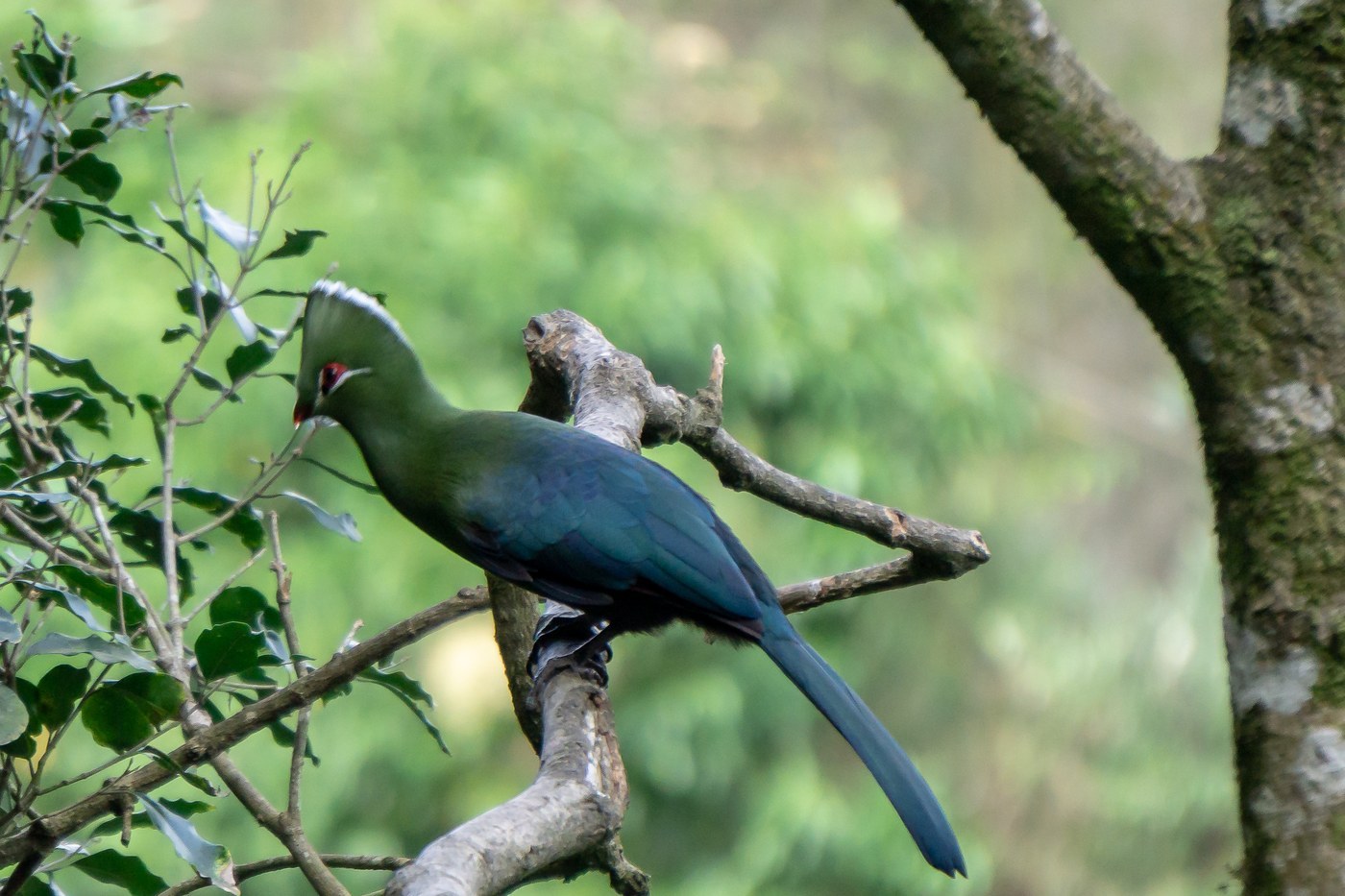
Key Field Marks
- Size & shape: A medium-large, long-tailed forest bird about 40–42 cm long, with a slim body, long tail, and rounded wings.
- Plumage: Overall rich emerald to bottle-green plumage with a bronzy sheen, offset by a tall, forward-pointing bushy green crest edged with a thin white line.
- Face: Bright red bare skin around the eye and a red-and-white facial pattern; the bill is short, stout, and coral-red to orange-red.
- Wings in flight: The most diagnostic feature — brilliant crimson-red primary feathers, hidden at rest but flashing vividly when the bird flies or glides between trees.
- Behavior: Moves through the canopy with agile, squirrel-like bounding hops along branches rather than extended flights; flies in short, heavy bursts between trees, often gliding at the end.
Separating Knysna Turaco from Similar Species
- Purple-crested Turaco: Overlaps in parts of the eastern range; has a purple (not green) crest and lacks the Knysna's green body tone — the two are usually separable by crest color and range.
- Livingstone's Turaco: Found further north/east; very similar green plumage but crest shape and white facial markings differ subtly, and ranges barely overlap with Knysna Turaco.
- Grey Go-away-bird (Grey Lourie): Superficially similarly shaped (crested, long-tailed) but plain grey overall with no red in the wings, easily separated by color.
- In practice, the combination of an all-green body, tall green crest, red eye-ring, and red bill within the Knysna Turaco's restricted South African range makes confusion unlikely once the red wing flash is seen.
Where & When to See
- Habitat: Indigenous evergreen forest, dense coastal bush, and forested gardens/plantations with fruiting trees; the species has adapted well to suburban gardens with fruiting figs and other trees within its range.
- Range: Endemic (near-endemic) to the southern and southeastern coast of South Africa, roughly from the Cape Peninsula and Garden Route (including the Knysna forests it is named for) east through the Eastern Cape.
- Season: Resident and non-migratory; present and identifiable year-round.
- Best viewing: Listen for its call from forest edges and gardens; scan fruiting trees (wild figs, loquats) at canopy level, and watch for the red wing flash as birds move between trees.
Voice & Sound Cues
- A loud, far-carrying, guttural "kok-kok-kok-kok-kok" or barking series of notes, often starting slowly and accelerating, given from cover.
- Also gives softer clucking and growling contact notes between family members.
- Calls are frequently heard before the bird is seen, especially at dawn and dusk, and are a reliable first clue to its presence in dense forest canopy.
Frequently asked questions
What is the easiest way to confirm a Knysna Turaco versus other turacos?
Look for the combination of an all-green crest and body plus a bright red eye-ring and bill; the crimson flight feathers, visible only in flight, confirm any turaco identification.
Why don't I see the red wing color when the bird is perched?
The crimson primaries are normally folded and concealed by the green covert feathers at rest, only becoming visible when the wing is spread in flight or during display.
Where in South Africa is this species most reliably found?
It is most reliable in the indigenous forests and gardens of the southern Cape coast, including the Garden Route region around Knysna, and east into the Eastern Cape.
Is the Knysna Turaco a good garden bird to look for?
Yes, within its range it regularly visits gardens with fruiting trees, making suburban gardens near forest edges a good place to look and listen for it.
How does its call help with identification?
Its loud, accelerating barking call is distinctive and often the first indication of its presence in dense forest, useful for locating the bird before a visual sighting.