
King Vulture Identification Guide
A large tropical American vulture identified by its bright white body, black flight feathers, and dramatically multicolored bare head and neck in shades of orange, yellow, and purple.
Read the full King Vulture encyclopedia entry →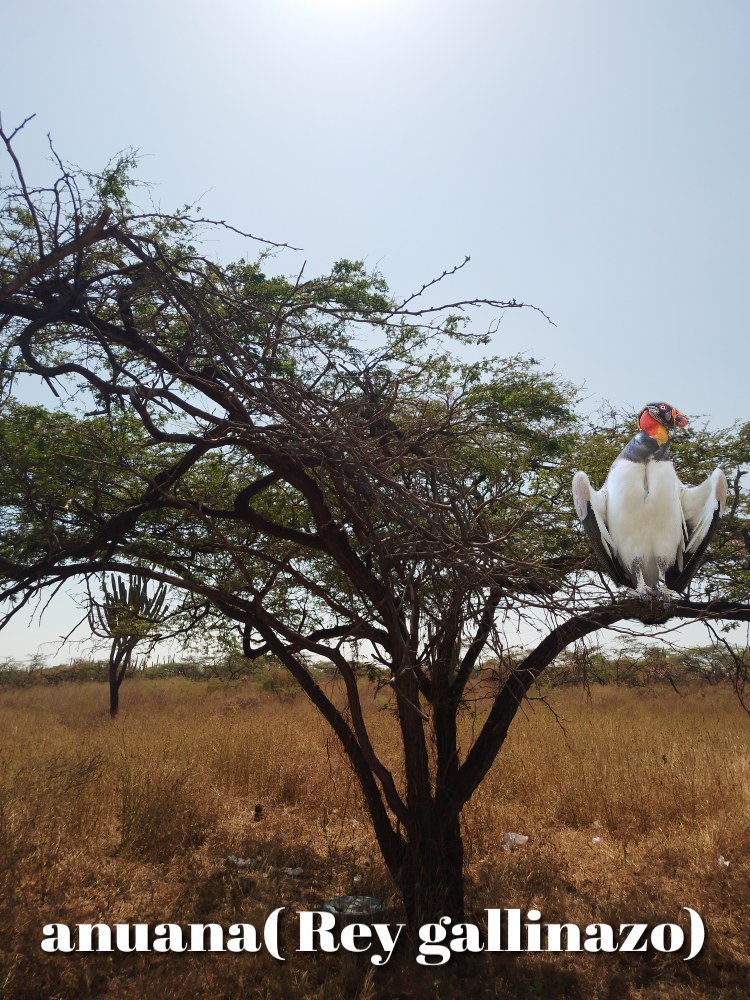
Key Field Marks
- Size & shape: Large vulture, about 71-81 cm (28-32 in) long with a broad wingspan around 1.2-2 m (4-6.5 ft), heavier-bodied and broader-winged than most New World vultures, giving a distinctive soaring silhouette with flat, broad wings.
- Plumage: Predominantly white to creamy-white body plumage contrasting sharply with glossy black flight feathers and tail, visible as a bold black-and-white pattern from below in flight. A grayish-black ruff of feathers encircles the base of the neck.
- Head & neck: The standout feature — bare, brightly multicolored skin in patches of orange, yellow, red, purple, and blue, topped with an irregular fleshy orange-yellow caruncle (wattle) at the base of the bill, unlike any other vulture in the Americas.
- Bill: Strong, hooked bill, pale with an orange-red base, powerful enough to tear tough hide that smaller vultures cannot open, giving it priority access at carcasses.
- Behavior: Typically solitary or in pairs, soaring at great height on thermals with minimal flapping; often the last species to arrive at a carcass but dominant over smaller vultures once there due to its size and bill strength.
Separating It From Similar Species
No other vulture in the Americas shows the King Vulture's combination of bright white body, black flight feathers, and vividly multicolored bare head. Turkey Vulture and Black Vulture are both overall dark/blackish-brown with much plainer, small red or gray bare heads, and Andean Condor, while also black-and-white, is far larger with a white neck ruff (not a colorful head) and is restricted to the Andes rather than lowland tropical forest. At a distance in flight, the King Vulture's broad, flat-winged silhouette and bold white body separate it from the dihedral-winged, teetering flight of Turkey Vultures.
Where & When to See One
Resident (non-migratory) from southern Mexico through Central America and into South America, ranging as far south as northern Argentina, generally in lowland tropical forest, forest edges, and adjacent savanna. It favors extensive undisturbed forest and is most often seen soaring at height over the canopy, sometimes spotted circling with other vulture species while searching for carrion, or arriving after Turkey Vultures have located a carcass by scent.
Voice & Sound Cues
Like most vultures, King Vulture is largely silent, lacking a syrinx capable of producing complex song; it may give low hisses, grunts, or croaking sounds at carcasses or nest sites during interactions with other vultures, but is not identified by voice in the field.
Frequently asked questions
What is the most distinctive feature of the King Vulture?
Its brightly multicolored bare head and neck, showing patches of orange, yellow, purple, and red, combined with a striking white body and black flight feathers.
How do I tell a King Vulture from a Turkey Vulture?
King Vulture has a bold white body with black flight feathers and a colorful head, while Turkey Vulture is uniformly dark brownish-black with a plain small red head and flies with wings held in a shallow V (dihedral).
Does the King Vulture make much sound?
No, like most New World vultures it lacks a true song-producing syrinx and is largely silent, occasionally giving low hisses or grunts near carcasses.
Where does the King Vulture live?
Lowland tropical forests from southern Mexico through Central America and into South America as far south as northern Argentina.
Why is the King Vulture important at carcasses despite arriving late?
Its powerful hooked bill can tear open tough hide that smaller vultures like Turkey and Black Vultures cannot, giving other species access once it has opened a carcass.