
King Eider Identification Guide
A large Arctic sea duck whose breeding male is unmistakable with a powder-blue crown, orange knobbed frontal shield, and black-and-white body, while females are best told from Common Eider by a shorter bill and crescent-shaped flank markings.
Read the full King Eider encyclopedia entry →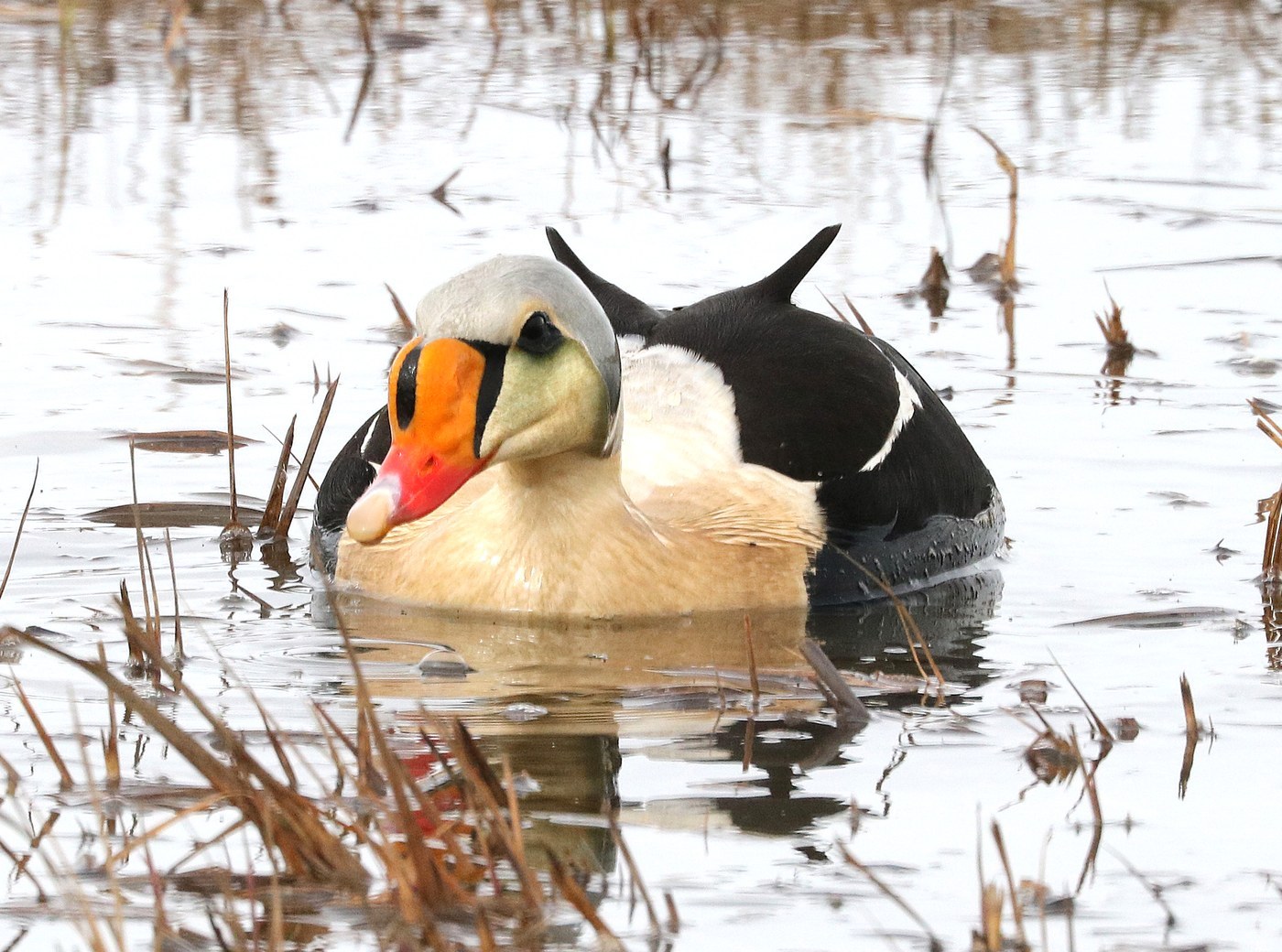
Key Field Marks
- Size & shape: Large, bulky sea duck, though slightly smaller and shorter-billed than the closely related Common Eider, with a more rounded head profile.
- Plumage (breeding male): Spectacular pattern — pale blue-grey crown and nape, a large orange-yellow knobbed frontal shield above the bill, a pale greenish face, black back and belly, white breast, and a distinctive black "V" mark on the white throat/chin area. White patches on the wings and rear flanks stand out against the mostly black body.
- Bill: The orange frontal shield is diagnostic in breeding males; the bill itself is relatively short and stubby compared with Common Eider's long, sloping bill/forehead profile.
- Female & non-breeding: Mottled warm rufous-brown to buff overall, with dark crescent-shaped (chevron) markings on the flanks rather than the more barred/vermiculated pattern of female Common Eider; shorter bill and a more rounded head give a subtly different profile useful for separating the two species even without color detail.
- Behavior: Dives for mollusks and crustaceans in cold marine waters; forms large rafts, sometimes mixed with Common Eiders, especially during migration and winter.
Separating It From Similar Species
The main identification challenge is separating King Eider from Common Eider, especially in female and eclipse/immature plumages. Key differences: King Eider has a shorter, more triangular bill with a steeper forehead angle (versus Common Eider's long, sloping bill that blends smoothly into the forehead), and female King Eiders show bolder, more crescent- or chevron-shaped flank barring compared to the finer vermiculation of female Common Eiders. Breeding males are unmistakable and cannot be confused with any other species once the orange shield and blue crown are seen.
Where & When to See One
Breeds across the high Arctic tundra of North America, Greenland, and Eurasia, nesting near tundra ponds and coastal areas. Winters at sea in northern waters, including the Bering Sea, North Atlantic coasts, and occasionally farther south during irruption years, often mixing with Common Eider flocks along rocky coastlines. Best looked for offshore or along northern coastlines in late fall through early spring, or on Arctic breeding grounds in summer.
Voice & Sound Cues
Breeding males give a soft, dove-like cooing "hoo hoo-hoo" call during courtship displays, quieter and less nasal than the moaning calls of Common Eider. Females give low growling or grunting notes, typical of eider hens, mainly around the nest or when alarmed.
Frequently asked questions
What is the most obvious feature of a breeding male King Eider?
A pale blue-grey crown combined with a large orange-yellow knobbed shield above the bill, set against a black-and-white body — a pattern unlike any other duck.
How do I tell a female King Eider from a female Common Eider?
Female King Eider has a shorter, steeper bill and bolder crescent- or chevron-shaped markings on the flanks, while female Common Eider has a longer sloping bill and finer, more vermiculated barring.
Where does the King Eider breed?
On high Arctic tundra across North America, Greenland, and Eurasia, nesting near tundra ponds and coastal wetlands.
Where can I see King Eiders in winter?
In cold offshore waters such as the Bering Sea and North Atlantic coasts, often rafting together with Common Eiders.
What does a male King Eider's call sound like?
A soft, dove-like cooing 'hoo hoo-hoo' given during courtship, quieter than the moaning call of a male Common Eider.