
Killdeer Identification Guide
A common, widespread North American plover recognized by its two black breast bands, brown back, and loud repeated 'kill-deer' call, often seen in open fields and parking lots far from water.
Read the full Killdeer encyclopedia entry →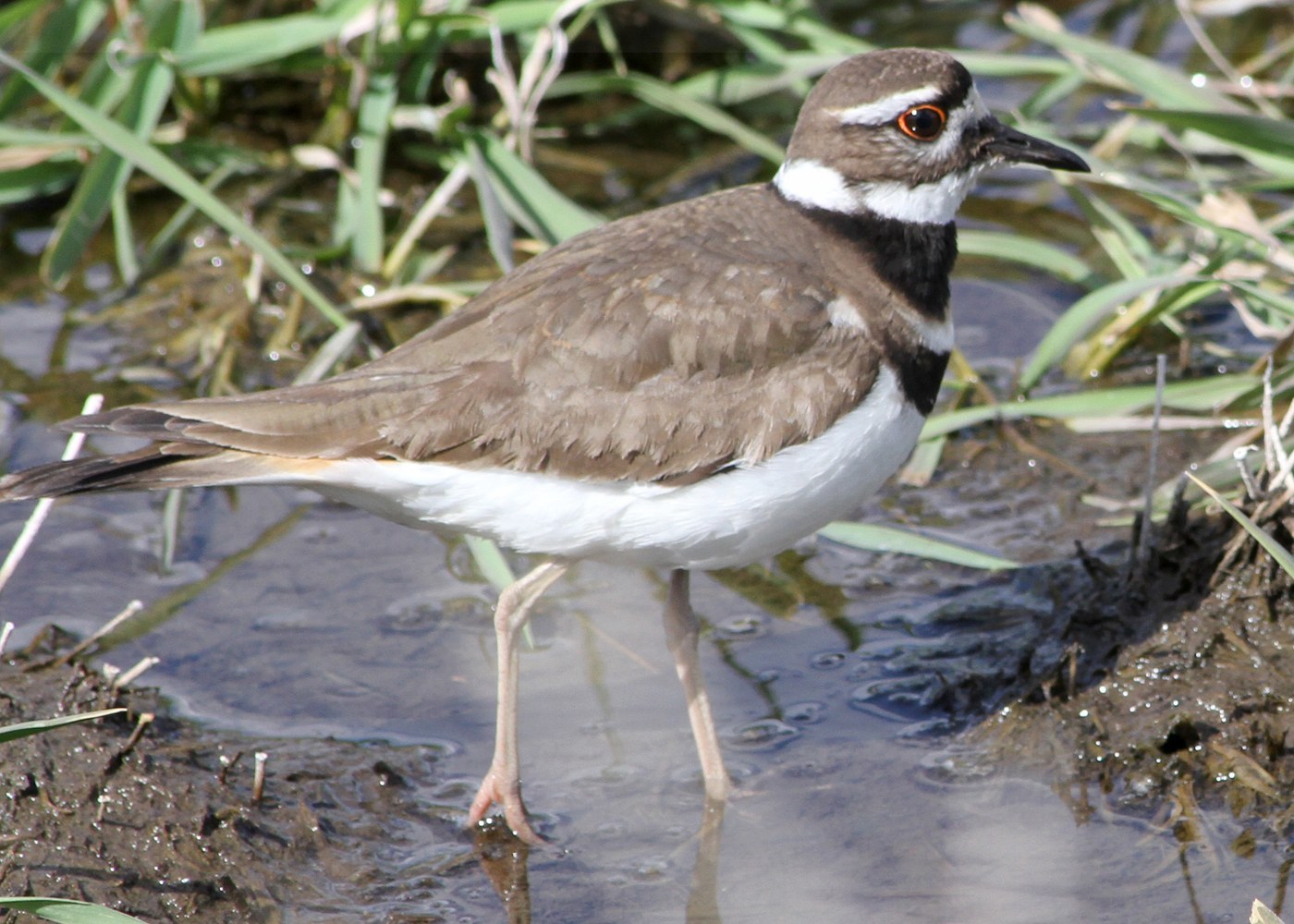
Key Field Marks
- Size & shape: Medium-sized plover, about 20-28 cm (8-11 in) long, with a fairly long tail for a plover, giving it a more elongated silhouette than most shorebirds.
- Plumage: Brown upperparts, white underparts, and the diagnostic double black breast bands crossing a white chest and throat — no other widespread North American shorebird shows two full bands. A bright orange-buff rump and uppertail coverts are conspicuous in flight, along with a white wing stripe.
- Face: White forehead and throat set off by a black band through the eye, with a red eye-ring and short dark bill.
- Legs: Pale pinkish-tan legs.
- Behavior: Frequently seen in open habitats far from water, including lawns, agricultural fields, gravel roads, athletic fields, and parking lots. Known for its dramatic broken-wing distraction display, feigning injury to lure predators away from its nest or chicks, which are precocial and mobile shortly after hatching.
Separating It From Similar Species
The double breast band immediately separates Killdeer from every other regularly occurring North American plover, most of which (Semipalmated Plover, Piping Plover, Snowy/Kentish-type plovers, Wilson's Plover) show only a single breast band or none at all. Its larger size, longer tail, and loud vocal habits further distinguish it from smaller "ringed" plovers. The bright orange-rufous rump, obvious in flight, is unique among North American plovers.
Where & When to See One
Widespread and common across nearly all of North America, breeding from Canada south through the US into Mexico, and present year-round in much of the southern and western US. Northern breeders migrate south for winter. Unlike most shorebirds, Killdeer thrives away from water in dry, open habitats — gravel lots, athletic fields, farmland, golf courses, and rooftops — making it one of the most frequently encountered "shorebirds" for people who don't typically visit wetlands.
Voice & Sound Cues
Named for its loud, distinctive call, a repeated, piercing "kill-deer, kill-deer" or "dee-dee-dee," given both in flight and while on the ground, especially when a nest or chicks are nearby and the bird is agitated. This vocal, alarm-prone behavior is often the first clue to the species' presence.
Frequently asked questions
What is the easiest way to identify a Killdeer?
Look for two black bands across a white breast, brown upperparts, and listen for its loud repeated 'kill-deer' call — no other common North American plover has two full breast bands.
Why do I see Killdeer in parking lots and fields far from water?
Unlike most shorebirds, Killdeer readily nest and forage in dry, open habitats such as gravel lots, athletic fields, and farmland, not just near wetlands or shorelines.
What is the Killdeer's broken-wing display?
A distraction behavior where an adult feigns an injured wing, dragging it while moving away from the nest to lure predators away from eggs or chicks.
What color is a Killdeer's rump?
A bright orange-buff rump and uppertail, conspicuous in flight and useful for confirming identification when the bird flushes.
Do Killdeer migrate?
Northern breeding populations migrate south for the winter, while Killdeer in much of the southern and western United States can be present year-round.