
Kentucky Warbler Identification Guide
A skulking eastern US woodland warbler identified by its bright yellow underparts, olive-green back, and bold black sideburn-like mask curving down from the eye.
Read the full Kentucky Warbler encyclopedia entry →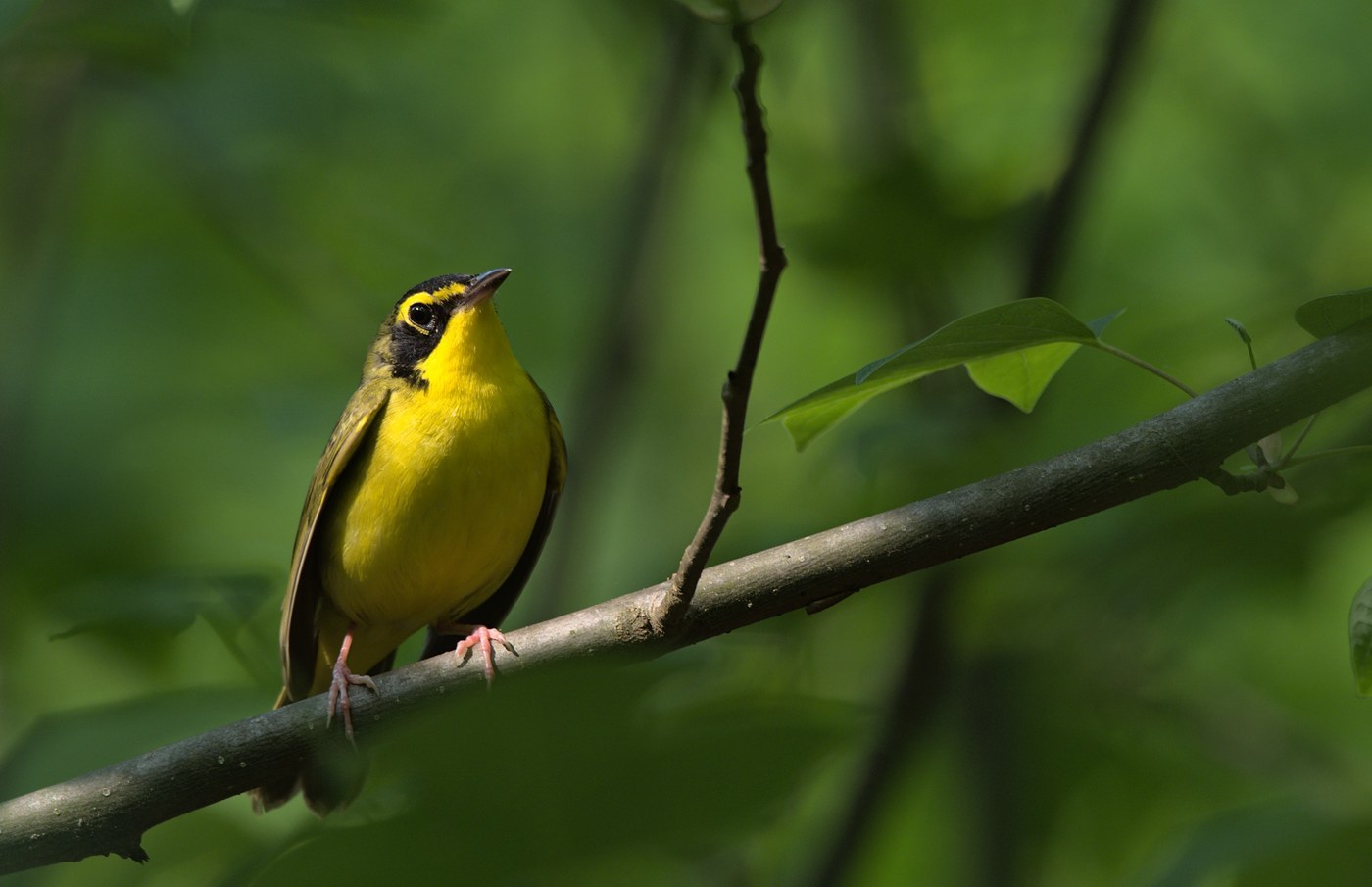
Key Field Marks
- Size & shape: Chunky, short-tailed warbler with a fairly large head and heavy bill for a wood-warbler, about 13 cm (5 in) long.
- Plumage: Bright olive-green upperparts and vivid yellow underparts, unmarked by wing bars or streaking. The signature mark is a bold black patch that extends from behind the eye down the side of the face, forming a "sideburn," combined with a broad yellow "spectacle" or eye-ring that wraps around the eye and connects to the yellow forehead.
- Legs: Pale pinkish legs, relatively long and sturdy for a warbler, matching its ground-dwelling habits.
- Behavior: A skulking bird of the leaf-litter and dense understory, often walking rather than hopping on the forest floor, flicking its tail as it moves. Males sing from low-to-mid perches but the species overall stays low and can be hard to see well despite a loud voice.
Separating It From Similar Species
Kentucky Warbler is most often confused with Common Yellowthroat, but the yellowthroat has a solid black mask across the forehead and face (not just sideburns) bordered above by a pale/white line, and lacks the Kentucky's yellow spectacles. Female Common Yellowthroats can also cause confusion, but they show a plainer face without black markings, unlike the female Kentucky Warbler which retains a hint of the dusky face pattern. Hooded Warbler is another possible confusion species, but Hooded shows large white tail spots (visible as it fans its tail) and a more solid black hood/bib in males, rather than isolated sideburns.
Where & When to See One
Breeds in the understory of mature, moist deciduous forests across the eastern and southeastern United States, particularly in ravines, floodplain forest, and areas with dense shrub layers. It is a long-distance migrant, wintering in Central America and northern South America, with birds returning to breeding grounds in spring (April-May) and departing again by late summer/early fall. Best detected by song, since birds forage low and can be difficult to spot visually in dense cover.
Voice & Sound Cues
The song is a loud, rolling series of two-syllable phrases, often rendered as "churry churry churry churry," similar in cadence to a Carolina Wren but lower and more even in pitch. The call note is a low, sharp "chuck," useful for locating skulking birds in dense understory.
Frequently asked questions
How do I tell a Kentucky Warbler from a Common Yellowthroat?
Kentucky Warbler has black sideburns behind the eye and yellow spectacles, while Common Yellowthroat has a solid black mask across the face bordered by a pale line above and no yellow eye-ring.
What kind of habitat does the Kentucky Warbler prefer?
Dense, moist deciduous forest understory, especially in ravines and floodplain forests across the eastern and southeastern United States.
What does a Kentucky Warbler sound like?
A loud, rolling, repeated two-syllable phrase often described as 'churry churry churry,' somewhat similar to a Carolina Wren's song but more even-pitched.
Is the Kentucky Warbler easy to see?
No, it is a skulking species that forages low in dense understory and leaf litter, so it is often detected by song before it is seen.
Where does the Kentucky Warbler spend the winter?
It migrates to Central America and northern South America for the winter, returning to breed in the eastern US in spring.