
Kentish Plover Identification Guide
A small, pale, sandy-colored shorebird of beaches and salt pans, identified by its incomplete dark breast patches, black legs, and thin dark bill.
Read the full Kentish Plover encyclopedia entry →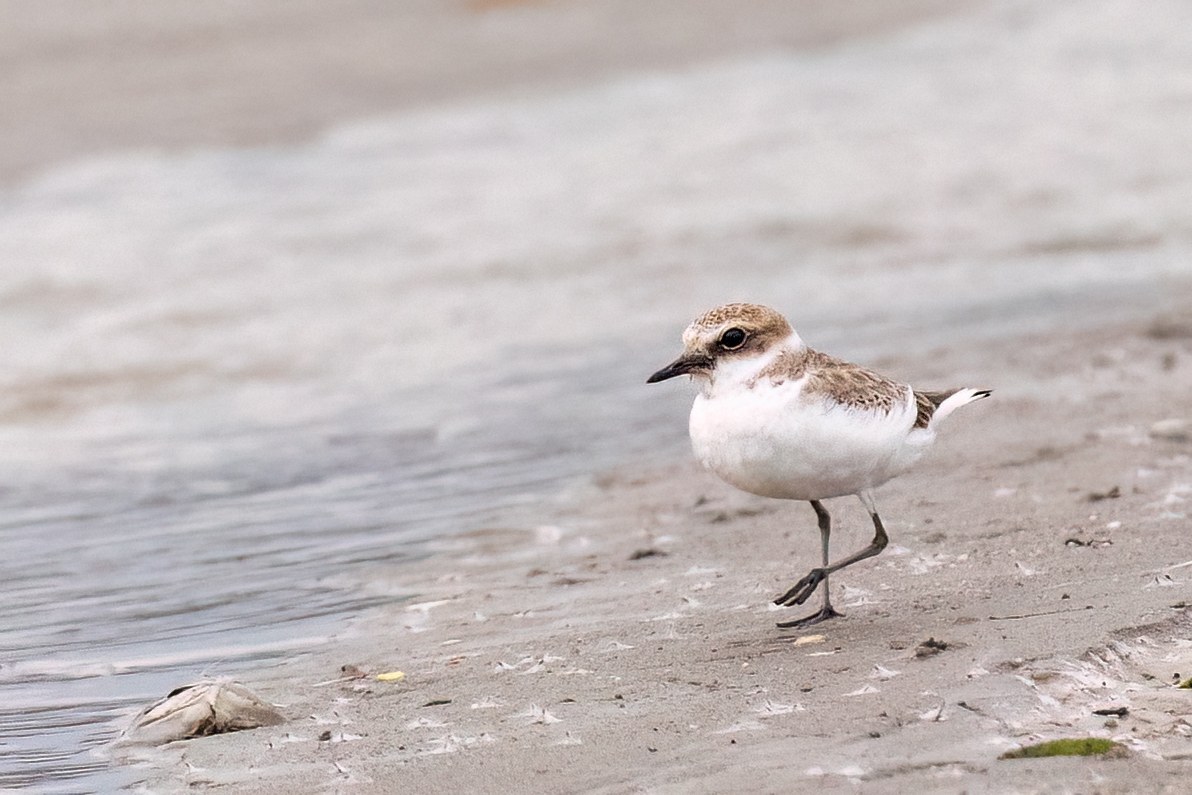
Key Field Marks
- Size & shape: Very small plover, about 15-17 cm (6-6.5 in) long, with a rounded head, large dark eye, and short thin bill, giving a delicate look compared to larger plovers.
- Plumage: Pale sandy-brown upperparts closely matching dry sand or salt-flat substrate, clean white underparts and forehead. Breeding males show a black patch through the eye (partial mask), a black patch on each side of the breast (not meeting in the center to form a full band), and often a rufous-orange wash on the crown/nape. Females and non-breeding birds are duller, with brownish smudges replacing the black breast patches.
- Bill & legs: Thin, all-dark bill; blackish-grey legs, distinguishing it from species with pale or pinkish legs.
- Behavior: Runs in short, quick bursts typical of plovers, then pauses to peck at the substrate; often forages along the tideline, salt pan edges, or dry mudflats, blending in remarkably well against pale sand.
Separating It From Similar Species
The key mark separating Kentish Plover from Common Ringed Plover and Semipalmated Plover is the incomplete breast band — Kentish shows two separate dark side patches rather than a continuous band across the chest — plus its overall paler, sandier upperparts and thin black (not orange-and-black) bill. In the Americas, the very similar Snowy Plover was formerly considered the same species as Kentish Plover and is now treated as separate, distinguished largely by range (Snowy Plover in the Americas, Kentish Plover in Eurasia/Africa) along with subtle differences in leg color and calls. White-fronted Plover, found in Africa, is similarly pale but has a more contrasting white forehead band and different range.
Where & When to See One
Breeds widely across temperate and subtropical Eurasia and Africa, on sandy and shell beaches, salt pans, estuarine mudflats, and inland saline lakes. Many populations are migratory, moving to coastal wintering areas in Africa and southern Asia, while others (in warmer regions) are resident year-round. Best looked for on open, sparsely vegetated sand or salt-flat habitat, often in loose association with other small shorebirds.
Voice & Sound Cues
Calls include a short, sharp "twit" or "pit" contact note and a soft trilled or rolling "prrreet" given in flight or during territorial disputes, generally quieter and less strident than the calls of larger plovers.
Frequently asked questions
What is the main field mark for a Kentish Plover?
Two separate dark patches on the sides of the breast that do not meet in the middle, unlike the complete breast band shown by Common Ringed and Semipalmated Plovers.
Is the Kentish Plover the same as the Snowy Plover?
They were once considered the same species; Snowy Plover is now treated as a separate species found in the Americas, while Kentish Plover occurs across Eurasia and Africa.
What color are a Kentish Plover's legs?
Blackish-grey, which helps separate it from shorebirds with pale pink or yellowish legs.
What habitat does the Kentish Plover prefer?
Open sandy beaches, salt pans, and estuarine mudflats with sparse vegetation, where its pale plumage provides camouflage.
Does the Kentish Plover migrate?
Many northern populations migrate to wintering grounds in Africa and southern Asia, while populations in warmer regions can be resident year-round.