
Keel-billed Toucan Identification Guide
A striking Central American rainforest bird instantly recognized by its enormous, multicolored green, orange, and red bill set against a mostly black body with a yellow bib.
Read the full Keel-billed Toucan encyclopedia entry →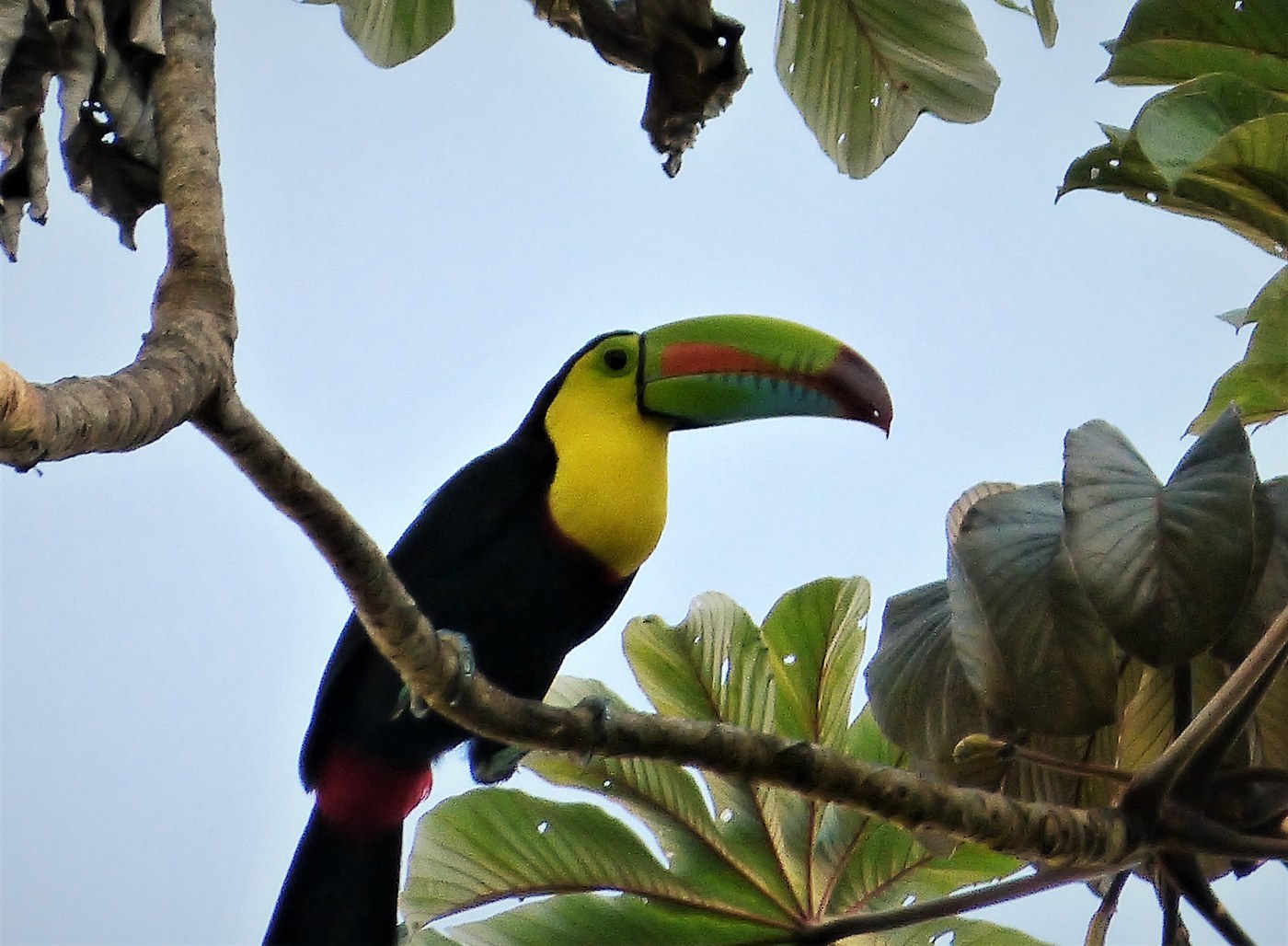
Key Field Marks
- Size & shape: Medium-large arboreal bird, about 42-55 cm (17-22 in) including a proportionally massive bill that can be nearly as long as the body. Compact body with a short neck and long tail.
- Bill: The signature feature — large, laterally flattened, and vividly multicolored: mostly bright green-yellow with an orange side patch, a red tip, and a blue base, described as looking almost carved or painted. Despite its size, the bill is lightweight, made of keratin over a honeycombed bone structure.
- Plumage: Mostly black body with a bright yellow face, throat, and chest; red undertail coverts; a thin blue-white line separating the black belly from the red rear. Skin around the eye is often greenish.
- Legs & feet: Grey legs with zygodactyl feet (two toes forward, two back), typical of toucans, aiding grip on branches.
- Behavior: Social, usually seen in small noisy flocks moving through the forest canopy in a hopping, undulating flight. Often perches conspicuously atop tall trees. Feeds mainly on fruit, plucked and tossed back with a flick of the head, supplemented with insects, eggs, and small vertebrates.
Separating It From Similar Species
Within its range, the main confusion species are other large-billed toucans such as the Chestnut-mandibled (Black-mandibled) Toucan, which has a mostly dark bill with a pale yellow-green base and lacks the Keel-billed's rainbow coloration, and Toco Toucan, which occurs farther south in South America and has an almost entirely orange bill. Aracaris are smaller with proportionally smaller, more uniformly dark bills and different body patterning. The Keel-billed Toucan's unmistakable rainbow-colored bill makes misidentification unlikely once seen well.
Where & When to See One
Resident year-round (non-migratory) in lowland and foothill tropical forests, forest edges, and semi-open woodland from southern Mexico through Central America (Belize, Guatemala, Honduras, Nicaragua, Costa Rica, Panama) to extreme northwestern Colombia and Venezuela. It is the national bird of Belize. Look for it in canopy fruiting trees, forest clearings, and along forest edges; it can also be found at lower densities in shade-coffee plantations and second-growth woodland.
Voice & Sound Cues
Gives a frequently repeated, far-carrying croaking call often rendered as a hoarse "creeek" or a series of croaking, frog-like notes, quite different from the deeper, growling call of larger congeners like the Chestnut-mandibled Toucan. Also makes bill-clattering sounds during social interactions.
Frequently asked questions
What is the most distinctive feature of the Keel-billed Toucan?
Its large, laterally flattened bill combining green, yellow, orange, red, and blue in a bold rainbow pattern, unlike any other toucan's bill coloration.
How can I tell a Keel-billed Toucan from a Chestnut-mandibled Toucan?
The Chestnut-mandibled (Black-mandibled) Toucan has a mostly dark, chestnut-colored bill with a pale yellow-green base, lacking the Keel-billed's multicolored rainbow pattern.
Is the Keel-billed Toucan's bill heavy?
No, despite its large size the bill is lightweight, built from keratin over a spongy, honeycombed bone structure.
Where does the Keel-billed Toucan live?
Lowland and foothill tropical forests from southern Mexico through Central America to northwestern South America; it is the national bird of Belize.
What does a Keel-billed Toucan eat?
Primarily fruit plucked from canopy trees, supplemented with insects, small lizards, eggs, and nestlings of other birds.