
Kea Identification Guide
A large, intelligent olive-green mountain parrot of New Zealand's South Island, best identified by its bright orange underwings and curious, bold behavior around people.
Read the full Kea encyclopedia entry →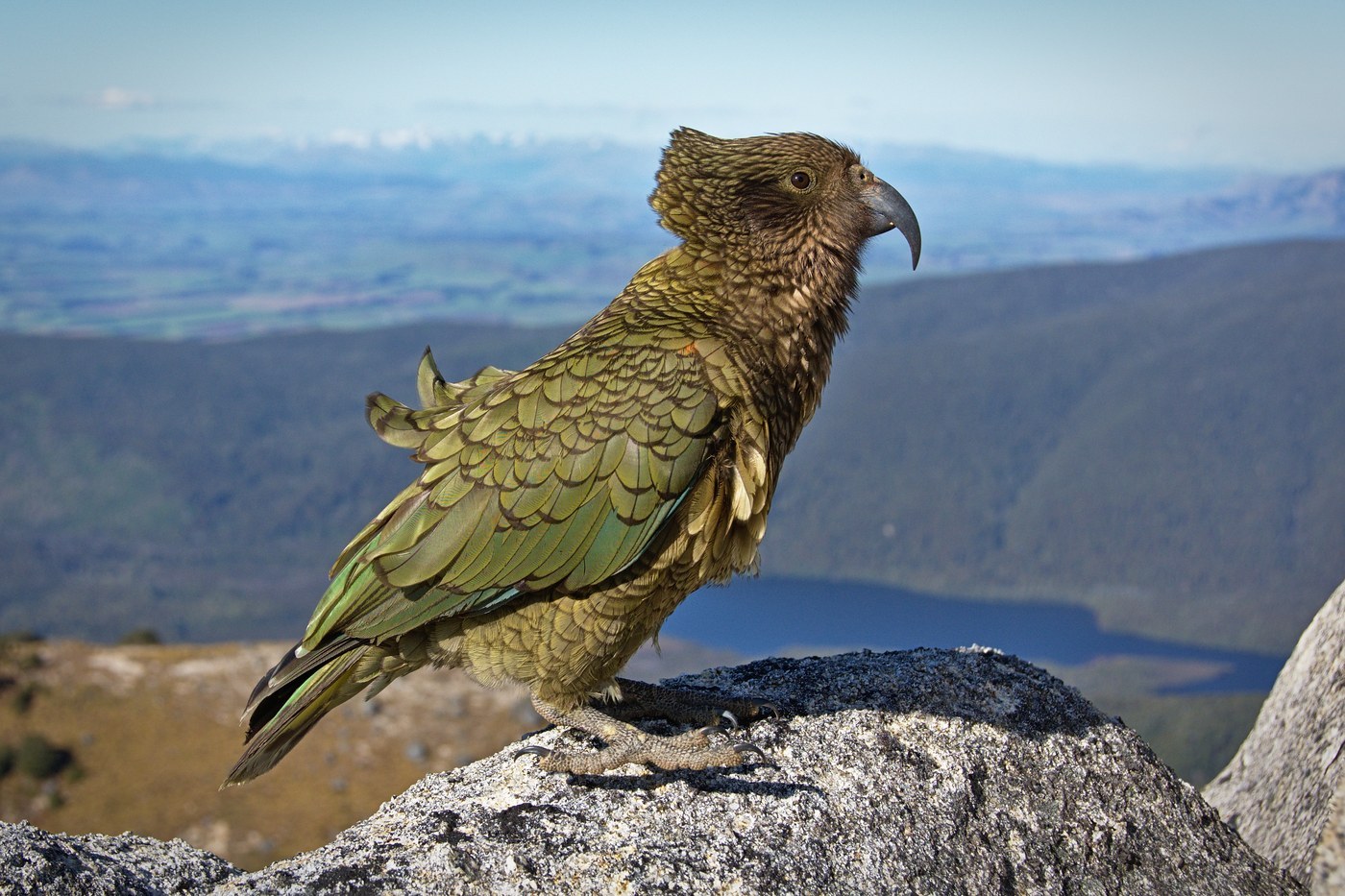
Key Field Marks
- Size & shape: Large parrot, about 46-50 cm (18-20 in) long, with broad rounded wings and a long, tapered tail suited to strong, agile flight in mountain terrain.
- Plumage: Overall dull olive-green with darker scalloped edging on the feathers, giving a scaly look. The most diagnostic feature is the brilliant orange-red underwing coverts, flashed conspicuously in flight and starkly contrasting with the dull upperparts.
- Bill: Long, narrow, strongly curved grey-brown bill used for probing, digging, and prying — much finer than the stubby bill of most parrots.
- Legs: Grey legs with strong climbing feet.
- Behavior: Highly intelligent, playful, and famously curious/bold around humans, frequently investigating and dismantling gear, backpacks, windshield wipers, and car trim at ski fields and mountain car parks. Often seen walking on the ground or perched on rooftops and rocks in small social groups.
Separating It From Similar Species
The Kea's closest look-alike is the Kaka, another native New Zealand forest parrot, but Kaka has a reddish-brown/olive body with a distinct pale-grey crown, russet underwings and belly (not orange-red), and lives mainly in lowland and mid-elevation forest rather than open alpine terrain. The Kea's high-altitude habitat, duller olive body, and bright orange underwing in flight make it readily distinguishable once the wings are seen. No other New Zealand bird combines a parrot silhouette with alpine habitat.
Where & When to See One
Kea are found only in New Zealand, restricted to the South Island, especially in and around the Southern Alps. Look for them at high elevations — alpine and subalpine zones, beech forest edges, mountain passes (such as Arthur's Pass and Milford Road), ski area car parks, and popular tramping/hiking huts — year-round, as they do not migrate. They are most easily and reliably encountered at well-known tourist stops where they have become accustomed to visitors, though feeding them is discouraged as it is harmful to their health and encourages destructive behavior.
Voice & Sound Cues
The name "Kea" imitates its loud, ringing flight call, a repeated "kee-aa" or "keee-ah," given frequently while soaring or gliding over mountain slopes. Kea also produce a range of chattering, warbling, and screeching contact calls when socializing in groups, plus a distinct play call associated with juvenile social behavior.
Frequently asked questions
How do I tell a Kea from a Kaka?
Kea are duller olive-green overall with bright orange-red underwings and live in open alpine habitat, while Kaka are more reddish-brown with a pale crown, russet underwings, and prefer forest.
Why do Kea approach cars and people?
Kea are extremely intelligent and curious, and have learned to associate human areas like ski fields and car parks with food and interesting objects to investigate or dismantle.
What color are a Kea's underwings?
Bright orange-red, a key field mark visible only when the bird is in flight or stretches its wings.
Where in New Zealand can I find Kea?
Only in the South Island, in alpine and subalpine areas of the Southern Alps, including mountain passes, ski fields, and high-country beech forest.
Are Kea found on New Zealand's North Island?
No, Kea are restricted to the South Island; the North Island has no native alpine parrot of this kind.