
Kakapo Identification Guide
A flightless, nocturnal, moss-green parrot found only on a few predator-free New Zealand islands, identified by its owl-like facial disc and heavy waddling gait.
Read the full Kakapo encyclopedia entry →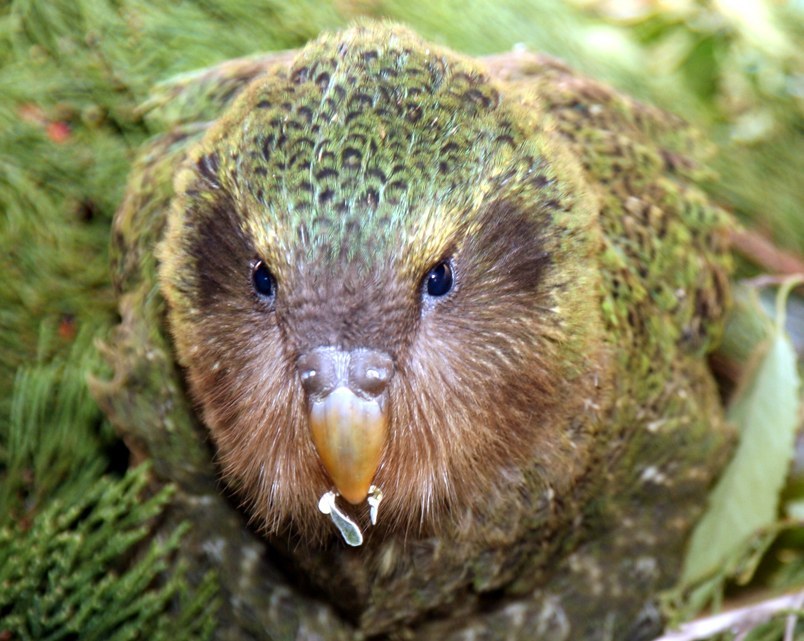
Key Field Marks
- Size & shape: Very large, heavy-bodied parrot (up to 4 kg / 8.8 lb), the heaviest parrot species in the world. Flightless, with short rounded wings and a long tail often dragged on the ground.
- Plumage: Moss-green upperparts finely mottled and barred with black and yellow, giving excellent camouflage against forest floor vegetation. Paler yellow-green underparts.
- Face: Distinctive owl-like facial disc of fine feathers around the eyes, which is why early European settlers nicknamed it the "owl parrot."
- Bill & legs: Large pale grey, slightly hooked bill; strong grey legs and feet built for climbing and walking rather than flight.
- Behavior: Nocturnal and largely solitary outside the breeding season. Moves by walking, climbing trees, and gliding/parachuting downward with outstretched wings rather than powered flight. During breeding (lek) season, males dig shallow bowls connected by cleared track systems and produce loud, low-frequency booming calls that can travel over a kilometer.
Separating It From Similar Species
Kakapo are unmistakable within their range: no other parrot in New Zealand is flightless, nocturnal, or this large and heavily built. The main confusion risk is only with other New Zealand parrots by sound rather than sight — the Kea and Kaka are both far more vocal in daylight, agile fliers, and lack the Kakapo's dish-shaped facial feathering. Because Kakapo are so rare and confined to intensively managed island sanctuaries, any sighting outside those locations should be treated with skepticism.
Where & When to See One
Kakapo survive only through active conservation management, with the entire known population (a few hundred birds) living on predator-free offshore islands such as Whenua Hou (Codfish Island), Anchor Island, and Little Barrier Island (Hauturu), all in New Zealand. Public access to these sanctuaries is tightly restricted or prohibited to protect the birds, so most people will never encounter one in the wild; sightings are effectively limited to conservation staff and occasional supervised programs. There is no general "season" for viewing, though the breeding (lek) season, which occurs irregularly in years when native rimu trees fruit heavily, is when males are most vocal.
Voice & Sound Cues
Breeding males produce a deep, resonant "boom" call, repeated for hours through the night, audible from great distances due to its low frequency. This is interspersed with a sharper metallic "ching" call used to help females locate the male's bowl. Outside the breeding lek, Kakapo are largely silent, making calls the most reliable way to detect their presence in dense forest at night.
Frequently asked questions
Can Kakapo fly at all?
No. Kakapo are completely flightless, though they can climb trees well and glide or parachute downward using their wings to slow a fall or cover distance downhill.
How is a Kakapo different from a Kea or Kaka?
Kea and Kaka are agile, day-active flying parrots with brighter coloring (olive-green with orange under Kea wings, or reddish-brown Kaka plumage), while Kakapo is flightless, nocturnal, moss-green, and has an owl-like facial disc.
Where is the only place to see a Kakapo?
Kakapo now survive solely on a handful of predator-free New Zealand offshore islands under conservation management, such as Whenua Hou (Codfish Island) and Anchor Island; access is highly restricted.
What sound does a Kakapo make?
Breeding males give a deep, far-carrying booming call at night, followed by a higher-pitched metallic 'ching,' both used to attract females to a lek display site.
Is the Kakapo the same as an owl?
No, it is a true parrot (family Strigopidae), but its dish-shaped facial feathers and nocturnal habits gave it the common nickname 'owl parrot.'