
Kaka Identification Guide
A large, olive-brown New Zealand forest parrot with flashing crimson underwings and a strongly curved bill used to strip bark for grubs and sap.
Read the full Kaka encyclopedia entry →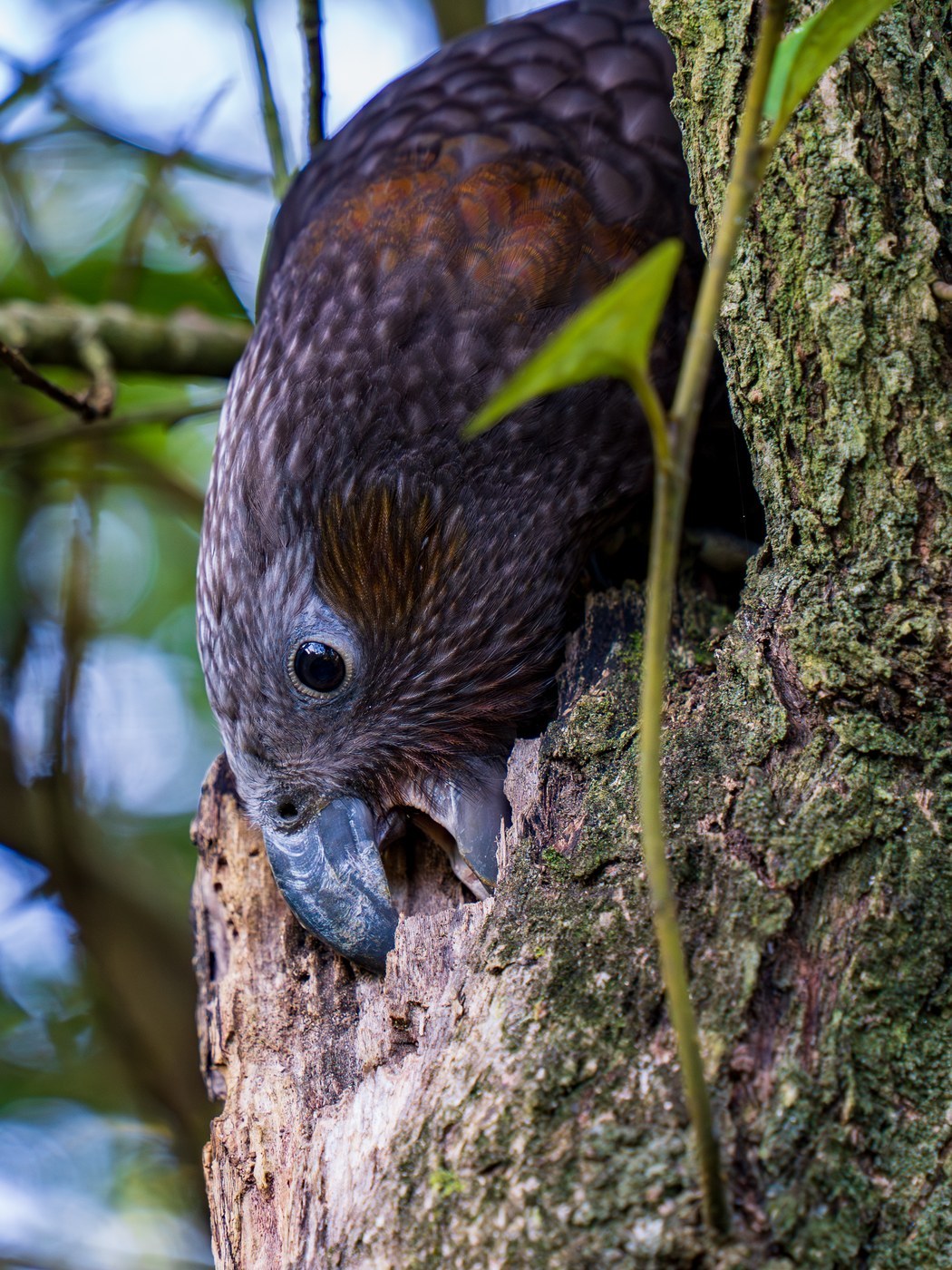
Key Field Marks
- Size & shape: Large, robust parrot with a heavy body, broad wings, and a long, strongly downcurved bill adapted for tearing bark and extracting wood-boring grubs.
- Plumage: Olive-brown overall with a scaly-looking pattern on the crown and upperparts; crown and nape are grayish-white, contrasting subtly with the browner body.
- In flight: Shows bright crimson-red patches on the underwing and rump — a striking flash of color from an otherwise dull-plumaged bird.
- Underparts: Orange-red wash on the belly and flanks, more vivid in South Island birds than North Island birds.
- Bill & eyes: Long, strongly curved dark bill; dark eye.
Separating It From Similar Species
- Kea (Nestor notabilis): Kaka's close relative is more olive-green overall (versus Kaka's browner tone), has bright orange (not crimson) underwings, and is found mainly in alpine and subalpine habitat rather than lowland forest.
- Two subspecies of Kaka are recognized: the North Island Kaka is duller and browner overall, while the South Island Kaka shows a more contrasting grayer crown and more vivid orange-red belly.
Where & When to See One
Native to New Zealand's native forests, particularly podocarp-broadleaf and beech forest. Due to predation by introduced mammals (rats, stoats, possums), Kaka populations have contracted significantly and are now strongest on predator-free offshore islands and in well-managed mainland forest sanctuaries; conservation efforts (such as at Zealandia in Wellington) have also reestablished visible urban-adjacent populations in some areas. It is non-migratory and can be seen year-round wherever present.
Behavior & Voice
An acrobatic climber, using its bill and strong feet in parrot-like fashion to move through the canopy. Feeds on nectar, fruit, seeds, invertebrates (extracted from dead wood and bark), and tree sap, sometimes stripping bark extensively while foraging. Highly vocal, giving loud, harsh, grating calls (often rendered "kaa-aa") as well as softer, more musical whistled notes; birds are frequently heard well before they are seen.
Frequently asked questions
How do I tell a Kaka from a Kea?
Kaka is browner overall with crimson underwings and lives mainly in lowland and mid-elevation forest, while Kea is more olive-green with orange underwings and is typically found in alpine and subalpine habitat.
Why are Kaka now hard to find in many parts of New Zealand?
Introduced predators such as rats, stoats, and possums have severely reduced Kaka numbers on the mainland, so the species is now strongest on predator-free islands and in actively managed forest sanctuaries.
What does a Kaka use its curved bill for?
Its strongly curved bill is used to strip bark and extract wood-boring grubs, as well as to feed on fruit, seeds, and nectar.
Are there different types of Kaka?
Yes, two subspecies are recognized — the North Island Kaka, which is duller, and the South Island Kaka, which shows a more contrasting gray crown and more vivid orange-red belly.