
Jenday Conure Identification Guide
A vividly colored Brazilian parakeet with a golden-orange head and underparts, green wings, and a blue-tipped tail, best separated from the similar Sun Conure by its solidly green wings.
Read the full Jenday Conure encyclopedia entry →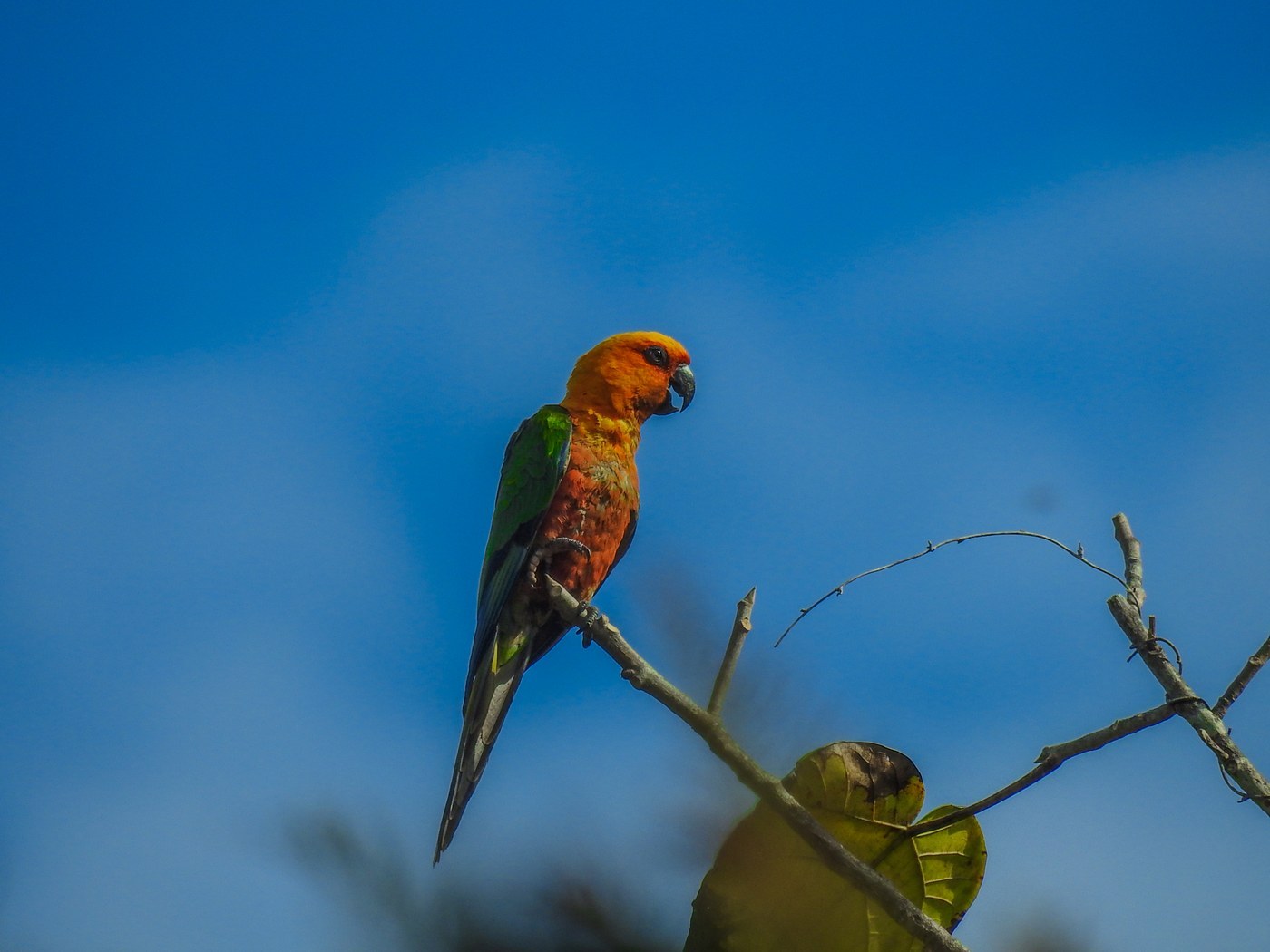
Key Field Marks
- Size & shape: Medium-small, slender parakeet with a long, pointed tail typical of Aratinga conures.
- Head & underparts: Bright golden-yellow head grading to orange on the nape and chest, deepening to orange-red on the belly and vent.
- Wings & back: Solidly green, contrasting sharply with the orange-yellow head and underparts; a bluish-green patch is often visible on the lower back/rump.
- Tail: Green at the base, tipped with blue.
- Bare parts: Pale grayish-white bare skin around the eye; dark gray to blackish bill.
Separating It From Similar Species
- Sun Conure (Aratinga solstitialis): Overall more extensively yellow-orange with less contrasting green in the wings and back, and a different (more northern South American) native range that does not overlap with Jenday Conure. The sharp, clean border between the orange-yellow body and solid green wings is a good mark for Jenday.
- Other Aratinga conures (e.g., Peach-fronted Conure) lack the extensive orange-red underparts and have duller, greener overall plumage.
Where & When to See One
Native to northeastern Brazil, where it inhabits gallery forest, palm groves, forest edges, and dry scrub (caatinga-type habitat), often near agricultural areas. Escaped or released birds have also established small feral populations in parts of the United States (such as Florida) and elsewhere, typically in urban and suburban areas with fruiting trees. Present year-round within its range; non-migratory.
Behavior & Voice
Highly social, usually seen in noisy flocks feeding on fruit, seeds, blossoms, and occasionally crops. Like other Aratinga conures, it is loud, giving harsh, piercing screeches in flight and while perched, especially when flocks are disturbed or communicating over distance.
Frequently asked questions
How do I tell a Jenday Conure from a Sun Conure?
Jenday Conure shows solidly green wings and back that contrast sharply with its orange-yellow body, while Sun Conure is more uniformly yellow-orange with less green contrast; their native ranges in South America also do not overlap.
Where is the Jenday Conure originally from?
Northeastern Brazil, where it lives in gallery forest, palm groves, and dry scrub habitat.
Are Jenday Conures found outside South America?
Small feral populations exist in some areas outside their native range, such as parts of Florida, established from escaped or released birds.
What does a Jenday Conure sound like?
It gives loud, harsh, piercing screeching calls typical of Aratinga conures, especially in flight or when flocking.