
Japanese Pygmy Woodpecker Identification Guide
East Asia's smallest woodpecker, a sparrow-sized bird with brownish barred upperparts and streaked underparts that forages acrobatically on thin twigs.
Read the full Japanese Pygmy Woodpecker encyclopedia entry →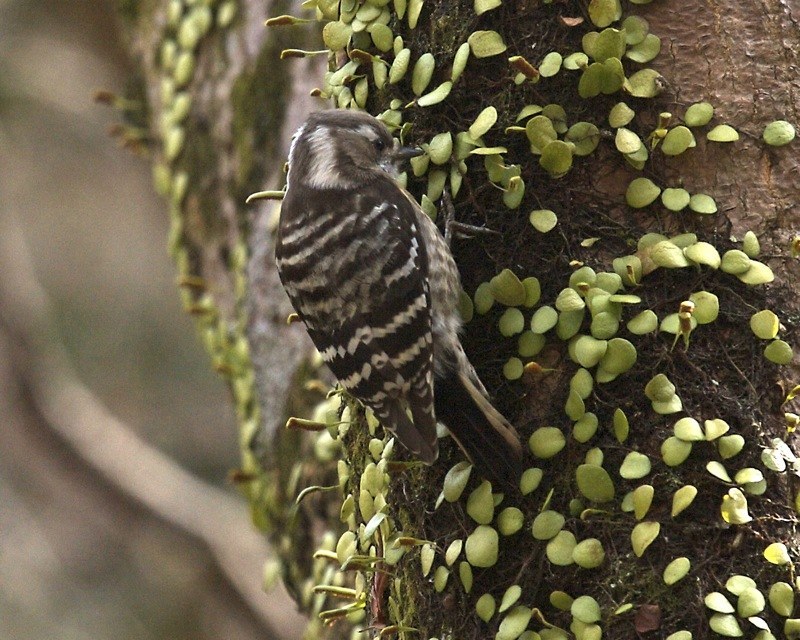
Key Field Marks
- Size & shape: Very small woodpecker, close to sparrow size, with a proportionately short bill and compact body.
- Plumage: Upperparts show blackish-brown barring on a paler brown background rather than the crisp black-and-white of larger spotted woodpeckers; underparts are whitish to buffy with fine dark streaking.
- Head pattern: Face shows a dark eye-stripe and a pale supercilium; males have a small, often subtle red patch on the side of the nape, which is absent in females.
- Bill: Short and narrow compared to the chisel-like bills of larger woodpeckers.
Separating It From Similar Species
- Great Spotted Woodpecker and other larger spotted woodpeckers are considerably bigger, with bold, clean black-and-white plumage and (in males) a red patch on the nape or crown rather than the pygmy's subtler markings and overall brownish tone.
- The combination of tiny size, brownish (not crisp black-white) barring, and streaked underparts is diagnostic within its range.
Where & When to See One
Resident across Japan and parts of the Korean Peninsula, eastern China, and the Russian Far East. It inhabits deciduous and mixed woodlands, forest edges, parks, and gardens, and is quite tolerant of human-modified landscapes, often appearing in urban parks and suburban trees.
Behavior & Voice
Forages actively and acrobatically on small branches, twigs, and even stems rather than large trunks, often clinging at odd angles. It frequently joins mixed-species foraging flocks with tits and other small woodland birds outside the breeding season. Its call is a sharp, high "kiki" or "kirik," and its drumming is notably weak and rapid compared to larger woodpeckers.
Frequently asked questions
How do I tell a male from a female Japanese Pygmy Woodpecker?
Males show a small red patch on the side of the nape that is completely absent in females; otherwise the sexes look alike.
What makes the Japanese Pygmy Woodpecker different from other spotted woodpeckers?
It is much smaller, with brownish (rather than bold black-and-white) barred upperparts and finely streaked underparts, plus a proportionately shorter bill.
What habitat does this woodpecker prefer?
Deciduous and mixed woodlands, forest edges, and also parks and gardens, including in urban and suburban settings.
Does the Japanese Pygmy Woodpecker drum loudly like larger woodpeckers?
No, its drumming is weak and rapid, much less resonant than the drumming of larger woodpecker species.