
Ivory Gull Identification Guide
A pure white, high-Arctic gull with black legs and a distinctive bicolored bill, rarely seen far south of the pack ice and instantly recognizable by its unmarked snowy plumage.
Read the full Ivory Gull encyclopedia entry →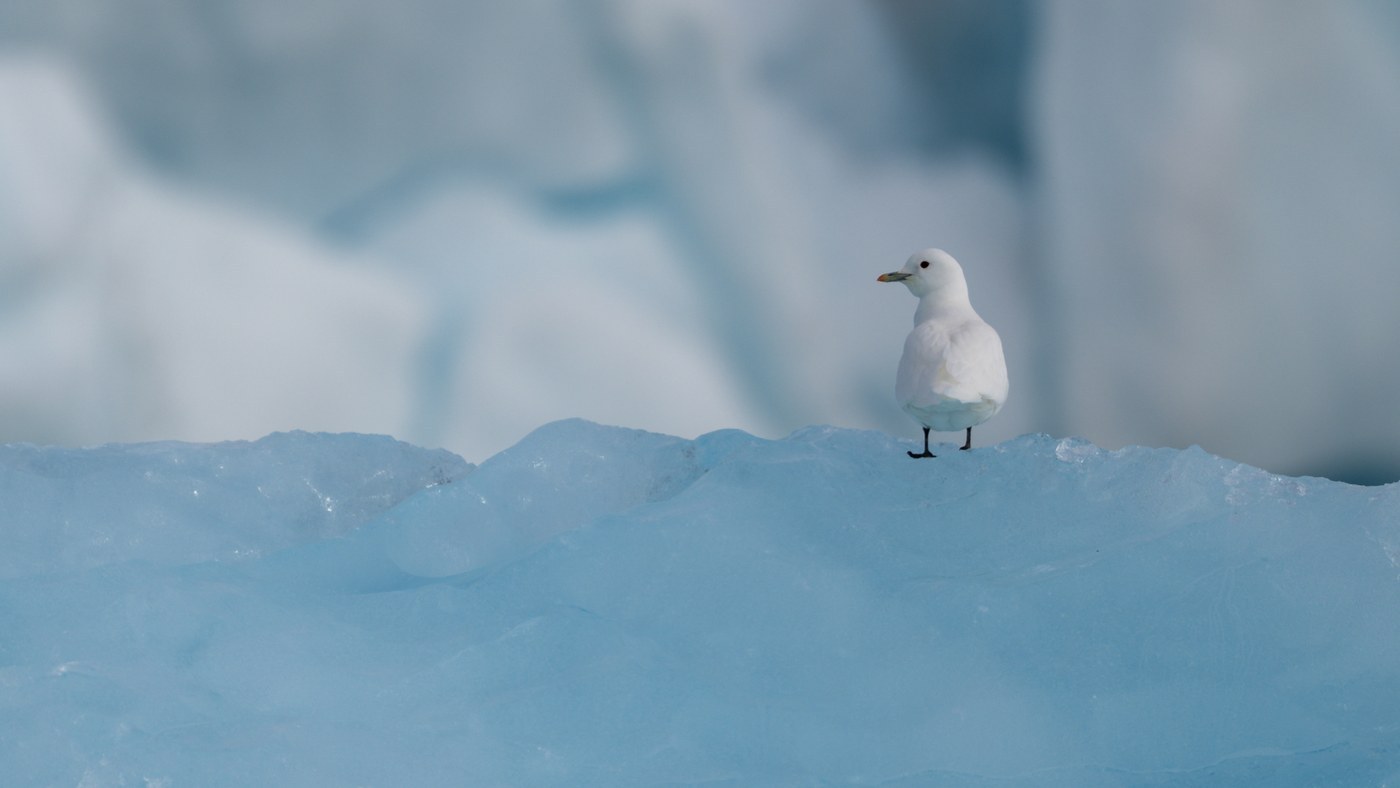
Key Field Marks
- Size & shape: A medium-sized, compact gull about 16–18 inches (41–46 cm) long, with a relatively short, stout body, rounded head, and moderately long pointed wings; pigeon-like proportions compared to typical larger gulls.
- Adult plumage: Entirely pure white all over, with no gray or black markings on the body, wings, or tail — the only gull in the world with completely white adult plumage.
- Bill: Distinctive two-toned pattern — grayish-blue at the base transitioning to a bright yellow tip, quite short and stubby compared to other gulls.
- Legs & feet: Short, black legs and feet, contrasting sharply against the snow-white body — a key mark visible at rest or on ice.
- Immature plumage: Also mostly white but shows a variable amount of blackish speckling on the face (giving a "dirty-faced" look), scattered dark spots on the wings and body, and a solid blackish tail-tip band — still readily identified by the overall white base color unlike any young gull of another species.
- Eye: Dark eye set in an all-white face (in adults), sometimes with a thin reddish orbital ring.
Separating It From Similar Species
- Glaucous Gull / Iceland Gull (pale morphs): Both can look very pale, but always retain some pale gray on the mantle/back and pink (not black) legs, unlike the Ivory Gull's uniformly pure white body and black legs.
- Snowy Owl (non-gull confusion in flight at distance): Bulkier, with a rounded owl head, no gull-like bill, and different flight style; unlikely to be confused on close view.
- Domestic/albino gulls of other species: True albinism is rare and usually shows some plumage irregularities plus a pink (not gray-and-yellow) bill and pink legs, unlike the Ivory Gull's consistent bill and leg coloration.
Where & When to See It
- Habitat: True high-Arctic specialist — associated with pack ice, ice floes, glaciers, and polynyas (areas of open water within sea ice); often follows polar bears and seal carcasses to scavenge.
- Range: Breeds in the high Arctic (Canadian Arctic islands, Greenland, Svalbard, and Russian Arctic islands); winters along the edge of the pack ice, rarely wandering south, though individual vagrants occasionally appear far outside their normal range during winter, causing major birding interest when they do.
- Season: Present on Arctic breeding grounds in summer; found near sea ice edges through the winter, tracking the ice margin as it shifts.
- Behavior: A scavenger as well as predator, feeding on fish, marine invertebrates, and carrion including seal and whale carcasses and polar bear kill remains; often remarkably tame and approachable, especially at food sources, likely due to limited historical contact with humans.
Voice
- A shrill, tern-like "kwee" or repeated harsh "kier-kier" call, higher-pitched and less raucous than typical large gulls.
Frequently asked questions
What is the most distinctive feature of an adult Ivory Gull?
It is the only gull species with completely pure white adult plumage and no gray or black markings anywhere on the body, combined with black legs and a gray-and-yellow bill.
How do you identify a young Ivory Gull?
Immatures are still mostly white but show blackish speckling on the face, scattered dark spots on the wings, and a solid dark tail band — still overwhelmingly white compared to young birds of any other gull species.
Why are Ivory Gulls hard to see?
They live almost exclusively in the high Arctic near pack ice and sea ice edges, rarely straying south, so most birders never encounter one without a dedicated Arctic trip or a rare vagrant sighting.
What do Ivory Gulls eat?
They scavenge carrion such as seal and whale remains and polar bear kills, and also hunt fish and marine invertebrates, often near ice edges and open-water polynyas.
Are Ivory Gulls tame around people?
They are often surprisingly approachable, likely because of limited historical exposure to humans in their remote Arctic range, though vagrant individuals should still be observed without disturbing them.