
Indian Roller Identification Guide
A stocky, crow-sized bird famed for its dazzling flash of turquoise, azure, and violet wing colors in flight, commonly seen perched on wires across the Indian subcontinent.
Read the full Indian Roller encyclopedia entry →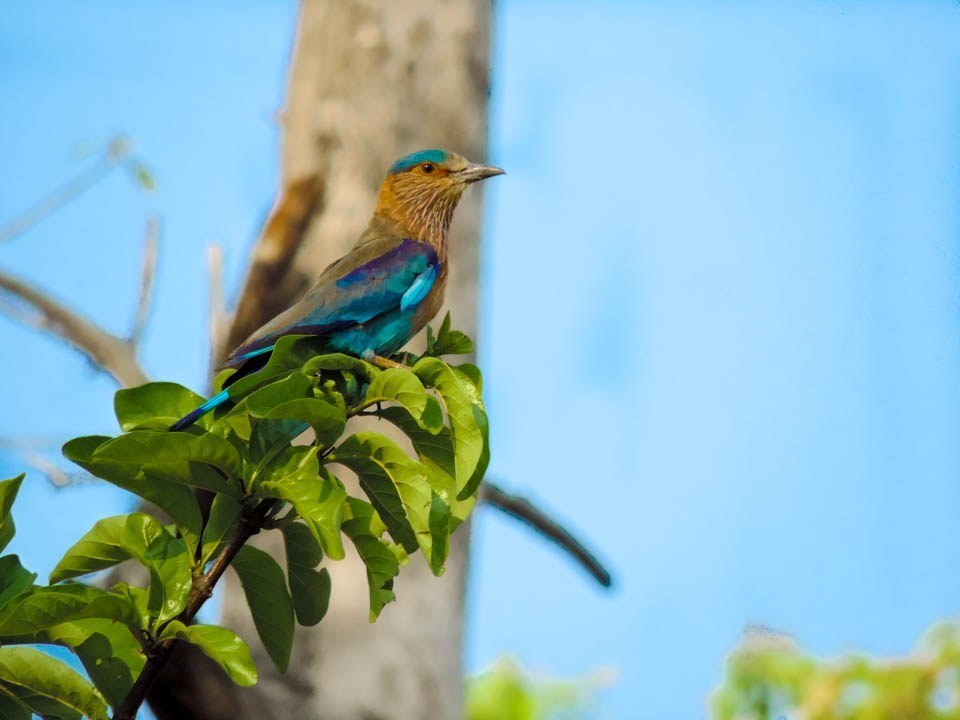
Key Field Marks
- Size & shape: Stocky and crow-like in build, about 12–13 inches (30–33 cm) long, with a large head, short neck, and a stout, slightly hooked bill; short legs give it an upright perched posture.
- Plumage at rest: Appears relatively subdued — a dull brownish/olive back and head, a pale lilac-brown breast, and a light blue-green belly — giving little hint of the spectacular colors revealed in flight.
- In flight: Explodes into brilliant bands of deep blue, turquoise, and violet across the wings and tail, especially visible as the bird opens its wings — this dramatic color contrast between perched and flying birds is the single best identification feature.
- Bill & legs: Blackish, hooked bill typical of rollers; short brownish legs.
- Behavior: Frequently perches upright and motionless on wires, poles, or bare branches, scanning the ground before dropping down or sallying out for prey.
Separating It From Similar Species
- European Roller: Has a more uniformly blue head, neck, and underparts (lacking the lilac-brown breast band) and a chestnut back; ranges mostly overlap only in winter in parts of India, where careful attention to the brownish breast band of Indian Roller is useful.
- Broad-billed Roller (Africa, non-overlapping): Not normally confused given range, but note its more purplish overall tone and different bill shape if traveling.
- No other bird in its core Indian subcontinent range shows the same dramatic still-vs-flight color transformation, making confusion with common resident species unlikely.
Where & When to See It
- Habitat: Open country — farmland, scrub, light woodland, grassland, and areas with scattered trees or wires for perching; avoids dense forest.
- Range: Resident across the Indian subcontinent (India, Pakistan, Nepal, Bangladesh, Sri Lanka) and into parts of the Middle East and Southeast Asia depending on subspecies; largely non-migratory, though some populations show local seasonal movements.
- Season: Visible year-round; the species is the state bird of several Indian states and is closely associated with agricultural landscapes.
- Behavior: A sit-and-wait predator of large insects (grasshoppers, beetles), also taking small reptiles and rodents; performs spectacular aerobatic "rolling" display flights during the breeding season, tumbling and diving while calling loudly — the behavior that gives rollers their name.
Voice
- Harsh, crow-like guttural calls — a loud "chack" or "chak-chak-chak" — given especially during display flights and when disturbed.
- Generally noisy and conspicuous when breeding, quieter otherwise.
Frequently asked questions
Why does the Indian Roller look so different perched versus flying?
At rest its plumage is fairly subdued brown and lilac, but when it opens its wings in flight it reveals brilliant bands of turquoise, deep blue, and violet — a dramatic contrast that is the species' hallmark field mark.
How do you separate Indian Roller from European Roller?
Indian Roller shows a lilac-brown breast band and browner back, while European Roller has a more uniformly blue head/underparts and a chestnut back; range and season also help since overlap is limited mostly to winter.
What does 'rolling' refer to in the Indian Roller's name?
It refers to the spectacular tumbling, diving aerobatic display flight the male performs during the breeding season, rolling and twisting in the air while calling.
What habitat should I search for Indian Rollers?
Open farmland, scrub, and grassland with scattered perches like wires, poles, or bare branches — it avoids dense forest and is easily seen along rural roadsides.