
Indian Ringneck Parakeet Identification Guide
A slim, long-tailed green parakeet of South Asia — the Indian subspecies of the Rose-ringed Parakeet — best known for the male's thin rose-and-black neck ring and a familiar screeching call.
Read the full Indian Ringneck Parakeet encyclopedia entry →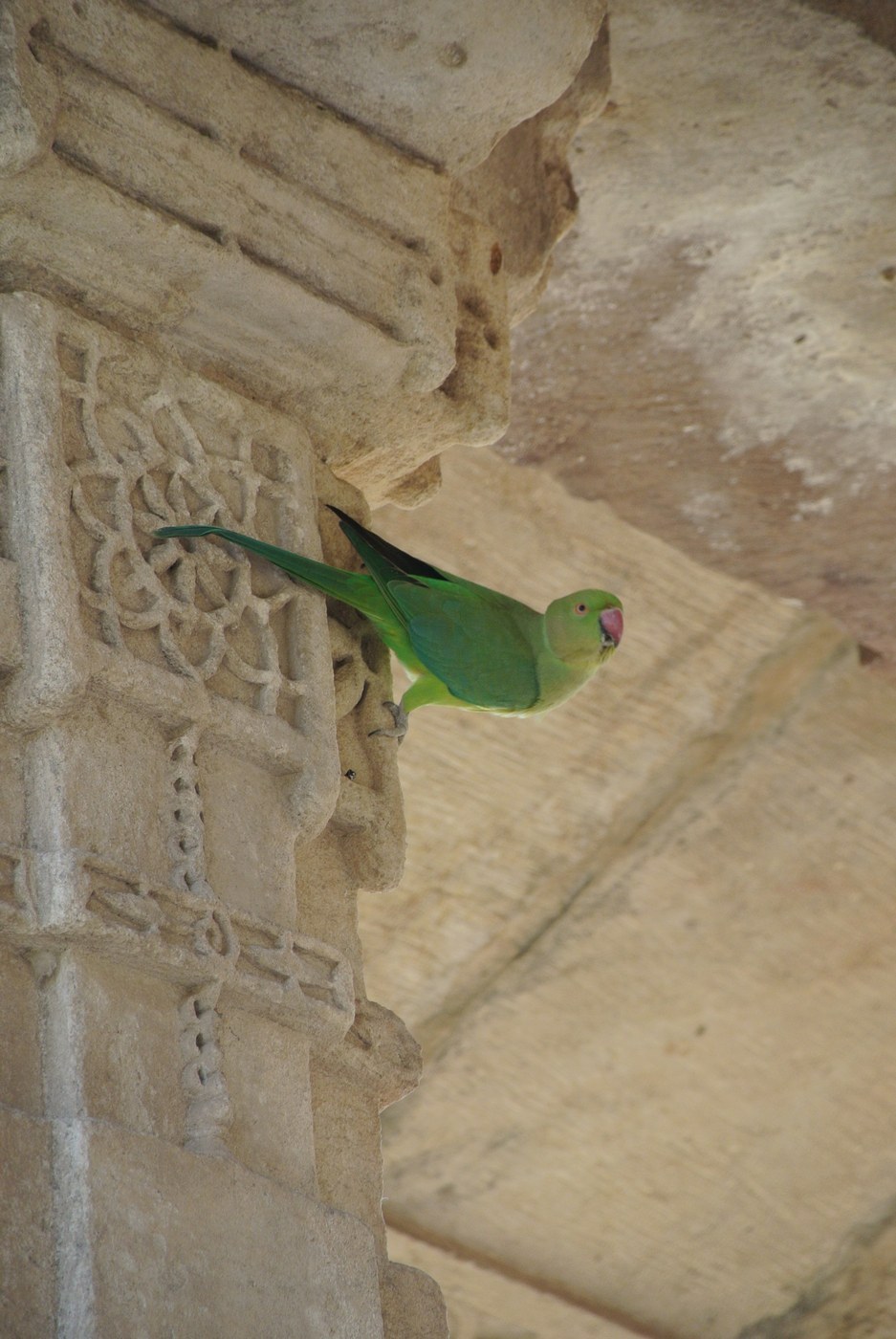
Key Field Marks
- Size & shape: A slender, medium-sized parakeet roughly 15‗17 inches (38–43 cm) long, over half of which is a long, graduated, pointed tail; pointed wings and a hooked, powerful bill typical of parrots.
- Plumage: Overall bright grass-green body, slightly paler and yellower on the underparts, with a bluish wash sometimes visible on the nape and central tail feathers.
- Male: Adult males show a narrow black chin stripe/ring around the lower throat that continues as a rosy-pink band around the back of the neck — the "rose ring" that gives the species its name; a black stripe also runs from the lower mandible.
- Female & immature: Lack the neck ring entirely, appearing plain green-headed; males do not acquire the full ring until about 2–3 years of age.
- Bill: Large, strongly hooked, deep red on the upper mandible in adults, blackish on the lower mandible.
Separating It From Similar Species
- Alexandrine Parakeet: Larger and heavier overall, with a maroon-red shoulder patch on the wing and a proportionally bigger, more massive bill — the Indian Ringneck lacks the maroon shoulder patch and has a slimmer bill.
- Plum-headed Parakeet: Male has a plum-purple head rather than green, and is smaller overall; females of that species lack the ringneck's black-and-pink collar structure.
- Feral/escaped populations worldwide (e.g., in the UK, US, and elsewhere): These are the same species/subspecies group and are identified the same way; habitat context (urban parks far outside native range) is a clue to feral origin rather than a plumage difference.
Where & When to See It
- Habitat: Highly adaptable — found in open woodland, farmland, orchards, city parks, and gardens; frequently nests in tree cavities and readily uses palm trees and old woodpecker holes.
- Range: Native across the Indian subcontinent and parts of the Middle East/Africa (as the wider Rose-ringed Parakeet species); the Indian subspecies (manillensis) is common throughout India, Pakistan, Nepal, Bangladesh, and Sri Lanka. Feral populations, largely derived from escaped cage birds, are established in cities across Europe, the Middle East, and the U.S.
- Season: Non-migratory resident; visible year-round, though flocks are especially conspicuous at communal roosts in the evening.
- Behavior: Highly social, forming large noisy flocks, especially at dusk roosts; fast, direct flight with rapid wingbeats; often raids crops and fruiting trees, and is a frequent visitor to bird feeders in areas with feral populations.
Voice
- A loud, harsh, screeching "kee-ak" or "kee-kee-kee," given constantly in flight and at roosts — often the first clue to a flock's presence before it is seen.
- Calls are sharper and less musical than many other parakeet species, carrying well over urban and rural noise alike.
Frequently asked questions
How can you tell a male from a female Indian Ringneck Parakeet?
Adult males show a black chin stripe merging into a rosy-pink neck ring; females and young birds lack any neck ring and have a plain green head.
At what age do male Indian Ringnecks get their neck ring?
The rose-and-black ring typically doesn't fully develop until the male is about 2 to 3 years old.
How do you tell an Indian Ringneck from an Alexandrine Parakeet?
Alexandrine Parakeet is noticeably larger with a heavier bill and a maroon patch on the shoulder/wing, which the Indian Ringneck lacks.
Why are Indian Ringneck Parakeets seen in cities far from India?
Escaped or released cage birds have established self-sustaining feral populations in many cities worldwide, including parts of Europe and the United States.
What does an Indian Ringneck Parakeet sound like?
A loud, harsh screeching call, often given repeatedly in flight and especially noisy at communal evening roosts.