
Indian Golden Oriole Identification Guide
A vivid yellow-and-black songbird of the Indian subcontinent, closely related to the Eurasian Golden Oriole and identified by its bright plumage, black eye-stripe, and fluty whistled call.
Read the full Indian Golden Oriole encyclopedia entry →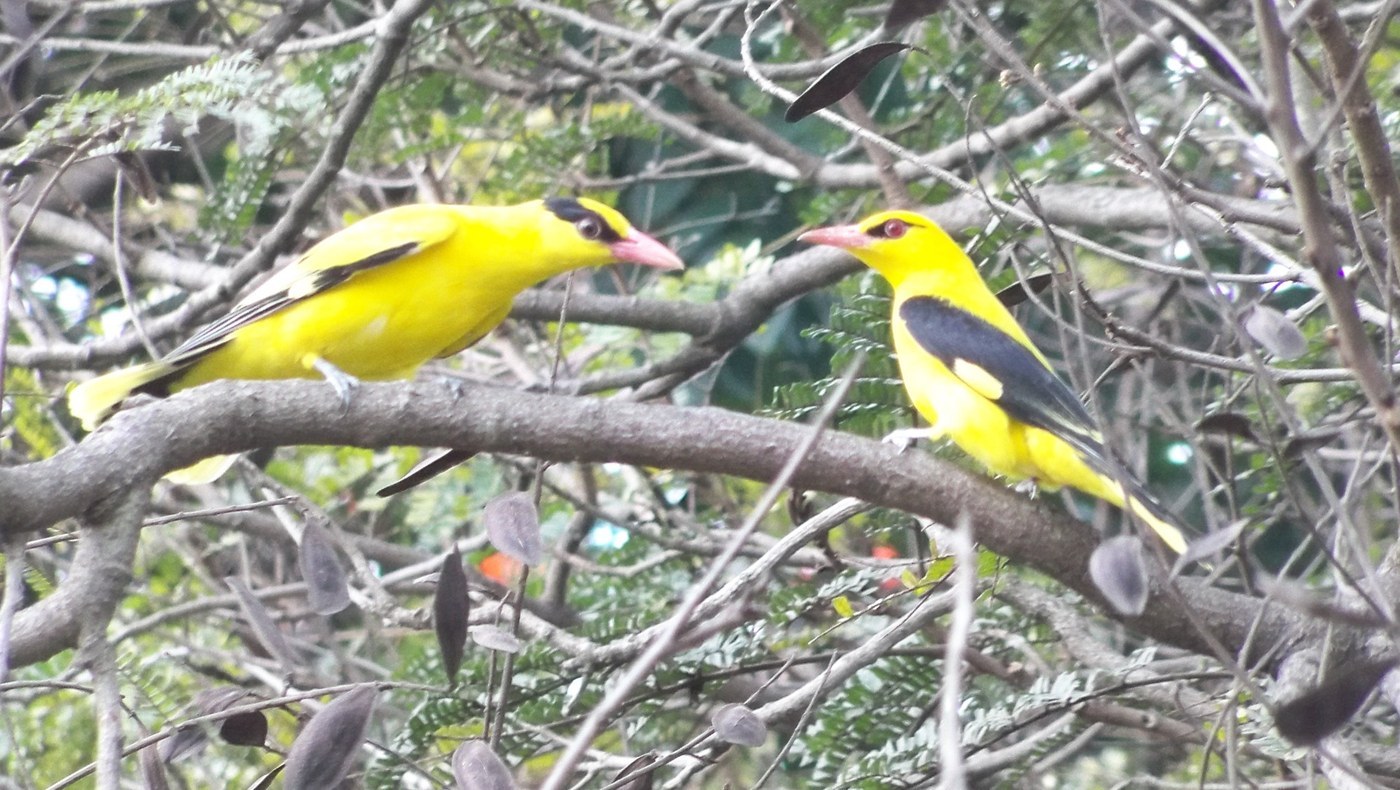
Key Field Marks
- Size & shape: A medium-sized passerine, about 9–10 inches (24–25 cm) long, with a stocky thrush-like body, moderately long wings, and a short square tail.
- Male plumage: Brilliant golden-yellow body with jet-black wings, a black tail with yellow corners, and a bold black stripe running from the bill through the eye to the nape — this eye-stripe is a key distinguishing feature from the Eurasian Golden Oriole, in which the black loral stripe stops behind the eye and does not extend past it as broadly.
- Female/immature plumage: Duller, more yellowish-green above with grayer underparts showing faint streaking; the dark eye-stripe is still present but less bold.
- Bill: Thick, slightly downcurved, pinkish-red to coral-red, conspicuous against the yellow face.
- Legs: Grayish, short and sturdy for a canopy-dwelling bird.
Separating It From Similar Species
- Eurasian Golden Oriole: Extremely similar and formerly considered the same species; the Indian Golden Oriole's black eye-stripe extends further behind the eye toward the nape, appearing broader and more extensive. Range and voice are the most reliable separators, as the two overlap only marginally.
- Black-naped Oriole: Has a solid black band across the nape connecting both eye-stripes (forming a complete band around the head), unlike the Indian Golden Oriole's stripe, which does not meet at the back of the neck.
- Black-hooded Oriole: Shows an entirely black head and hood, not just an eye-stripe, making confusion unlikely once seen well.
Where & When to See It
- Habitat: Open woodland, groves, orchards, mango plantations, and well-wooded gardens; favors tall leafy trees and stays mostly in the canopy.
- Range: Breeds across the Indian subcontinent — Pakistan, India, Nepal, Bangladesh, and Sri Lanka; some populations are resident while northern breeders may show local movements.
- Season: Present year-round in much of its range, though more vocal and conspicuous during the breeding season (spring into early summer).
- Behavior: Arboreal and often surprisingly hard to spot despite bright colors, as it stays hidden among leaves; flight is strong and slightly undulating between trees.
Voice
- A rich, fluty, whistled "pee-lo-lo" or "weela-wee-ooo," often given from high in a tree canopy — a signature sound of open Indian woodland.
- Also gives a harsh, cat-like scolding note when alarmed.
Frequently asked questions
How is the Indian Golden Oriole different from the Eurasian Golden Oriole?
The Indian Golden Oriole has a broader black eye-stripe extending further onto the nape; the two were once treated as one species and are best separated by range and this stripe extent, since plumage is otherwise very similar.
Why are Indian Golden Orioles hard to see despite their bright color?
They stay high in leafy canopy and their yellow plumage blends surprisingly well with dappled sunlight through leaves, so they're often located by voice before being seen.
What does the Indian Golden Oriole's call sound like?
A rich, fluty whistle often rendered as 'pee-lo-lo,' one of the most recognizable songs of Indian open woodland.
Do female Indian Golden Orioles look like males?
No, females and immatures are duller yellow-green with grayer, lightly streaked underparts, though they retain the dark eye-stripe.