Inca Dove Identification Guide
A tiny, scaly-looking desert dove of the American Southwest and Mexico, told by its small size, sandy-scaled plumage, and long tail edged in white.
Read the full Inca Dove encyclopedia entry →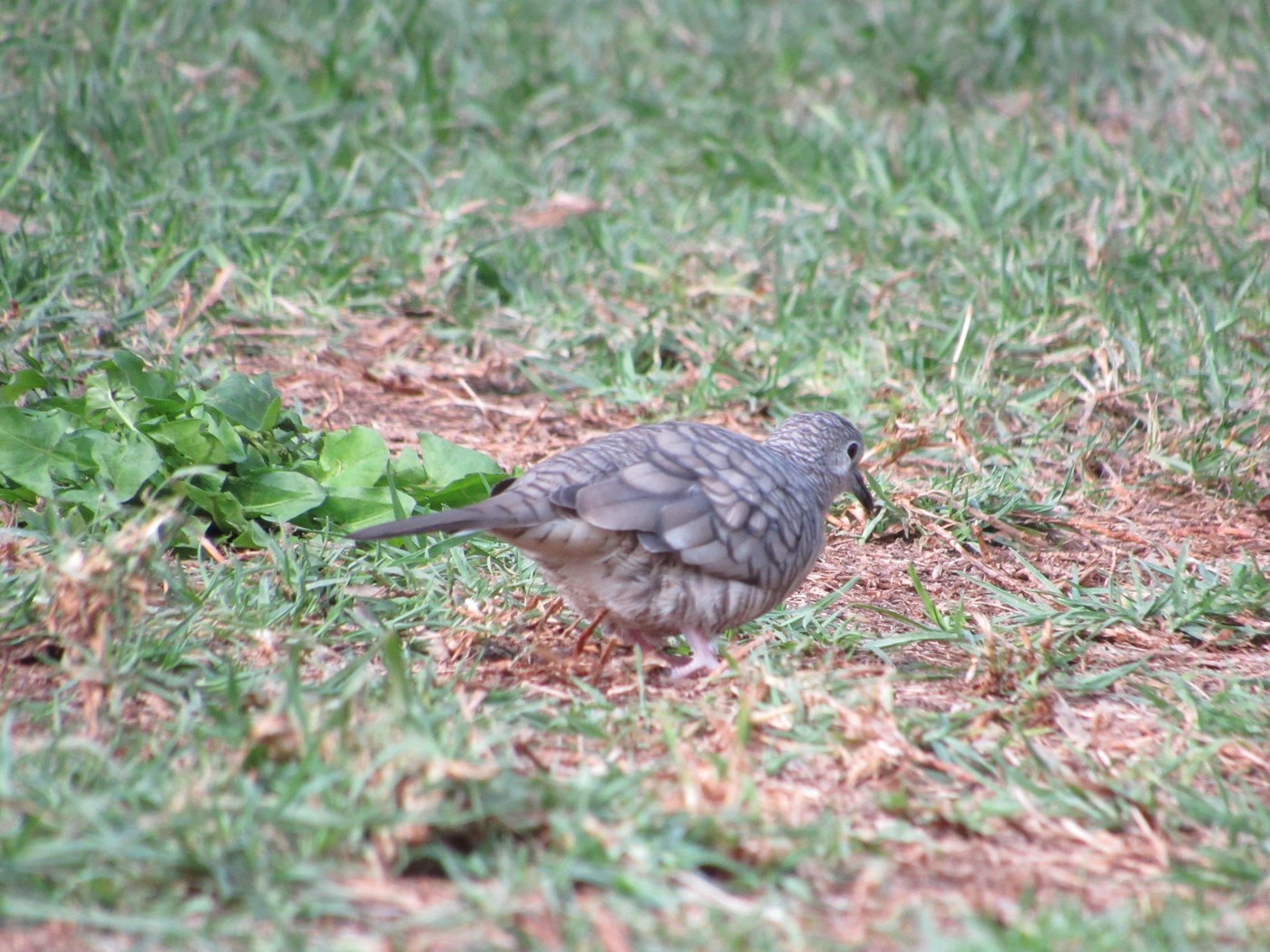
Key Field Marks
- Size & shape: One of the smallest doves in North America, about 7.5–8 inches (19–20 cm) long, roughly sparrow-to-thrush sized, with a small head, slim body, and a proportionally long, squared tail.
- Plumage: Overall pale grayish-brown with a distinctive "scaly" or fish-scale pattern created by dark feather edges across the head, back, breast, and belly — visible at close range and a top diagnostic feature.
- Tail: Long and dark with prominent white outer tail-tip edges that flash in flight and when the bird fans its tail on landing.
- In flight: Shows rusty-cinnamon primaries/wing patches that flash conspicuously, especially against the pale body.
- Bill & legs: Thin, dark bill; pinkish-red legs and feet.
- Bare skin: A small patch of blue-gray skin around the eye is visible at close range.
Separating It From Similar Species
- Common Ground Dove: Similar tiny size but lacks the strong scaly pattern; Common Ground Dove has a shorter tail, scaled pattern mostly confined to the breast/head with a more uniform back, and shows less white in the tail. Inca Dove's tail is noticeably longer and more square-tipped.
- Mourning Dove: Much larger, with a long pointed (not squared) tail, plain unscaled plumage, and a single black spot on the cheek — easy to rule out on size alone.
- White-winged Dove: Larger, stockier, with a bold white wing bar visible at rest, unlike the scaly Inca Dove.
Where & When to See It
- Habitat: Highly adapted to human-altered landscapes — city parks, suburban yards, farms, feedlots, and desert scrub edges. Common around bird feeders and in urban centers of the Southwest.
- Range: Resident from the southwestern United States (Arizona, New Mexico, Texas) south through Mexico and into Central America. Non-migratory; range has expanded northward with urbanization.
- Season: Present year-round wherever found; no notable migratory movements.
- Behavior: Often seen walking on the ground in pairs or small flocks, pecking for seeds; frequently perches on wires, fences, and rooftops. Roosts communally, sometimes stacking in pyramid-like clusters on cold mornings to conserve heat.
Voice
- Song is a repeated, mournful two- or three-syllable phrase often rendered as "no hope" or "whirl-pool," given persistently, especially in the breeding season.
- Flight produces a distinctive dry, rattling whir of the wings on takeoff.
Frequently asked questions
What makes the Inca Dove's plumage look scaly?
Each body feather has a thin dark edge, which creates an overlapping, fish-scale pattern across the head, back, and underparts — visible at close to moderate range and the bird's most distinctive feature.
How do I tell an Inca Dove from a Common Ground Dove?
Inca Dove has a longer, squared tail with white edges and a more extensively and evenly scaled body, while Common Ground Dove is shorter-tailed with scaling mostly on the head and breast and a plainer back.
What color flashes in the wings when an Inca Dove flies?
Rusty-cinnamon primary feathers flash prominently in flight, contrasting with the pale scaly body.
Where is the best place to look for Inca Doves?
They favor urban and suburban areas, parks, and farmland edges in the desert Southwest and Mexico, often seen walking on lawns, sidewalks, or under bird feeders.
Do Inca Doves migrate?
No, they are non-migratory residents throughout their range and can be found in the same areas year-round.
Inca Dove identified by the community
Recent Inca Dove sightings identified with Bird Identifier.