Hyacinth Macaw Identification Guide
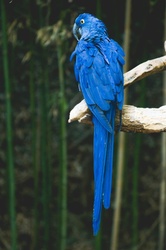
The world's largest flying parrot, unmistakable for its all-over cobalt-blue plumage, massive black bill, and bright yellow bare skin around the eye and at the base of the lower mandible.
Read the full Hyacinth Macaw encyclopedia entry →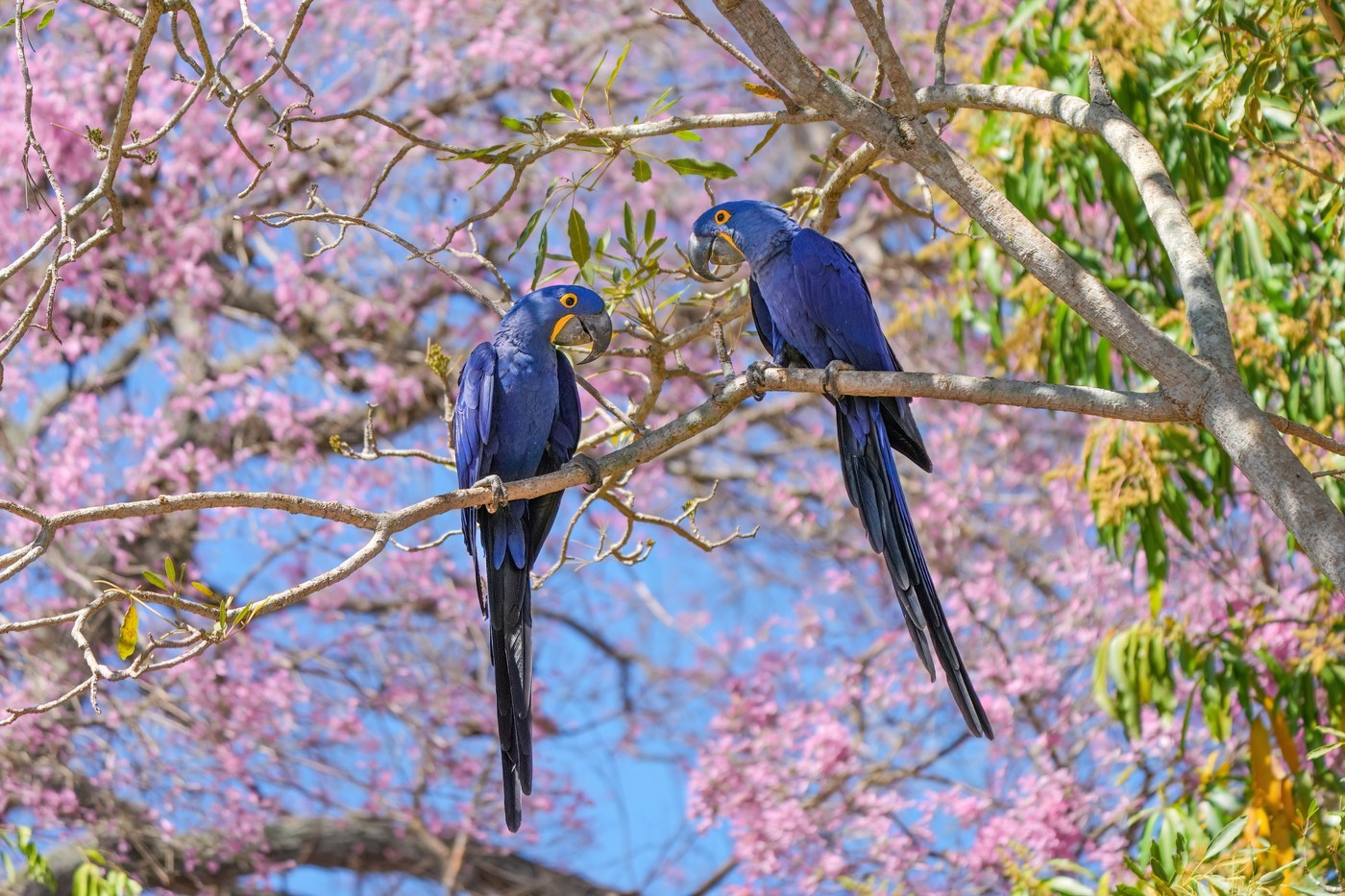
Overview
The Hyacinth Macaw (Anodorhynchus hyacinthinus) is the largest of all parrot species by length, a striking, entirely blue macaw native to central and eastern South America. Its size, deep cobalt coloring, and massive bill make it essentially unmistakable in the wild.
Key Field Marks
- Size & shape: Enormous macaw, about 39-40 inches (100 cm) long including a long, pointed tail — the longest of any parrot species — with broad wings and a heavy, powerful flight.
- Plumage: Entirely deep cobalt-blue overall with no other markings, including the head, body, wings, and tail; underwing and undertail flight feathers appear slightly darker/grayish in flight.
- Bill: Massive, strongly hooked black bill, among the largest of any parrot, adapted for cracking extremely hard palm nuts.
- Bare facial skin: Bright yellow bare skin forms a ring around the eye and a crescent-shaped patch at the base of the lower mandible — a diagnostic contrast against the blue plumage and black bill.
- Legs and feet: Dark grayish-black, typical zygodactyl parrot feet (two toes forward, two back).
Separating Hyacinth Macaw from Similar Species
Lear's Macaw
- Lear's Macaw is noticeably smaller (about 29-30 inches) with a slightly greener-blue cast to the plumage (less pure cobalt) and a smaller bill and yellow eye-ring/facial patch; ranges do not overlap (Lear's is restricted to a small area of northeastern Brazil).
Glaucous Macaw (likely extinct)
- Historically similar but paler, more grayish-blue overall with a grayer head, and much smaller yellow facial patches; essentially never a realistic identification concern today given its probable extinction.
Blue-and-yellow Macaw
- Blue-and-yellow Macaw has bright yellow underparts and a green forehead, completely different from the all-blue Hyacinth Macaw, and is a different genus altogether.
Habitat and Range
Hyacinth Macaws are found in three main disjunct populations in Brazil, Bolivia, and Paraguay, favoring palm savannas (especially areas with manduvi and other palm trees), gallery forest along rivers, and the wetland/savanna mosaic of the Pantanal. They are strongly tied to specific palm species for both feeding (palm nuts) and nesting (large tree cavities, often in manduvi trees).
Seasonal Occurrence
Non-migratory residents throughout their South American range year-round; local movements may track palm nut fruiting seasons, but there is no long-distance seasonal migration.
Behavior
Hyacinth Macaws use their extremely powerful bill to crack open palm nuts too hard for most other animals, including nuts from acuri and bocaiuva palms; they also take nuts partially processed by cattle digestion in ranching areas. They typically pair for life, nest in large natural tree cavities, and are often seen in pairs or small family groups flying with slow, deep wingbeats and giving loud calls. The species is classified as vulnerable, primarily due to historical trapping for the pet trade and ongoing habitat loss.
Voice
Loud, harsh, far-carrying calls including deep, guttural screams and croaking notes, often given in flight or as contact calls between paired birds; among the loudest vocalizations of any macaw species.
Frequently asked questions
What makes the Hyacinth Macaw easy to identify?
It is entirely cobalt-blue with no other body color, has a massive black bill, and shows bright yellow bare skin around the eye and at the base of the lower mandible — a combination found in no other wild bird.
How do you tell Hyacinth Macaw from Lear's Macaw?
Hyacinth Macaw is larger with purer cobalt-blue plumage, while Lear's Macaw is smaller, slightly greener-blue, and restricted to a small region of northeastern Brazil, so range alone often settles the question.
Where do Hyacinth Macaws live in the wild?
They are found in Brazil, Bolivia, and Paraguay, primarily in palm savannas, the Pantanal wetlands, and gallery forests where specific palm trees provide both food and nest cavities.
Why is the Hyacinth Macaw considered vulnerable in the wild?
Historical illegal capture for the pet trade drastically reduced wild populations, and ongoing habitat loss and reliance on specific palm trees for food and nesting continue to threaten the species.
Hyacinth Macaw identified by the community
Recent Hyacinth Macaw sightings identified with Bird Identifier.