
Hutton's Vireo Identification Guide
A small, plain olive-gray West Coast vireo often confused with Ruby-crowned Kinglet, best separated by its thicker hooked bill, slower deliberate movements, and incomplete white eye-ring.
Read the full Hutton's Vireo encyclopedia entry →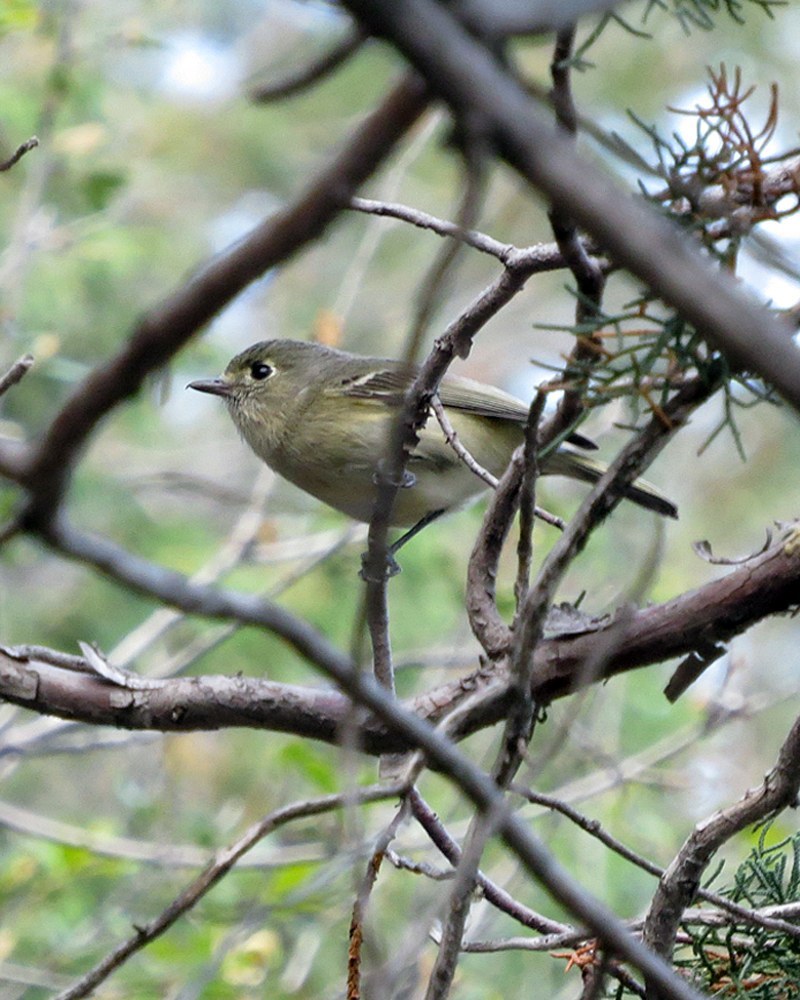
Overview
Hutton's Vireo (Vireo huttoni) is a small, nondescript, year-round resident of western North American woodlands, famous among birders as one of the classic identification challenges due to its close resemblance to the unrelated Ruby-crowned Kinglet.
Key Field Marks
- Size & shape: Small, chunky-headed songbird about 4.5-5 inches (11-13 cm), with a relatively large head, short tail, and a notably thick, slightly hooked bill for a bird this size — typical vireo bill structure.
- Plumage: Plain olive-gray to olive-green overall, unstreaked, with two pale wing bars (the lower one often bolder/broader than the upper).
- Face: Broken, incomplete whitish eye-ring that is thicker/bolder above and below the eye but interrupted in front, giving a "spectacled" look; lores (area between eye and bill) are dusky.
- Behavior: Moves deliberately and somewhat sluggishly through foliage compared to the constantly flitting, wing-flicking behavior of kinglets.
- Bill shape: Thicker-based with a small hook at the tip — a key structural difference from the thin, needle-like bill of kinglets.
Separating Hutton's Vireo from Similar Species
Ruby-crowned Kinglet
- Kinglet has a thin, straight, pointy bill (no hook), constantly flicks its wings nervously, and shows a complete bold white eye-ring plus a small red crown patch (usually hidden) in males; kinglets also have a blacker area at the base of the primaries bordered by a whitish wing bar, creating a more contrasty wing pattern than the vireo's plainer wings.
- Hutton's Vireo moves more slowly and deliberately, rarely flicking its wings, and has a proportionally bigger head and thicker neck-to-head transition.
Warbling Vireo
- Warbling Vireo lacks wing bars entirely and has a bolder pale eyebrow stripe (not a broken eye-ring), with a more elongated, slimmer overall shape.
Cassin's Vireo / Blue-headed Vireo
- Both show bold, complete white "spectacles" (not just a broken eye-ring) and a contrasting gray or blue-gray hood, unlike Hutton's plain-headed look.
Habitat and Range
Hutton's Vireo is a resident of evergreen and mixed woodlands along the Pacific Coast and interior mountain ranges of the western United States and Mexico, favoring live oak, Douglas-fir, and mixed conifer-broadleaf forests. It is non-migratory (or only locally/altitudinally migratory), remaining in the same general area year-round, distinguishing it ecologically from most other vireos, which are long-distance Neotropical migrants.
Seasonal Occurrence
Present year-round throughout its range; unlike nearly all other vireo species, it does not undertake long-distance migration, making it a reliable find in appropriate habitat in any season.
Behavior
Forages deliberately in the mid-to-upper canopy of oaks and conifers, gleaning insects from foliage with slow, methodical movements. Often joins mixed-species foraging flocks with chickadees, kinglets, and warblers in winter, which is exactly when confusion with Ruby-crowned Kinglet is most likely since the two species frequently forage together.
Voice
The song is a simple, repeated two-note phrase, often rendered as "zu-wee, zu-wee" or "chu-wee," repeated monotonously — quite distinct from the kinglet's much longer, more complex jumbled song. The call is a scolding, harsh "chek" or "dijjt."
Frequently asked questions
What is the single best way to tell Hutton's Vireo from a Ruby-crowned Kinglet?
Check the bill: Hutton's Vireo has a thick, slightly hooked bill and moves deliberately, while Ruby-crowned Kinglet has a thin, straight bill, a complete bold eye-ring, and constantly flicks its wings.
Does Hutton's Vireo migrate?
No, it is largely non-migratory, remaining resident in its western woodland habitat year-round, unlike most other vireo species that migrate to the Neotropics.
What habitat should I search for Hutton's Vireo?
Look in evergreen and mixed woodlands along the Pacific Coast and western mountains, especially areas with live oak or Douglas-fir, often in mixed foraging flocks in winter.
Does Hutton's Vireo have wing bars like a kinglet?
Yes, both species show two pale wing bars, which is part of why they're so easily confused; structural and behavioral differences (bill shape, eye-ring completeness, movement style) are more reliable than the wing bars alone.