
Humboldt Penguin Identification Guide
A medium-sized South American penguin identified by its black-and-white banded chest pattern, pink facial patch, and the single black breast band that distinguishes it from similar banded penguins.
Read the full Humboldt Penguin encyclopedia entry →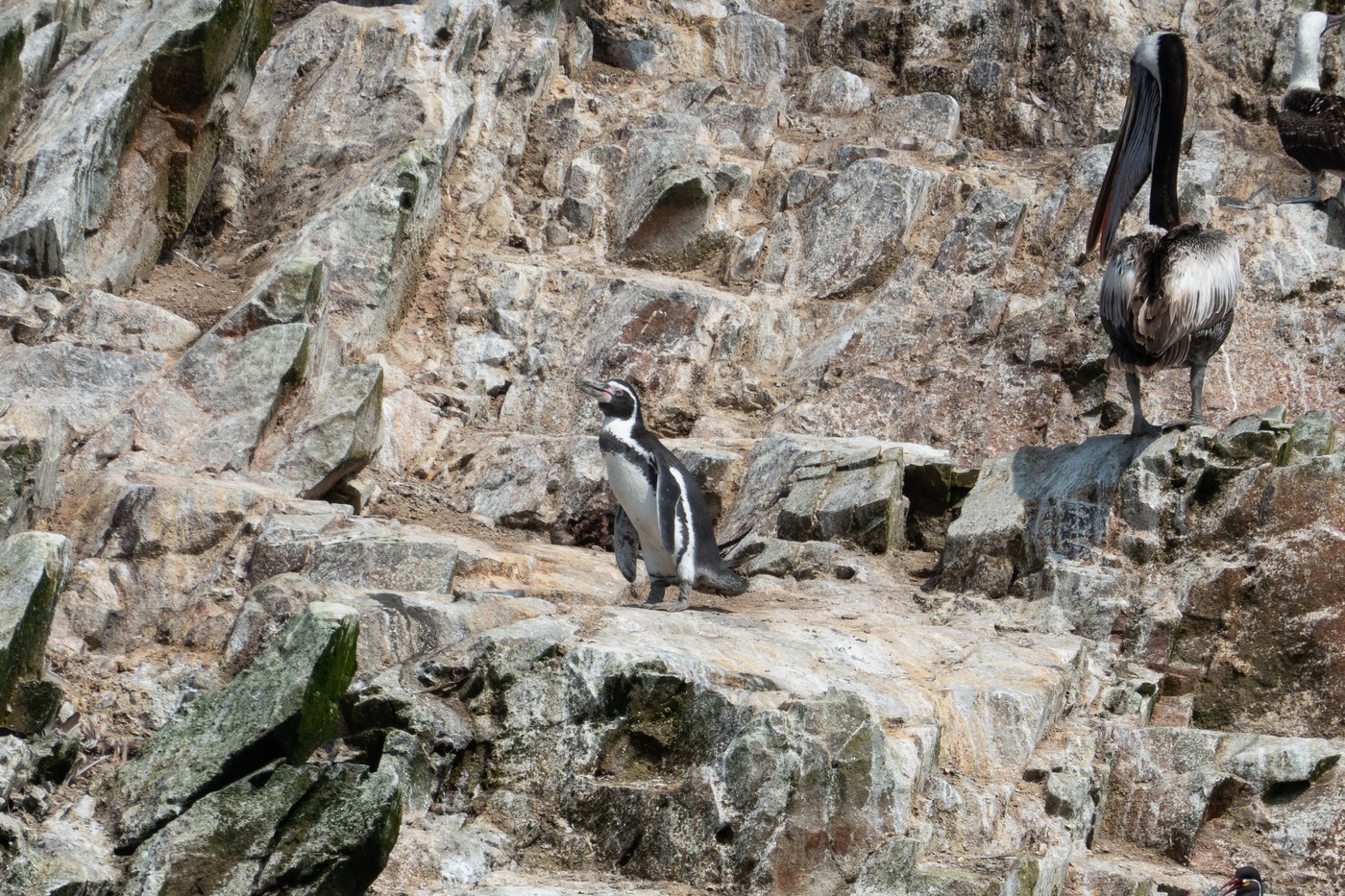
Overview
The Humboldt Penguin (Spheniscus humboldti) is a medium-sized, temperate-zone penguin native to the coasts of Peru and Chile, named for the cold Humboldt Current that sustains the productive waters where it feeds. It is one of four closely related "banded" penguins in the genus Spheniscus.
Key Field Marks
- Size & shape: Medium-sized penguin, about 26-28 inches (65-70 cm) tall, with the typical stocky, upright, torpedo-shaped penguin body.
- Head and back: Black crown and back with a white stripe running from above the eye, around the black ear coverts, down the side of the neck, and meeting at the breast.
- Breast band: A single black horizontal band across the upper breast, forming an inverted horseshoe shape down the flanks — the key diagnostic mark among banded penguins.
- Underparts: White below, with scattered irregular black spotting on the belly and flanks (spotting pattern is unique to each individual).
- Face: Bare pink patch of skin at the base of the bill and around the eye, used for thermoregulation in warmer climates.
- Bill: Blackish, fairly stout, with a pale/pinkish base in some individuals.
Separating Humboldt Penguin from Similar Species
Magellanic Penguin
- Magellanic Penguin has two black breast bands (a narrow band across the throat/upper chest and a second wider band lower down forming a horseshoe), whereas Humboldt Penguin has only one breast band.
African Penguin
- African Penguin also shows a single black breast band similar to Humboldt, but has a larger, more extensive bare pink patch above the eye and different range (native to southern Africa, not South America); black spotting pattern on the belly also differs individually but overall structure is very similar, so range is the most reliable clue in the wild.
Galápagos Penguin
- Smaller overall, with a thinner white facial stripe and a more irregular, less complete breast band; restricted to the Galápagos Islands.
Habitat and Range
Humboldt Penguins are found along the Pacific coast of South America, primarily Peru and Chile, in the cool waters of the Humboldt Current. They nest in burrows dug into guano deposits or rocky crevices along rocky, arid coastlines and offshore islands, rather than on ice or snow like many other penguin species.
Seasonal Occurrence
Humboldt Penguins are non-migratory residents of their South American range year-round, though breeding activity can occur at varying times depending on local food availability, with some populations breeding twice a year when conditions allow.
Behavior
They forage in the cold, nutrient-rich Humboldt Current for small schooling fish such as anchovies and sardines, diving to pursue prey underwater. Humboldt Penguins nest in burrows or rock crevices, which provide protection from the intense coastal sun and predators. The species is classified as vulnerable due to historical guano harvesting (which destroyed nesting habitat), overfishing of prey species, and El Niño-related food shortages.
Voice
Like other banded penguins, Humboldt Penguins give loud, braying donkey-like calls at breeding colonies, used in mate recognition and territorial displays, along with various grunts and contact calls near burrows.
Frequently asked questions
How do you tell a Humboldt Penguin from a Magellanic Penguin?
Humboldt Penguin has a single black breast band, while Magellanic Penguin has two black bands crossing the chest — one narrow upper band and one broader lower band.
Where do Humboldt Penguins live in the wild?
They are found along the rocky Pacific coasts of Peru and Chile, in the cold waters of the Humboldt Current, nesting in burrows or crevices on arid coastal islands and headlands.
Do Humboldt Penguins live on ice like Emperor Penguins?
No, Humboldt Penguins live in a temperate, largely ice-free coastal desert environment and nest in burrows dug into guano or rock crevices rather than on ice.
Why is the Humboldt Penguin considered vulnerable?
Populations have declined due to historic large-scale removal of the guano deposits they nest in, competition with commercial fisheries for prey fish, and periodic food shortages caused by El Niño events.