
Hudsonian Godwit Identification Guide
A large, long-billed shorebird known for its dramatic long-distance migration, identified by its upturned bicolored bill, dark cinnamon breeding barring, and bold black-and-white tail and underwing pattern in flight.
Read the full Hudsonian Godwit encyclopedia entry →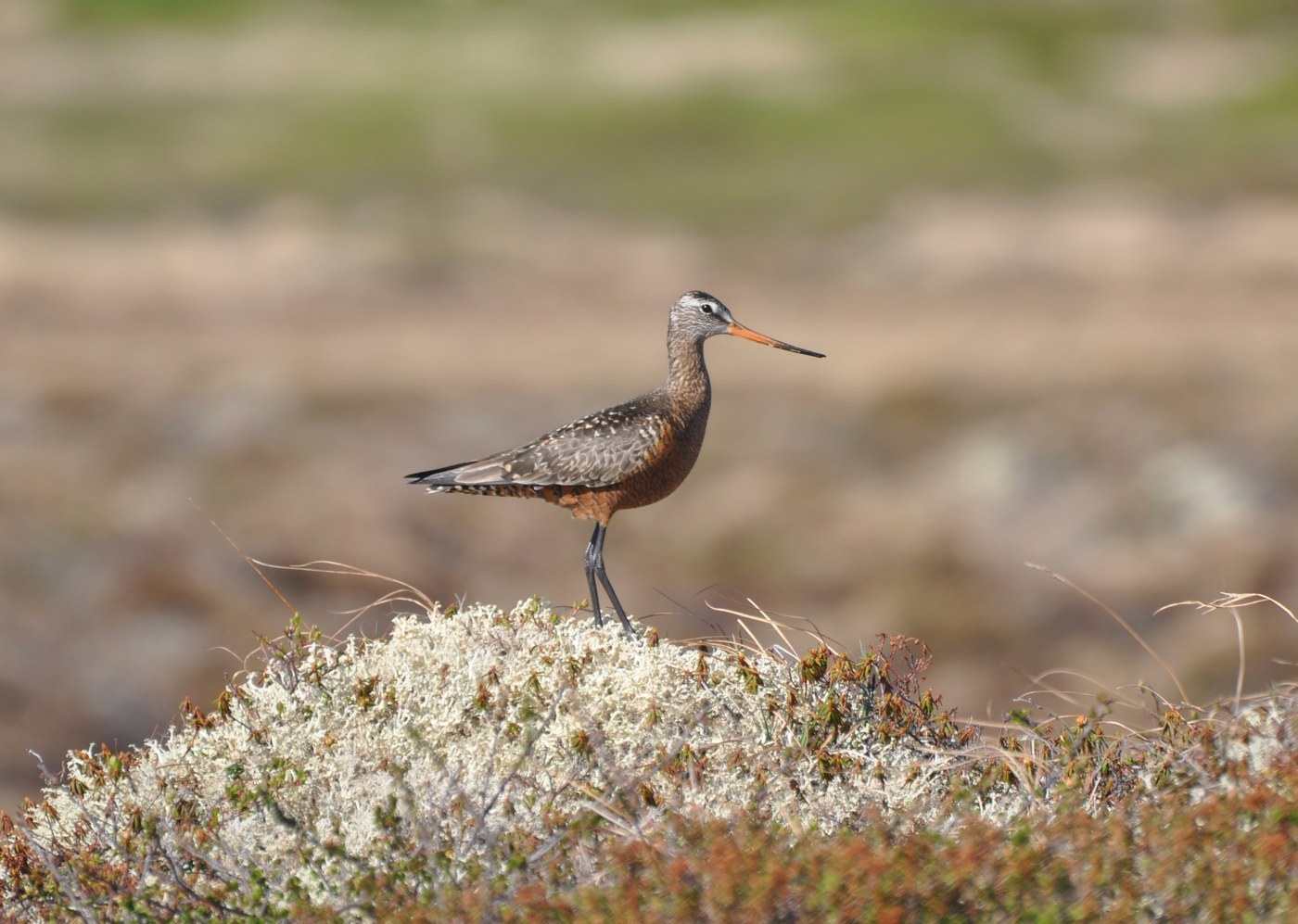
Overview
The Hudsonian Godwit (Limosa haemastica) is a large, elegant shorebird famous for one of the longest nonstop migratory flights of any bird, breeding in isolated Arctic and subarctic pockets and wintering primarily in southern South America.
Key Field Marks
- Size & shape: Large shorebird, about 14.5-16.5 inches (37-42 cm), with long legs, a long neck, and a very long, slightly upturned bill.
- Bill: Long, straight to slightly upcurved, bicolored — pinkish-orange at the base transitioning to black toward the tip.
- Breeding plumage: Rich chestnut-cinnamon underparts with dense dark barring across the breast and belly; mottled brown-gray back.
- Non-breeding plumage: Plain gray-brown above and pale grayish below, much less distinctive than breeding plumage, requiring attention to structure and flight pattern.
- In flight: Diagnostic black tail with a narrow white band at the base (white uppertail coverts), and blackish underwing coverts/axillars contrasting with paler flight feathers — a key mark separating it from other godwits.
- Legs: Long, dark bluish-gray to blackish legs.
Separating Hudsonian Godwit from Similar Species
Marbled Godwit
- Marbled Godwit is larger and buffier overall with warm cinnamon-buff underwings (not blackish) and an all-buffy, mottled plumage lacking the Hudsonian's contrasting black tail/white rump band.
Bar-tailed Godwit
- Bar-tailed Godwit shows a finely barred tail (not solid black) and lacks the bold blackish underwing of Hudsonian Godwit; non-breeding birds are grayer and more streaked.
Black-tailed Godwit
- Very similar in flight pattern (black tail, white base), but Black-tailed Godwit has a bold white wing stripe across the flight feathers that Hudsonian Godwit lacks, along with paler (not blackish) underwing coverts.
Willet
- Willet is stockier with a shorter, straighter, thicker bill and a bold black-and-white wing stripe pattern in flight, quite different from the godwit's slim, long, subtly upturned bill.
Habitat and Range
Hudsonian Godwits breed in scattered, disjunct locations across the Arctic and subarctic — notably around Hudson Bay, the Mackenzie Delta area, and coastal western Alaska. They undertake an extraordinary migration, with some populations flying nonstop for thousands of miles over the Atlantic or Pacific from staging areas to wintering grounds in southern South America (Argentina, Chile). During migration, look for them at coastal mudflats, flooded fields, and prairie wetlands, especially in spring on the Great Plains.
Seasonal Occurrence
A scarce and localized breeder in the Arctic (June-August). Migration windows are narrow and geographically concentrated — spring migrants pass through the central Great Plains (notably prairie Canada and the northern Plains states) in April-May, while fall migrants often stage on the Atlantic coast (e.g., James Bay, New England) before making long oceanic flights south, mainly August-September. Wintering birds are found in South America, essentially absent from North America in winter.
Behavior
Hudsonian Godwits forage by probing deeply into mud and shallow water for invertebrates, often wading up to the belly. They are known for forming large pre-migratory flocks that stage at key stopover sites before undertaking exceptionally long nonstop overwater flights, one of the most impressive migratory feats among shorebirds.
Voice
Calls include a sharp, rising "toe-wit" or "ta-wit" and various excited chattering notes given in flight or when flushed. Vocalizations are given mainly on the breeding grounds and during migration flocking; birds are relatively quiet on the wintering grounds.
Frequently asked questions
What is the best flight field mark for Hudsonian Godwit?
Look for a solid black tail with a narrow white band at the base and blackish underwing coverts contrasting with paler flight feathers — a distinctive combination among godwits.
How does Hudsonian Godwit differ from Marbled Godwit?
Hudsonian Godwit has a blackish underwing and a black-and-white tail pattern, while Marbled Godwit is larger, buffier, has cinnamon (not blackish) underwings, and lacks the contrasting tail pattern.
When and where is the best time to see Hudsonian Godwits in North America?
Spring migration (April-May) on the northern Great Plains and prairie wetlands, and fall staging (August-September) at select coastal sites like James Bay, offer the best chances before birds depart on long transoceanic flights.
Do Hudsonian Godwits winter in North America?
No, nearly the entire population winters in southern South America, particularly Argentina and Chile, making them absent from North America outside the breeding and migration seasons.