House Wren Identification Guide
A small, plain brown, energetic backyard wren identified by its cocked tail, fine barring on wings and tail, and its loud, bubbling, cascading song.
Read the full House Wren encyclopedia entry →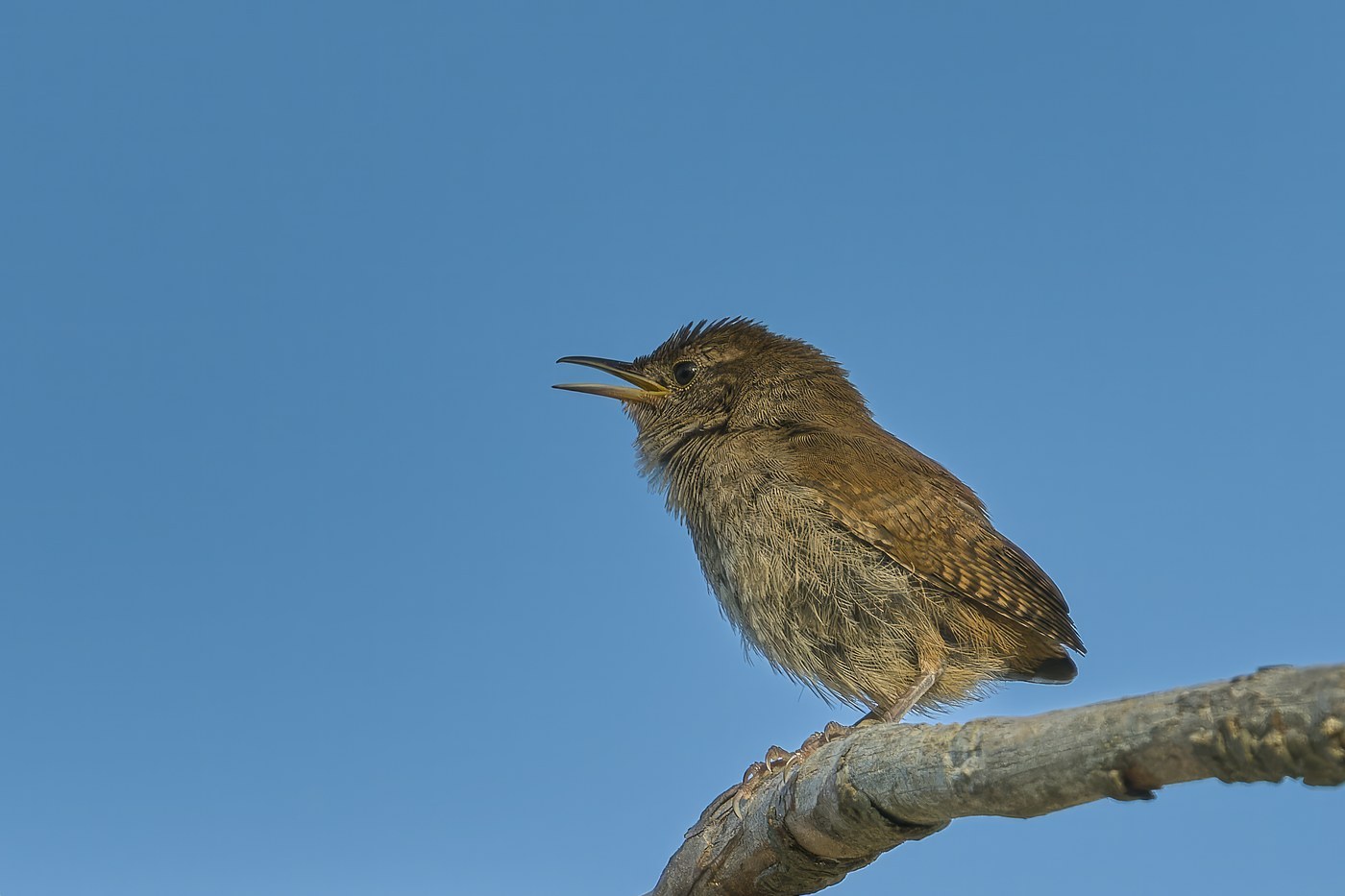
Overview
The House Wren (Troglodytes aedon) is a small, plain, highly vocal songbird common across backyards, gardens, and woodland edges throughout much of the Americas. Despite its unassuming looks, it is one of the most frequently heard birds in its range thanks to its loud, energetic song.
Key Field Marks
- Size & shape: Very small, compact songbird, about 4.3-5.1 inches (11-13 cm), with a short, often upward-cocked tail and a slim, slightly downcurved bill.
- Plumage: Overall plain warm brown to grayish-brown above, paler dingy brown-gray below, without any bold markings, wing bars, or strong facial pattern.
- Barring: Fine dark barring visible on the wings and especially the tail at close range — a useful confirming mark distinguishing it from unmarked brown birds.
- Face: Faint, indistinct pale eyebrow (much less bold than in other wren species) and a subtly streaked crown.
- Behavior/posture: Constantly cocks its tail up over its back, often flicking it, and moves in quick, jerky hops through low, dense vegetation.
Separating House Wren from Similar Species
Winter Wren / Pacific Wren
- Winter and Pacific Wrens are noticeably smaller, darker (richer reddish-brown), with a much shorter, stubbier tail, more contrasting barring on the belly and flanks, and a different, longer, more intricate tinkling song.
Bewick's Wren
- Bewick's Wren has a bold, long white eyebrow stripe, a longer tail with white outer tail corners, and grayer-brown overall tone, versus the House Wren's faint eyebrow and plainer tail.
Carolina Wren
- Larger, richer rusty-orange overall with a bold, long white eyebrow stripe and a much louder, whistled "tea-kettle" song, easily separated from the smaller, drabber House Wren.
Habitat and Range
House Wrens breed across most of the United States and southern Canada in a wide variety of shrubby, brushy habitats: gardens, parks, forest edges, thickets, and suburban yards, readily using nest boxes. They range south through Mexico, Central America, and much of South America (where some southern populations were once considered a separate species). Northern populations are migratory, wintering in the southern U.S. and Mexico.
Seasonal Occurrence
Summer breeding visitor across most of the northern and central parts of its range, typically present April/May through September/October; year-round in much of the southern U.S., Mexico, and points south.
Behavior
House Wrens are feisty and territorial, sometimes puncturing the eggs of competing cavity-nesting species near their nest sites. Males build multiple "dummy" nests of sticks in cavities or nest boxes, and the female chooses one to line and complete. They forage low in dense brush and tangles for insects and spiders, rarely staying still for long.
Voice
The song is a loud, bubbling, cascading series of chattering trills that rises and falls rapidly, often repeated persistently through the day. The call is a harsh, scolding "churr" or "chek-chek" rattle, frequently given when the bird is agitated near the nest.
Frequently asked questions
What is the most reliable way to identify a House Wren?
Look for a small, plain brown bird with an upward-cocked tail, faint eyebrow, fine barring on the wings and tail, and listen for its loud, bubbling, cascading song.
How is House Wren different from Winter Wren?
House Wren is larger with a proportionally longer tail and plainer overall coloring, while Winter/Pacific Wren is tinier, darker, stubbier-tailed, and more heavily barred below.
Do House Wrens use nest boxes?
Yes, they readily nest in bird houses as well as natural cavities, old woodpecker holes, and even odd cavities like mailboxes or flowerpots.
Why do House Wrens sometimes destroy other birds' eggs?
Males are highly territorial around cavity nest sites and will puncture eggs or damage nests of competing cavity nesters (including other House Wrens) to reduce competition for nesting spots.
House Wren identified by the community
Recent House Wren sightings identified with Bird Identifier.