
Horned Puffin Identification Guide
A North Pacific seabird recognized by its large triangular orange-and-yellow bill, white face, and the tiny fleshy black "horn" above each eye that gives it its name.
Read the full Horned Puffin encyclopedia entry →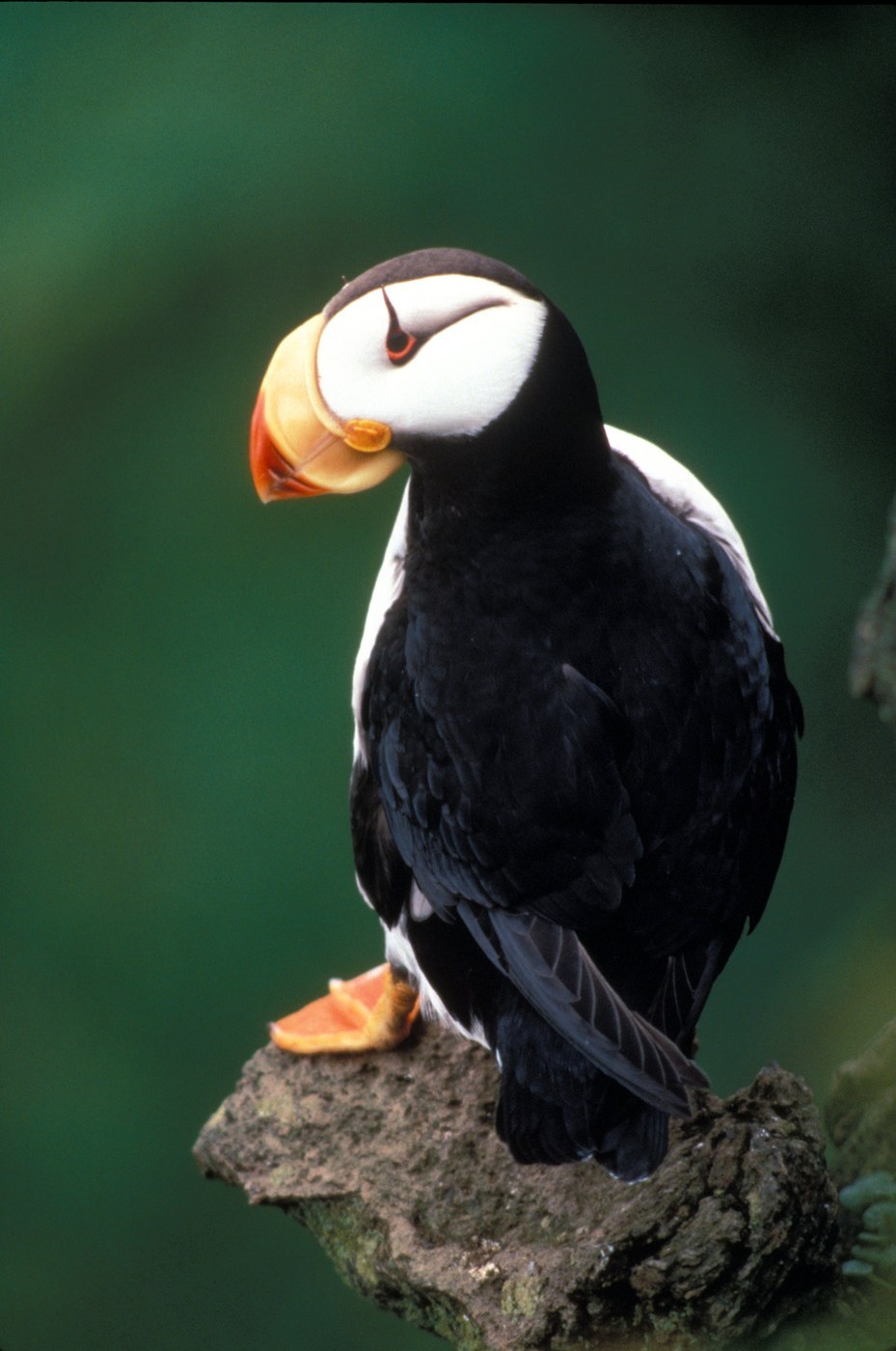
Overview
The Horned Puffin (Fratercula corniculata) is a stocky, colorful alcid of the North Pacific and Bering Sea, the western counterpart to the Atlantic Puffin. It nests on rocky sea cliffs and islands and spends the rest of the year far offshore.
Key Field Marks
- Size & shape: Chunky, short-necked, short-winged seabird about 14.5-15 inches (37-38 cm) long, with an upright "penguin-like" posture on land.
- Bill (breeding): Large, laterally flattened triangular bill, yellow at the base and bright orange toward the tip, with a small reddish-orange plate at the very tip; base of the bill is edged in pale yellow-green.
- Face: White face and underparts contrasting with an entirely black crown, nape, back, and upperparts — giving a sharply bicolored look.
- "Horn": A small fleshy black projection extending upward above each eye, visible at close range in breeding adults — the source of the species' name.
- Legs and feet: Bright orange-red legs and feet.
- Non-breeding/winter: Bill shrinks and dulls (loses the outer colorful plates), face becomes duskier/grayer, and the eye horn is shed.
Separating Horned Puffin from Similar Species
Tufted Puffin
- Tufted Puffin has an entirely dark (blackish) body including the face and underparts in breeding plumage, plus long pale yellow head plumes ("tufts") sweeping back from behind the eye — very different from the Horned Puffin's white face and underparts.
Atlantic Puffin
- Ranges do not normally overlap (Atlantic Puffin is an Atlantic species), but Atlantic Puffin has a grayer face, a bill with distinct blue-gray basal plates, and lacks the fleshy horn above the eye.
Rhinoceros Auklet
- Lacks the puffin's colorful triangular bill; instead has a dull brownish-gray body with a pale belly, dark bill with a pale horn-like knob at the base (in breeding plumage), and lacks the bold white face/black upperparts contrast.
Habitat and Range
Horned Puffins breed colonially on rocky cliffs, boulder crevices, and offshore sea stacks around the coasts of Alaska (including the Aleutians and Bering Sea islands), extending west to the Russian Far East coast. Outside the breeding season they winter far out at sea across the North Pacific, rarely seen from shore.
Seasonal Occurrence
Breeding adults are present at colonies roughly May through August/September. During the non-breeding season (fall through spring) they are pelagic, dispersing widely over open ocean waters and essentially unobservable except from boats far offshore.
Behavior
Horned Puffins are excellent divers, using their wings to "fly" underwater in pursuit of small fish such as sand lance and capelin, which they carry back to nestlings crosswise in the bill, sometimes several at once. They nest in rock crevices and burrows on steep cliffs and are highly colonial, often nesting alongside murres, kittiwakes, and other puffins.
Voice
Generally silent at sea. At breeding colonies, adults give a low, growling or groaning "arr" or "uh-uh-uh" call from burrows and crevices, mainly during social interactions near the nest site.
Frequently asked questions
What is the best way to tell Horned Puffin from Tufted Puffin?
Look at the face and underparts: Horned Puffin has a clean white face and belly against black upperparts, while Tufted Puffin is entirely dark-bodied with pale yellow head tufts.
Is the "horn" on a Horned Puffin a real horn?
No, it's a small fleshy black skin projection above each eye, present only in breeding adults and shed after the breeding season along with the colorful bill plates.
Where can you see Horned Puffins?
They breed on rocky cliffs and islands around Alaska and the Bering Sea; the best viewing is at accessible seabird colonies in coastal Alaska during summer.
Do Horned Puffins look different outside the breeding season?
Yes, in winter the bill becomes smaller and duller, the face turns grayer/duskier, and the eye horns are lost, making them less flashy than breeding-season birds.