
Horned Lark Identification Guide
A ground-loving open-country songbird identified by its black facial mask, black bib, and tiny dark feather "horns," usually seen walking in flocks across bare fields and shorelines.
Read the full Horned Lark encyclopedia entry →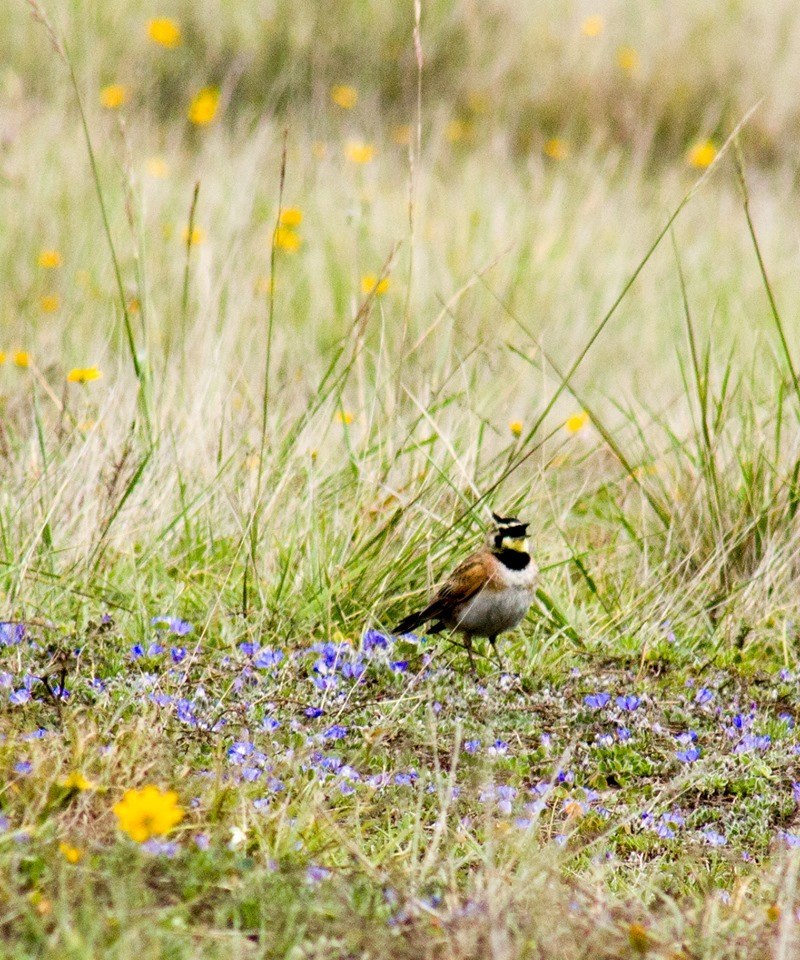
Overview
The Horned Lark (Eremophila alpestris) is a sparrow-sized songbird of open, sparsely vegetated country — plowed fields, prairies, beaches, airports, and alpine tundra. It is North America's only true lark and, along with pipits and longspurs, is a classic bird of bare-ground habitats.
Key Field Marks
- Size & shape: Small, slim, terrestrial songbird about 6.25-7.75 inches (16-20 cm) long, with a horizontal posture and a habit of walking (not hopping) on the ground.
- Face pattern: Bold black mask through the eye and a black stripe below a pale to yellow throat, contrasting with a pale yellowish or whitish face.
- "Horns": Tiny black feather tufts on the crown, often erected, though they can be hard to see at a distance or in flat light — most visible on close or displaying birds.
- Breast: Solid black crescent-shaped bib across the upper chest, a diagnostic mark distinguishing it from pipits and longspurs.
- Upperparts: Brownish to pinkish-gray or grayish back depending on subspecies/region, streaked, blending well with dirt and dry vegetation.
- Tail: Mostly black with white outer edges, visible in flight.
- Bill: Short, thin, conical, dark.
Separating Horned Lark from Similar Species
American Pipit
- Pipits lack the black facial mask and black chest bib; they have thin streaking on the breast instead and bob their tail constantly while walking.
Longspurs (Lapland, Chestnut-collared, McCown's, Smith's)
- Longspurs are chunkier with heavier conical bills and lack the Horned Lark's distinct black mask-and-bib combination; in flight, longspurs show more white in the tail and different wing patterns.
Sprague's Pipit
- Much plainer-faced, lacks black markings, and has a distinctive erratic, high circling flight display.
Habitat and Range
Horned Larks favor wide-open, low-vegetation or bare-ground habitats: agricultural fields, short-grass prairie, alkali flats, beaches, airports, and above treeline on mountains. They are found nearly continent-wide in North America and also occur across Eurasia. Many populations are year-round residents, while northern and high-altitude breeders move to lower elevations or farther south in winter, often joining large mixed flocks with Snow Buntings and longspurs.
Seasonal Occurrence
Present year-round across much of their range, but winter flocks in agricultural and open lowland areas swell with migrants from northern and mountain breeding populations, generally October through March. Breeding activity, including some of the earliest nesting of any North American songbird, can begin as early as late winter.
Behavior
Horned Larks forage on the ground for seeds and insects, walking steadily rather than hopping, often in flocks that flush together and fly in tight, undulating groups showing dark tails with white edges. Males perform a striking high aerial song-flight display, climbing steeply and then descending in a fluttering dive while singing.
Voice
The song is a thin, tinkling, irregular series of high notes, often delivered during the male's sky-high display flight. The flight call is a distinctive high, thin "tsee-titi" or "tsi-tsi" often given by flushed or passing flocks.
Frequently asked questions
Can you actually see the "horns" on a Horned Lark?
The tiny black feather tufts are often flattened and hard to see, especially at a distance or on females; they're most visible on close, alert males, particularly during display.
What is the best field mark to separate Horned Lark from pipits and longspurs?
The combination of a black facial mask and a solid black breast band/bib is unique to the Horned Lark among these open-country ground birds.
Where is the best place to find Horned Larks?
Look on bare agricultural fields, short-grass prairies, beaches, and airport grasslands, where they walk on open ground often in loose flocks.
Do Horned Larks migrate?
Northern and high-elevation breeding populations move south or downslope in winter, while many populations in temperate latitudes are year-round residents.