
Horned Grebe Identification Guide
A small, red-eyed diving waterbird best told from its similar cousin the Eared Grebe by its straighter bill, flatter head profile, and cleaner black-and-white breeding pattern.
Read the full Horned Grebe encyclopedia entry →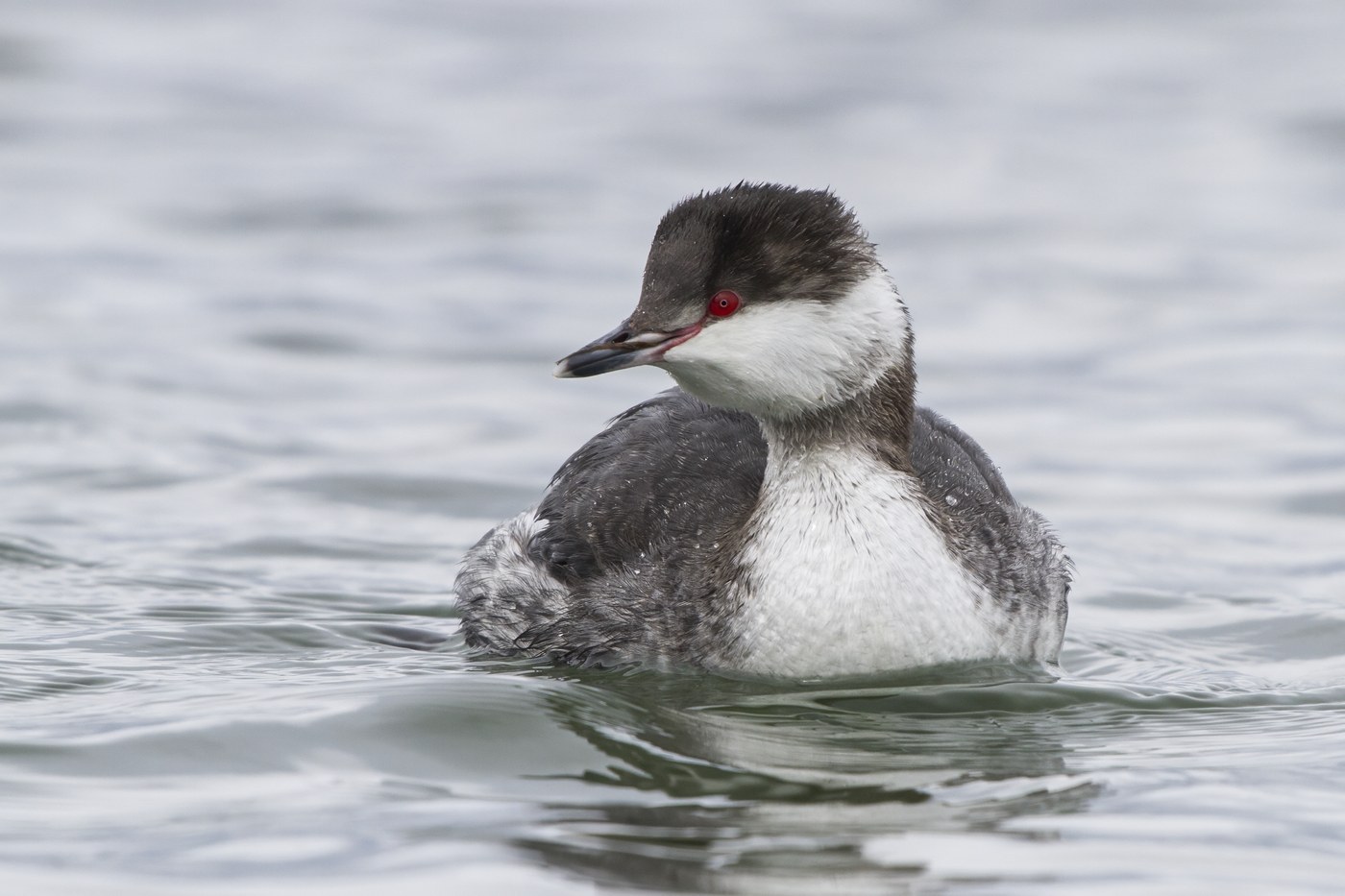
Overview
The Horned Grebe (Podiceps auritus) is a compact, buoyant diving bird found on lakes, ponds, and coastal bays across North America and Eurasia. It is one of the most frequently confused species with the Eared Grebe, especially in winter plumage, but a handful of structural clues make separation reliable with practice.
Key Field Marks
- Size & shape: Small grebe, roughly 12-15 inches (31-38 cm) long, with a fairly flat crown and a straight, relatively thick, blunt-tipped bill held horizontally.
- Breeding plumage: Striking black head with wide golden-buff tufts ("horns") sweeping back from in front of the eye to behind it; chestnut-red neck and flanks; blackish back.
- Non-breeding (winter) plumage: Crisp, clean-cut division between black cap/nape and white cheeks and foreneck — the white on the face extends up and around the eye and onto the ear region. Gray back, white underparts.
- Eye: Bright red iris year-round, though duller and harder to see in winter light.
- Bill: Straight, stout, pale-tipped, held level — not upturned or thin.
- Legs and feet: Lobed toes (not webbed) typical of grebes; legs set far back on the body, giving an awkward gait on land.
Separating Horned Grebe from Similar Species
Eared Grebe
- Eared Grebe has a peaked crown (highest point toward the rear of the head) versus the Horned Grebe's flatter, more evenly rounded crown.
- Eared Grebe's bill is thinner and often looks slightly upturned; Horned Grebe's bill is straighter and thicker.
- In winter, Eared Grebe shows a diffuse, smudgy gray wash on the cheek and neck rather than the Horned Grebe's sharply demarcated white cheek.
- Eared Grebe typically rides higher at the rear with the tail cocked up; Horned Grebe sits flatter and more level on the water.
Pied-billed Grebe
- Pied-billed Grebe is chunkier with a thick chicken-like bill (with a black ring in breeding season) and lacks any red eye or bold black-and-white head pattern.
Red-necked Grebe
- Larger and bulkier, with a long yellow-based dagger bill, lacking the compact rounded look of the Horned Grebe.
Habitat and Range
Horned Grebes breed on shallow, vegetated freshwater ponds and marshes across the northern Prairie provinces, Alaska, and boreal Canada, as well as parts of northern Eurasia. In winter they move to sheltered coastal bays, estuaries, and larger ice-free lakes across much of the U.S. coastline and interior south, often in loose flocks alongside other grebes and diving ducks.
Seasonal Occurrence
- Spring/Summer (breeding season): Look for adults in full rufous-and-black plumage on prairie potholes and northern lakes, typically April through August.
- Fall/Winter: Birds molt into the gray-and-white winter plumage and disperse to coastal waters and large open lakes, present roughly October through March.
Behavior
Horned Grebes dive frequently and can stay submerged for extended periods hunting small fish, aquatic insects, and crustaceans. They are often solitary or in small loose groups, less densely packed than wintering Eared Grebe flocks. Like other grebes, they rarely come ashore and struggle to walk on land due to rear-set legs.
Voice
On the breeding grounds, Horned Grebes give an eerie, rising trilled shriek and a series of chattering and croaking notes during courtship displays. They are largely silent in winter, so plumage and structure are the primary identification tools outside the breeding season.
Frequently asked questions
What is the easiest way to tell a Horned Grebe from an Eared Grebe in winter?
Look at the head shape and cheek pattern: Horned Grebe has a flatter crown and a sharply defined white cheek/neck against the black cap, while Eared Grebe has a peaked rear crown and a smudgy gray-white cheek that blends into the neck.
Does the Horned Grebe have red eyes year-round?
Yes, adults retain a bright red iris in both breeding and winter plumage, though it can look duller and less obvious in low winter light.
Where can I see Horned Grebes in winter?
They winter along sheltered coastal bays and estuaries on both the Atlantic and Pacific coasts of North America, as well as on large ice-free lakes and reservoirs inland.
Do Horned Grebes nest in colonies?
They typically nest as scattered single pairs or in loose, small colonies on shallow vegetated ponds, building floating nests anchored to emergent plants.