
Hooded Oriole Identification Guide
A slender, palm-loving oriole of the American Southwest and Mexico, the male Hooded Oriole shows a bright orange-yellow hood and body set off by a black face, throat, and back.
Read the full Hooded Oriole encyclopedia entry →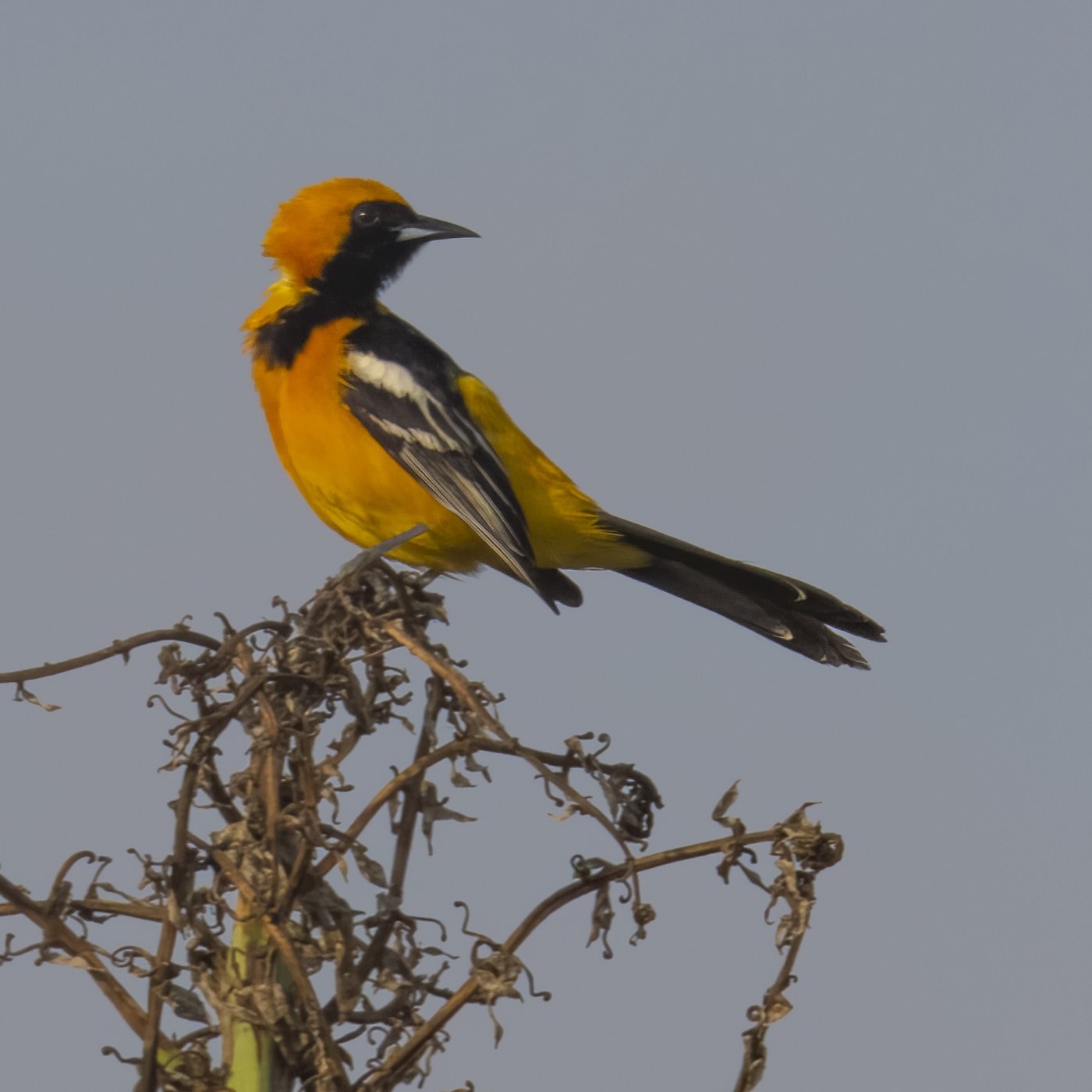
Key Field Marks
- Size & shape: A slim, slender-bodied oriole, about 18–20 cm (7–8 in) long, with a notably long tail and a fine, distinctly decurved (downward-curving) bill — more slender-billed than most other orioles.
- Male plumage: Bright orange to orange-yellow head, nape, and underparts (color varies geographically from deep orange to yellow-orange) contrasting with a black face, throat, back, wings, and tail; white wing bars are visible on the black wings.
- Female/immature plumage: Olive-yellow above and paler yellow below, lacking the black hood, with two white wing bars; immature males may show a black throat patch before acquiring full adult plumage.
- Behavior: Agile and acrobatic, often seen hanging upside down while foraging or probing into palm fronds and flowers; frequently associated with palm trees, from which it also hangs its woven nest.
Separating It From Similar Species
- Bullock's Oriole: Male Bullock's shows a black eyeline and cap rather than a full orange hood, with more extensive white in the wing and a different face pattern; female Bullock's is grayer overall compared to the more uniformly yellow-olive female Hooded Oriole.
- Altamira Oriole: Larger and bulkier with a thicker bill and different wing pattern; ranges overlap only marginally in southern Texas.
- Baltimore/Orchard Oriole: Baltimore Oriole (mostly eastern) has a solid black hood extending onto the back differently and a stouter bill; Orchard Oriole is smaller and darker chestnut rather than orange. The Hooded Oriole's notably thin, curved bill is a useful mark separating it from all of these.
Where & When to See One
Hooded Orioles breed across the southwestern United States (California, Arizona, New Mexico, Texas) south through Mexico, favoring open woodland, desert washes, riparian corridors, and especially areas with palm trees, which have allowed the species to expand its range northward alongside ornamental palm plantings in urban and suburban areas. Most U.S. populations are migratory, arriving in spring and departing for Mexico in fall, though some coastal California populations have become increasingly year-round residents.
Voice
A chattering, harsh "chek" or rattling call note, along with a varied, somewhat scratchy warbling song that includes whistled and chattering phrases, often delivered from a high perch.
Frequently asked questions
What is the best way to tell a male Hooded Oriole from a Bullock's Oriole?
Hooded Oriole has a full orange hood covering the head with a black face and throat, while Bullock's Oriole shows a black eyeline and crown with an orange face, plus Hooded Oriole has a noticeably thinner, more curved bill.
Why are Hooded Orioles associated with palm trees?
They favor palm fronds both for foraging and for weaving their hanging nests, and the spread of ornamental palms has helped the species expand its breeding range in the southwestern U.S.
Are Hooded Orioles migratory?
Most populations migrate between the southwestern U.S./Mexico breeding range and wintering areas farther south in Mexico, though some coastal California birds now remain year-round.
What does a female Hooded Oriole look like?
Females are olive-yellow above and paler yellow below with two white wing bars, lacking the male's black hood and face pattern.