
Hooded Crane Identification Guide
A rare East Asian crane with a dark slate-gray body and a strikingly white head and neck, the Hooded Crane is best known from its wintering flocks in Japan and Korea.
Read the full Hooded Crane encyclopedia entry →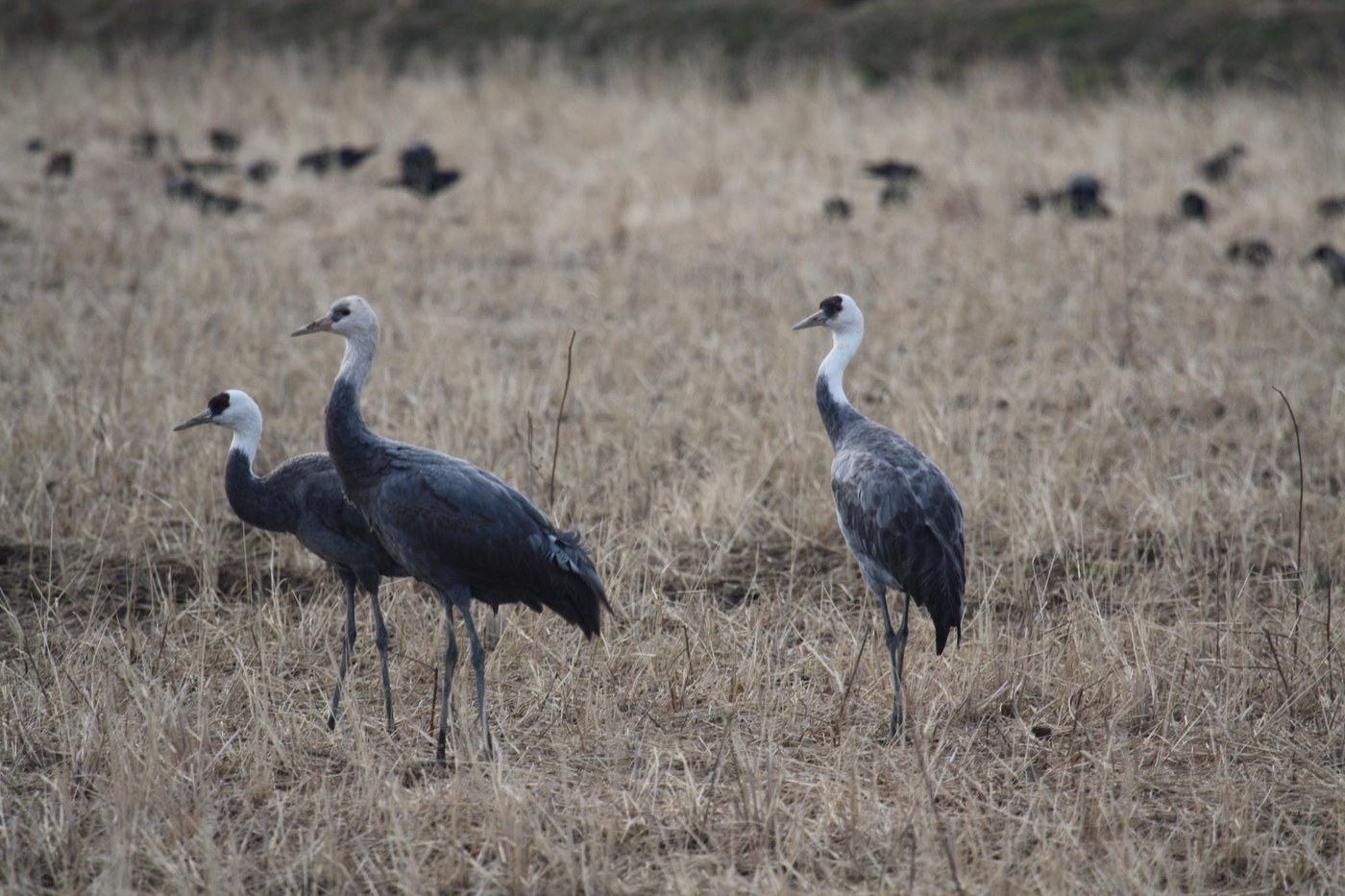
Key Field Marks
- Size & shape: A medium-sized crane by crane standards, roughly 96–100 cm (38–39 in) tall, with the typical long-legged, long-necked crane silhouette but noticeably smaller and more compact than most other crane species.
- Body: Overall dark slate-gray to blackish plumage covering the body, neck base, and wings.
- Head and neck: Clean white head and upper neck, sharply demarcated from the dark body — the source of the species' name, as if wearing a white hood.
- Face: Bare red skin on the crown/forehead, contrasting with the white feathering around it and the black skin around the eye and bill base.
- In flight: Uniformly dark wings and body with the contrasting white head/neck visible at a distance, and the characteristic straight-necked, trailing-legs crane flight profile.
Separating It From Similar Species
- Demoiselle Crane: Overall gray rather than dark slate, with black on the face and neck rather than a clean white head, and long white plume feathers behind the eye; ranges also differ substantially.
- Common Crane: Larger, with a gray body, black-and-white head/neck pattern, and a red crown patch, but the head pattern is more black-and-white striped rather than a solid white hood.
- Other dark cranes (e.g., Black-necked Crane): Show a black neck rather than a white head/neck combined with dark body, so overall head-body contrast pattern quickly separates Hooded Crane from confusion species.
Where & When to See One
Hooded Cranes breed in remote bog and wetland habitat in southeastern Russia and adjacent parts of China, a poorly known and inaccessible breeding range. The species is best known from its wintering grounds, where the vast majority of the world population congregates each winter at a handful of key sites, most famously around Izumi in Kyushu, Japan, as well as scattered wetlands in South Korea and along the middle Yangtze River in China. It is classified as globally Vulnerable due to its small population and concentration at very few wintering sites, making conservation of these wetlands critical.
Voice
Loud, far-carrying trumpeting and bugling calls typical of cranes, given both in flight and from the ground, especially during social interactions and unison calling between paired birds at wintering roosts.
Frequently asked questions
What is the easiest way to identify a Hooded Crane?
Look for a crane with an overall dark slate-gray body sharply contrasting with a clean white head and neck, plus a patch of bare red skin on the crown.
Where is the best place to see Hooded Cranes?
The majority of the world population winters at just a few East Asian wetlands, most famously around Izumi, Japan, as well as sites in South Korea and along China's middle Yangtze River.
How does a Hooded Crane differ from a Common Crane?
Common Crane has a more black-and-white striped head pattern and a grayer body, while Hooded Crane shows a solidly dark body with a clean white hood covering the head and upper neck.
Is the Hooded Crane endangered?
It is classified as globally Vulnerable, with a small total population concentrated at very few wintering wetlands, making it highly sensitive to habitat loss at those sites.