
Hill Myna Identification Guide
A glossy black forest starling of South and Southeast Asia, the Hill Myna stands out with bright yellow facial wattles, an orange bill, and a bold white wing patch flashed in flight.
Read the full Hill Myna encyclopedia entry →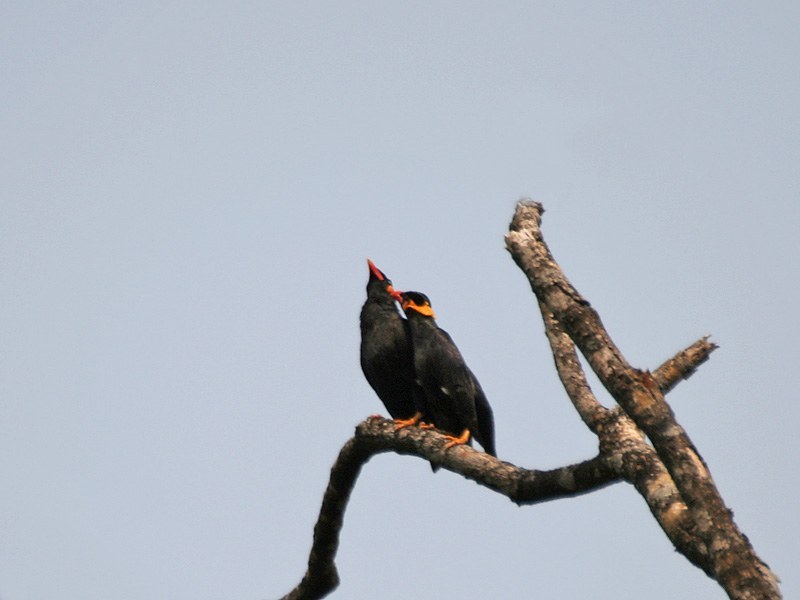
Key Field Marks
- Size & shape: A stocky, medium-sized starling relative, about 25–29 cm (10–11.5 in) long, with a short tail and strong, direct flight.
- Plumage: Overall glossy black with an iridescent purple-green-blue sheen visible in good light. A prominent white patch on the primaries flashes conspicuously in flight but is hidden at rest.
- Bare parts: The standout features are the bright yellow fleshy wattles and bare skin patches on the sides of the head and nape, contrasting sharply with the black plumage. The bill is stout and orange-yellow, and the legs are bright yellow.
- Behavior: Typically seen in pairs or small noisy flocks moving through the forest canopy, often perching high in fruiting trees.
Separating It From Similar Species
- Common Myna: Much smaller, brown-bodied with a black head, yellow bare skin only around the eye, and lacks the Hill Myna's glossy black body and prominent head wattles.
- Other myna and starling species: No other Asian starling shares the combination of all-glossy-black body plus large yellow head wattles; the wattle pattern alone is diagnostic.
- Regional races vary somewhat in the size and shape of the wattles, but the overall structure and coloration remain consistent.
Where & When to See One
Hill Mynas inhabit evergreen and semi-evergreen forests, forest edges, and hill country across South and Southeast Asia, from the Indian subcontinent through Indochina, the Malay Peninsula, and Indonesia. They favor tall trees in humid forest, often at mid to higher elevations in hilly terrain, and are non-migratory residents. Look and listen for them in the canopy of forest reserves and well-wooded hill stations, where they are most active in early morning and late afternoon.
Voice
Extremely vocal, with a loud repertoire of whistles, shrieks, gurgles, and clicks. Wild birds give far-carrying, liquid whistled phrases used for territory and contact, and the species is renowned as one of the most accomplished vocal mimics among birds, capable of reproducing an enormous range of sounds.
Frequently asked questions
What is the easiest way to identify a Hill Myna in the field?
Look for an all-glossy-black bird with bright yellow fleshy wattles on the head and nape, an orange bill, yellow legs, and a white wing patch that flashes in flight.
How is the Hill Myna different from the Common Myna?
The Common Myna is smaller and brown-bodied with only a small patch of bare yellow skin around the eye, while the Hill Myna is entirely glossy black with large, obvious yellow head wattles.
What habitat should I search for Hill Mynas?
Search the canopy of humid evergreen forest and forest edge, particularly in hilly or upland terrain across South and Southeast Asia.
Are Hill Mynas migratory?
No, they are generally non-migratory residents, though some populations may make local altitudinal movements in response to fruit availability.