
Herring Gull Identification Guide
A large, pale gray-backed gull with pink legs and a yellow bill marked by a red spot, the Herring Gull is the default "big gull" across much of North America and Eurasia's coasts, lakes, and landfills.
Read the full Herring Gull encyclopedia entry →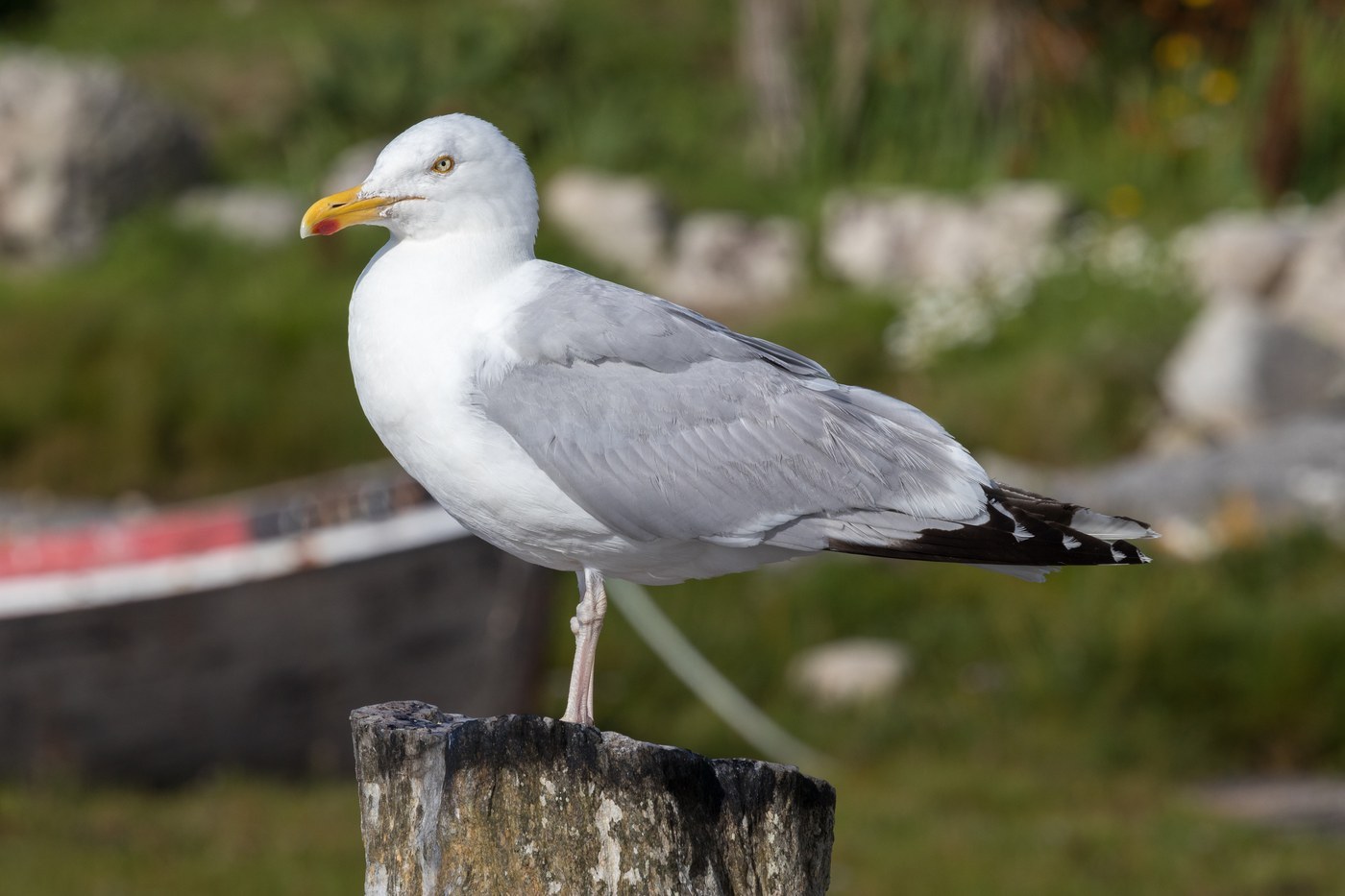
Key Field Marks
- Size & shape: A large, bulky gull, roughly 55–66 cm (22–26 in) long with a wingspan near 1.3–1.5 m. Thick neck, deep chest, and a heavy, slightly drooping bill give it a powerful look compared to smaller gulls.
- Adult plumage: Pale gray ("gull-gray") back and upperwings, white head, neck, and underparts, with black wingtips showing small white spots ("mirrors"). Legs are bubblegum pink. The stout yellow bill has a bold red spot near the tip of the lower mandible, used by chicks to trigger feeding.
- Eye: Pale yellow iris with a thin yellow or orange eye-ring, giving adults a somewhat fierce, staring expression.
- Immatures: Herring Gulls take about four years to reach adult plumage. First-winter birds are mottled brown overall with a dark bill and dark eye; each successive winter shows more gray on the back and more pale in the underparts until the classic adult pattern appears.
- In flight: Broad, powerful wings with black tips; look for the white mirrors near the wingtip on adults, useful even at distance.
Separating It From Similar Gulls
- Ring-billed Gull: Noticeably smaller and slimmer, with yellow (not pink) legs and a black ring encircling the bill rather than a red spot.
- Lesser Black-backed Gull: Similar structure but with a distinctly darker, slate-gray to blackish mantle and yellow (not pink) legs.
- California Gull: Slightly smaller, with greenish-yellow legs, a darker eye, and a bill showing both a red and a black spot.
- Thayer's/Iceland Gull: Paler wingtips (gray or pale gray rather than solid black) and a more delicate, rounded head shape.
- Great Black-backed Gull: Much larger and bulkier with a blackish mantle, easily separated when seen together with Herring Gull.
- Hybridization with Glaucous-winged Gull and others occurs in some regions, producing confusing intermediate birds — focus on the combination of mantle shade, leg color, and bill pattern rather than any single trait.
Where & When to See One
Herring Gulls are widespread and common across the Northern Hemisphere. In North America they breed around the Great Lakes, along the Atlantic and Pacific coasts, and across much of Canada and Alaska, wintering south to the Gulf Coast and Mexico. In Eurasia they breed from Iceland and the British Isles east through Scandinavia and Russia. Look for them on beaches, harbors, lakes, rivers, plowed fields, and especially landfills and fishing docks, where they gather in large numbers year-round. They are highly adaptable generalists and often the most numerous large gull at any given site.
Voice
The classic "seagull" sound: a loud, deep "kyow" or "keeow," a rhythmic laughing or bugling call (the long call) given with the head thrown back, and short barking "ha-ha-ha" notes used in alarm or aggression.
Frequently asked questions
How can I tell an adult Herring Gull from a Ring-billed Gull?
Check leg color and size: Herring Gulls are larger with pink legs, while Ring-billed Gulls are smaller with yellow legs and a black ring around the bill instead of a red spot.
Why do young Herring Gulls look so different from adults?
Herring Gulls take about four years to mature. Juveniles are mottled brown and gradually molt into gray-backed adult plumage over several winters, passing through intermediate brown-and-gray stages.
What is the red spot on a Herring Gull's bill for?
It's a target that stimulates chicks to peck at the bill, prompting the adult to regurgitate food — a well-studied example of an instinctive feeding cue in animal behavior.
Where do Herring Gulls nest?
They nest colonially on the ground, cliffs, or rooftops, typically on islands, coastal cliffs, or near large lakes, laying two to three olive-brown speckled eggs in a scraped nest.