
Hermit Warbler Identification Guide
A crisp, clean Pacific Northwest warbler of tall conifer canopies, with a bright unmarked yellow head, black throat (males), and gray back.
Read the full Hermit Warbler encyclopedia entry →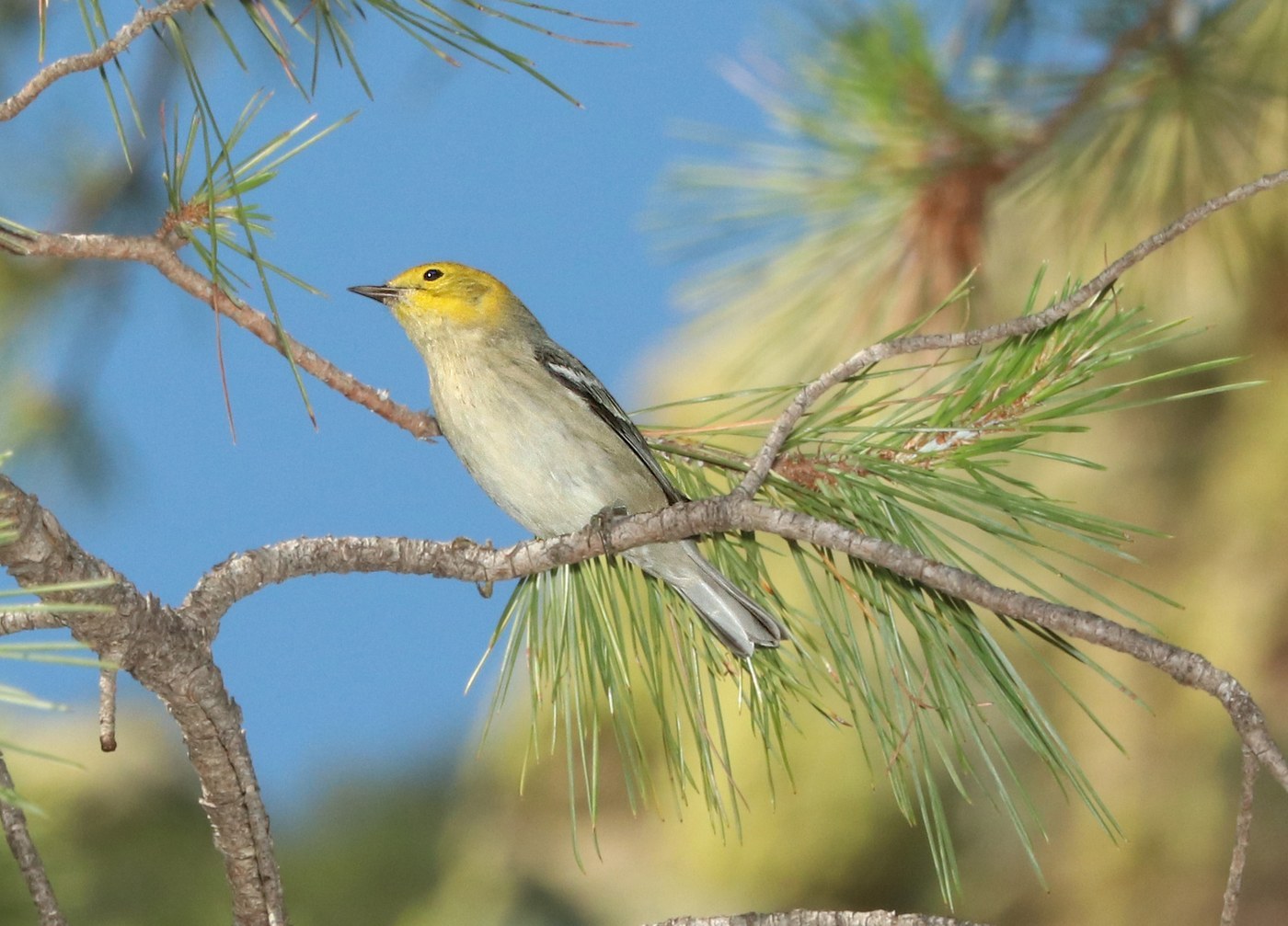
Key Field Marks
- Size & shape: A small, slim warbler with a fine, pointed bill, typical of the Setophaga (formerly Dendroica) group, often foraging actively high in conifer canopy.
- Male plumage: Bright, clean yellow face and crown with no facial markings, solid black throat and upper breast, gray back and nape (unstreaked or only faintly streaked), white underparts, and two white wing bars.
- Female/immature plumage: Similar pattern but duller — yellow face, little or no black on the throat (often just dusky mottling), gray-olive back — still shows the clean, unmarked yellow face as the key mark.
- Behavior: Forages high in the canopy of tall conifers, often hard to see well; frequently hybridizes with Townsend's Warbler where ranges meet in Washington and Oregon, producing intermediate-looking birds.
Similar Species
- Townsend's Warbler: Has dark cheek patch/auriculars and olive streaking on the yellow breast/sides, plus olive (not clean gray) back — Hermit Warbler lacks the dark cheek patch and has a plain yellow face.
- Black-throated Green Warbler: Yellow face with a dusky olive eyeline/auricular smudge and olive-green (not gray) back, plus yellow wash on the flanks with streaking — Hermit is grayer-backed and cleaner-faced.
- Hybrids with Townsend's Warbler show intermediate face patterns (partial cheek patch, some olive on back) and should be noted as probable intergrades rather than forced into one species.
Range, Habitat & Season
Breeds in tall, mature coniferous forest (especially Douglas-fir and other tall conifers) of the Pacific Northwest — western Washington and Oregon south through the mountains of California. Migrates through the interior West and winters primarily in the highlands of Mexico and Central America, in pine-oak forest. A canopy specialist, it can be difficult to observe well on the breeding grounds despite being locally common by voice.
Voice
A buzzy, ascending song similar to other Setophaga warblers, typically rendered as "seedle-seedle-seedle-tzee" or a series of high buzzy notes ending in an emphatic upslurred note; call is a sharp, high "tsip.
Frequently asked questions
How do I separate Hermit Warbler from Townsend's Warbler?
Hermit Warbler has a clean, unmarked yellow face and gray back, while Townsend's Warbler shows a dark cheek patch and olive streaking on the back and flanks.
Do Hermit and Townsend's Warblers hybridize?
Yes, they hybridize regularly in a contact zone in Washington and Oregon, producing birds with intermediate facial and back patterns that can be difficult to assign to either species.
What habitat should I search for breeding Hermit Warblers?
Tall, mature coniferous forest, especially stands of Douglas-fir, in the Pacific Northwest and California mountains, usually foraging high in the canopy.
Where do Hermit Warblers spend the winter?
Mainly in pine-oak forest in the highlands of Mexico and Central America.