
Hermit Thrush Identification Guide
A quiet, spot-breasted North American thrush recognized by its habit of slowly raising and lowering its reddish tail, and famed for its flute-like, ethereal song.
Read the full Hermit Thrush encyclopedia entry →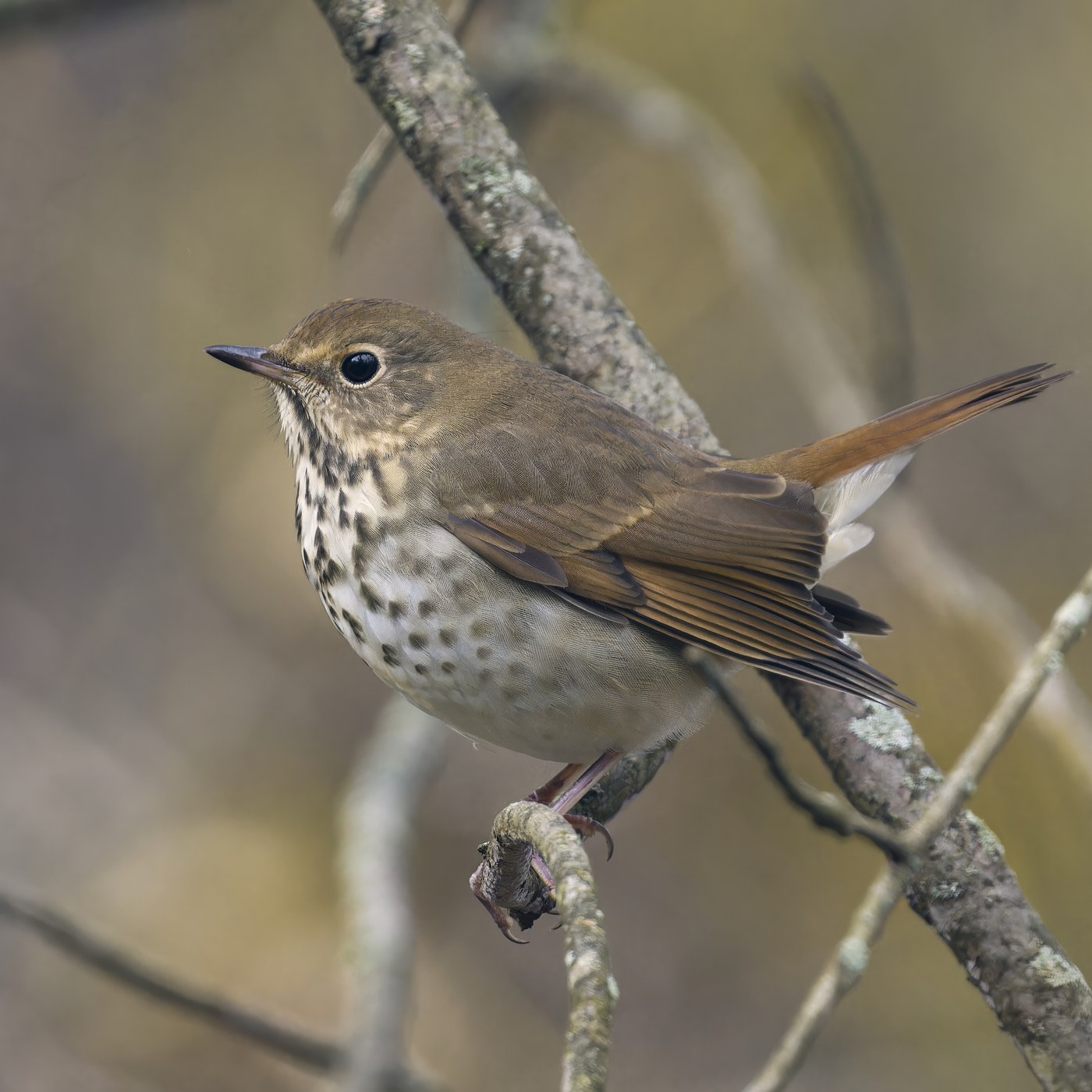
Key Field Marks
- Size & shape: A small, plump, compact thrush with a fairly short bill and a moderate tail, similar in build to other Catharus thrushes.
- Plumage: Warm brown upperparts with a contrastingly reddish-rufous tail and rump; underparts whitish with bold dark spotting concentrated on the upper breast, fading to less distinct markings on the flanks; whitish eye-ring.
- Behavior: A distinctive habit of slowly raising its tail and then dropping it, often while giving a soft call — a good behavioral clue not shown by most similar thrushes; forages on the ground in leaf litter, flicking leaves aside, and often flicks its wings nervously.
Similar Species
- Swainson's Thrush: More uniformly olive-brown above (no contrasting rufous tail), buffy eye-ring and lores, and lacks the tail-raising habit.
- Veery: More uniformly warm cinnamon-brown above with faint, indistinct breast spotting, no contrasting rufous tail against duller back.
- Wood Thrush: Larger, brighter rufous on the head/upper back grading to olive-brown on the rump/tail (opposite contrast direction), with bolder, larger dark spots covering the whole underside.
- The key trick: Hermit Thrush is the only common Catharus thrush with a tail distinctly more rufous than the back, combined with the tail-pumping habit.
Range, Habitat & Season
Breeds across boreal and montane coniferous and mixed forest of Canada, the northeastern and western U.S. mountains. The most cold-hardy of the brown thrushes, it winters further north than other Catharus species — commonly in the southern and southeastern U.S., Mexico, and along parts of the Pacific Coast — often in woodland understory, thickets, and shrubby edges, sometimes lingering into winter well north of other thrush species.
Voice
One of the most celebrated songs in North American birdsong: a series of clear, flute-like phrases, each introduced by a long, pure whistled note followed by an ethereal, spiraling series of notes at a different pitch, with phrases repeated at varying pitches — often described as haunting or reverent, frequently sung at dawn and dusk in forest settings. Calls include a low "chuck" and a soft, nasal "peeew.
Frequently asked questions
What is the easiest field mark to separate Hermit Thrush from other brown thrushes?
Its tail is distinctly more reddish-rufous than its back, and it habitually raises the tail slowly and lowers it — neither trait shown reliably by Swainson's Thrush or Veery.
Why is the Hermit Thrush's song so well known?
It sings a series of clear, flute-like, ethereal phrases that shift pitch between phrases, widely regarded as one of the most beautiful bird songs in North America.
When and where can I find Hermit Thrush in winter?
It is the hardiest Catharus thrush, wintering as far north as the southern and southeastern United States, in shrubby woodland understory and edges, while other similar thrushes winter farther south in the tropics.
What habitat does Hermit Thrush breed in?
Coniferous and mixed boreal or montane forest across Canada and higher-elevation areas of the western and northeastern United States.