
Henslow's Sparrow Identification Guide
A secretive, large-headed grassland sparrow best known for its remarkably weak, insect-like two-note song, 'tsi-lick.'
Read the full Henslow's Sparrow encyclopedia entry →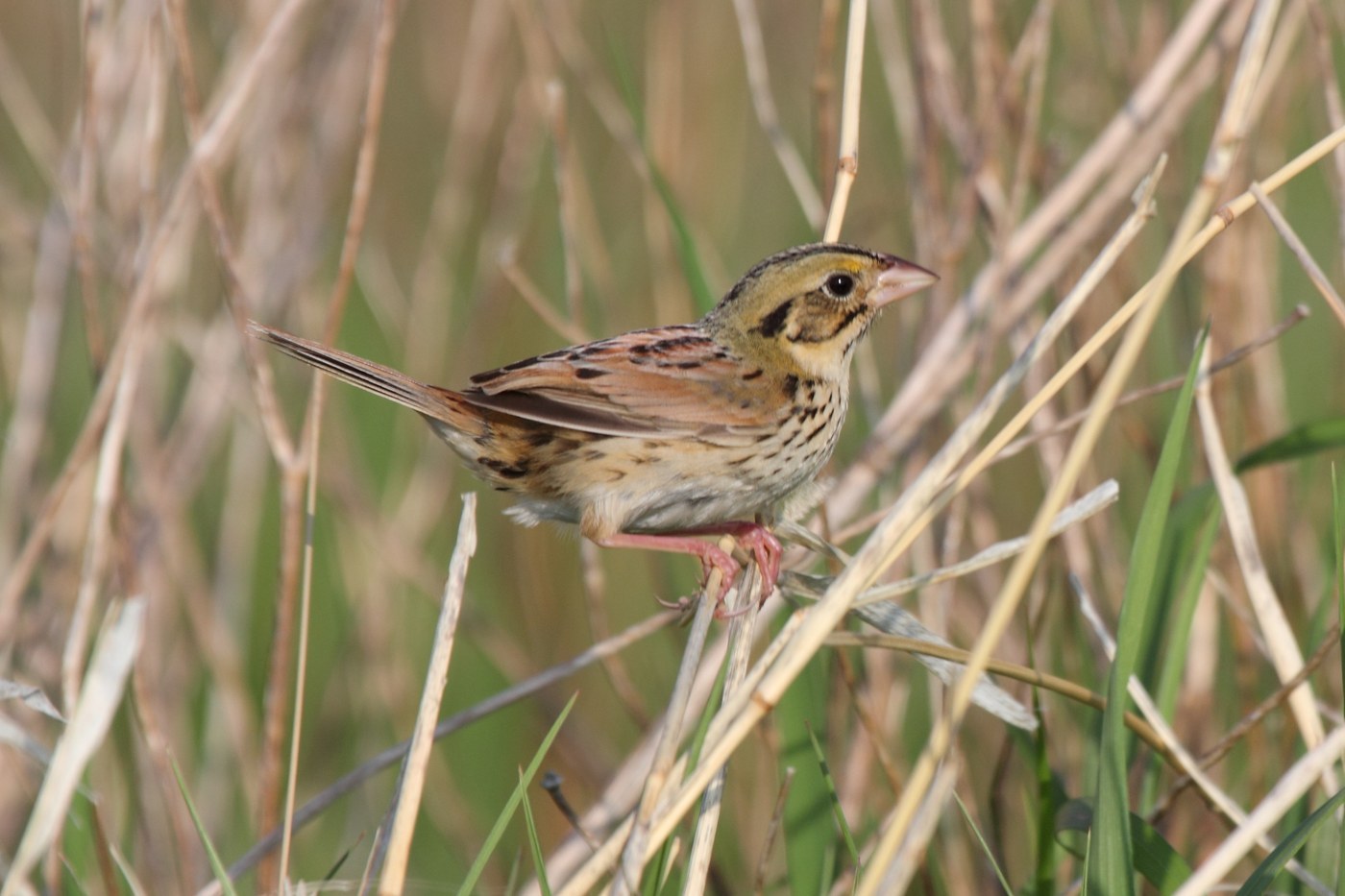
Key Field Marks
- Size & shape: A small, flat-headed, short-tailed sparrow with a notably large bill and a somewhat big-headed, short-necked look that gives it a distinctive silhouette even at a glance.
- Plumage: Olive to greenish tinge on the head and nape contrasts with a warm rusty-brown, streaked back; breast is buffy with fine dark streaking; overall a subtly colored, well-camouflaged bird.
- Bill: Disproportionately large, pale, conical bill relative to its small size.
- Behavior: Extremely secretive, usually staying hidden low in dense grass and rarely flushing; when flushed, flies weakly on whirring wings for a short distance before dropping back into cover. Best detected by its song, given from a low grass stem, rather than by sight.
Similar Species
- Grasshopper Sparrow: Also flat-headed and grassland-dwelling, but plainer buffy-orange face, unstreaked buffy breast, and a different, more buzzy insect-like song; lacks Henslow's greenish head tone.
- LeConte's Sparrow: Brighter orange-buff face and breast with fine dark streaking on the sides, more contrasting head stripes; found in similar wet grassland habitat but more richly colored overall.
- Savannah Sparrow: Has yellowish supercilium and pink legs, more heavily streaked underparts overall, less olive on the head.
Range, Habitat & Season
Breeds locally and patchily in tallgrass and old-field grasslands of the eastern and midwestern United States, favoring dense, weedy, relatively tall and often slightly damp grassland with standing dead vegetation (an increasingly scarce and fragmented habitat, contributing to population declines). Winters in similarly dense grassy and weedy fields across the southeastern U.S. Gulf Coast states. Migratory, moving between breeding grounds and southeastern wintering areas.
Voice
An extremely brief, weak, hiccupping two-syllable song, "tsi-lick" or "flee-sick," often described as one of the least impressive songs of any North American bird — easy to overlook amid other grassland insect and bird sounds, but diagnostic once learned.
Frequently asked questions
What does a Henslow's Sparrow sound like?
Its song is an extremely short, weak, hiccup-like two-note 'tsi-lick,' often mistaken for an insect rather than a bird song, and it's usually the best way to detect the species.
Why is Henslow's Sparrow so hard to see?
It stays low and hidden in dense grass, rarely perches in the open, and only flushes briefly when nearly stepped on, quickly dropping back into cover.
What habitat does Henslow's Sparrow need?
Dense, relatively tall, weedy grassland with a thick litter layer and standing dead vegetation from the previous year — a specific and increasingly rare habitat type.
How do I distinguish Henslow's Sparrow from a Grasshopper Sparrow?
Henslow's shows an olive-green tinge to the head and a heavier bill, while Grasshopper Sparrow has a plainer buffy-orange face and an unstreaked buffy breast.