
Hen Harrier Identification Guide
A slim, long-winged, low-flying raptor of open country, with strongly dimorphic plumage — gray males and brown streaky females — and a bold white rump.
Read the full Hen Harrier encyclopedia entry →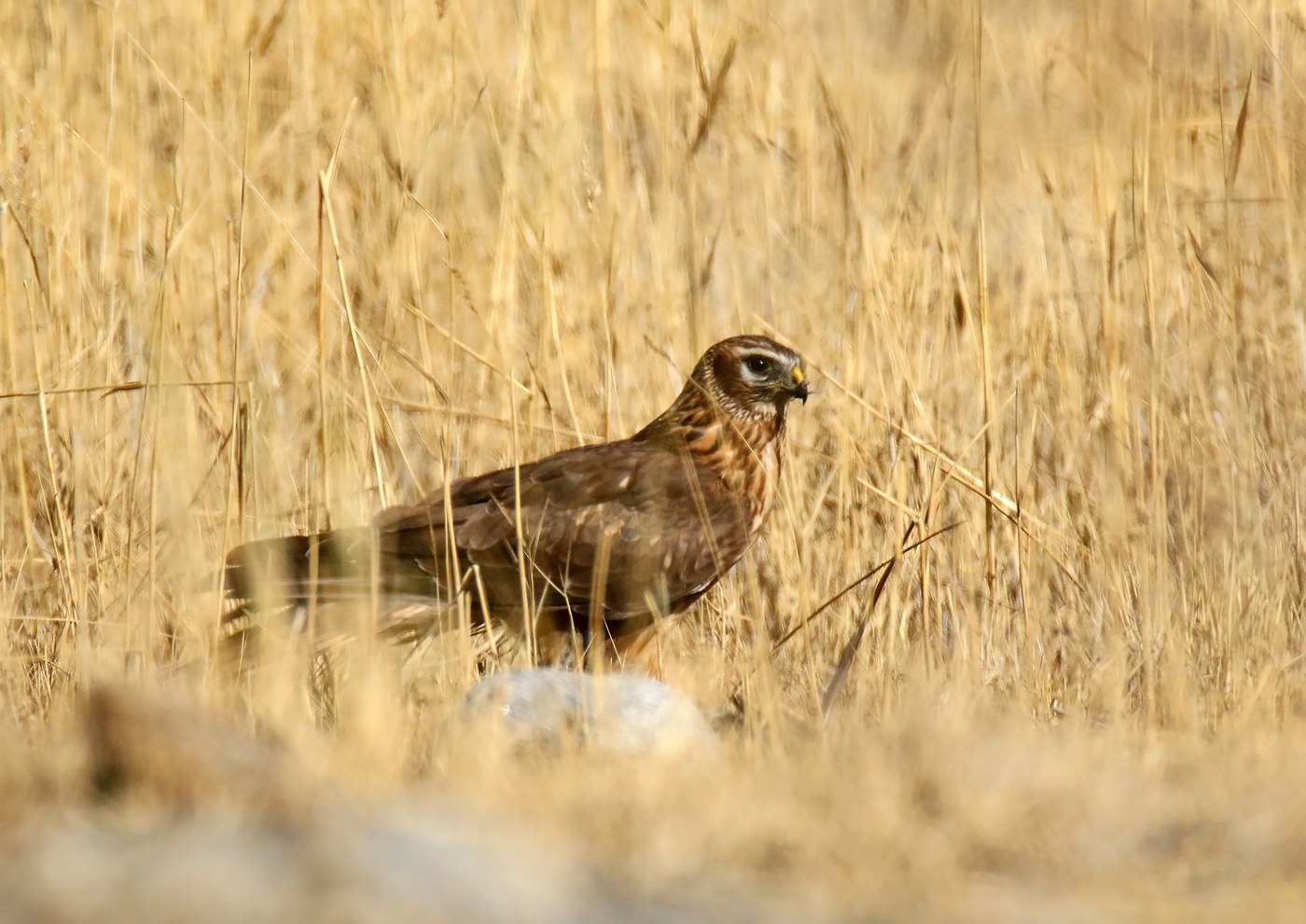
Key Field Marks
- Size & shape: A slender, long-winged, long-tailed raptor that flies with wings held in a shallow V (dihedral) low over open ground; the owl-like facial disc aids hearing while hunting.
- Male plumage: Pale gray above and on the breast, with contrasting black wingtips and a white rump — often described as a "gray ghost."
- Female/immature plumage: Warm brown, heavily streaked below, with a bold white rump patch and banded tail — the white rump is the most reliable mark on brown birds at any distance.
- Behavior: Characteristic low, buoyant, tilting quartering flight just above vegetation while hunting small mammals and birds by sound and sight; roosts communally on the ground in winter, sometimes in shared roosts with Short-eared Owls.
Similar Species
- Northern Harrier (in North America, now often treated as a separate species from Hen Harrier): Nearly identical in shape and behavior; male Northern Harrier is paler gray, female/immature very similar brown with white rump — largely separated by range (Old World Hen Harrier vs. New World Northern Harrier) and subtle plumage/structure differences.
- Pallid Harrier / Montagu's Harrier (Old World): Slimmer-winged, males show less black in the wingtip and different underwing pattern; females and immatures are more rufous below and require careful wing-pattern comparison.
- Short-eared Owl: Similarly flies low over open ground but has a rounder head, more mottled buffy-brown plumage, and different, more moth-like wingbeats; lacks the harrier's white rump.
Range, Habitat & Season
Breeds across northern and upland Europe and Asia in moorland, heath, young conifer plantations, and open grassland/wetland; in winter, moves to lowland farmland, coastal marshes, grassland, and reedbeds across its breeding range and further south into southern Europe, the Middle East, and parts of Asia. Migratory to partially migratory depending on region, with northern breeders moving south for winter while some populations are more resident.
Voice
A rapid, chattering "chek-chek-chek-chek" alarm/display call near the nest; largely silent away from breeding grounds, when it is typically located visually by its low quartering flight.
Frequently asked questions
How do I tell a male from a female Hen Harrier?
Males are pale gray above with black wingtips, sometimes called the 'gray ghost,' while females and immatures are streaky brown; both sexes show a bold white rump patch.
What is the best behavioral clue to identify a harrier?
Its low, buoyant, tilting flight just above the ground or vegetation, with wings held in a shallow V, is very distinctive compared to other raptors.
Is the Hen Harrier the same as the Northern Harrier?
They are extremely similar and closely related; the Hen Harrier occurs in the Old World (Europe/Asia) while the very similar Northern Harrier occurs in North America, and the two are now generally treated as separate species.
What habitat should I look for Hen Harriers in?
Open, treeless country such as moorland, heath, rough grassland, farmland, and coastal marshes, especially during quartering hunting flights low over the vegetation.