
Helmeted Hornbill Identification Guide
A huge, critically endangered Southeast Asian rainforest hornbill known for its solid ivory casque and its long, extravagant central tail feathers.
Read the full Helmeted Hornbill encyclopedia entry →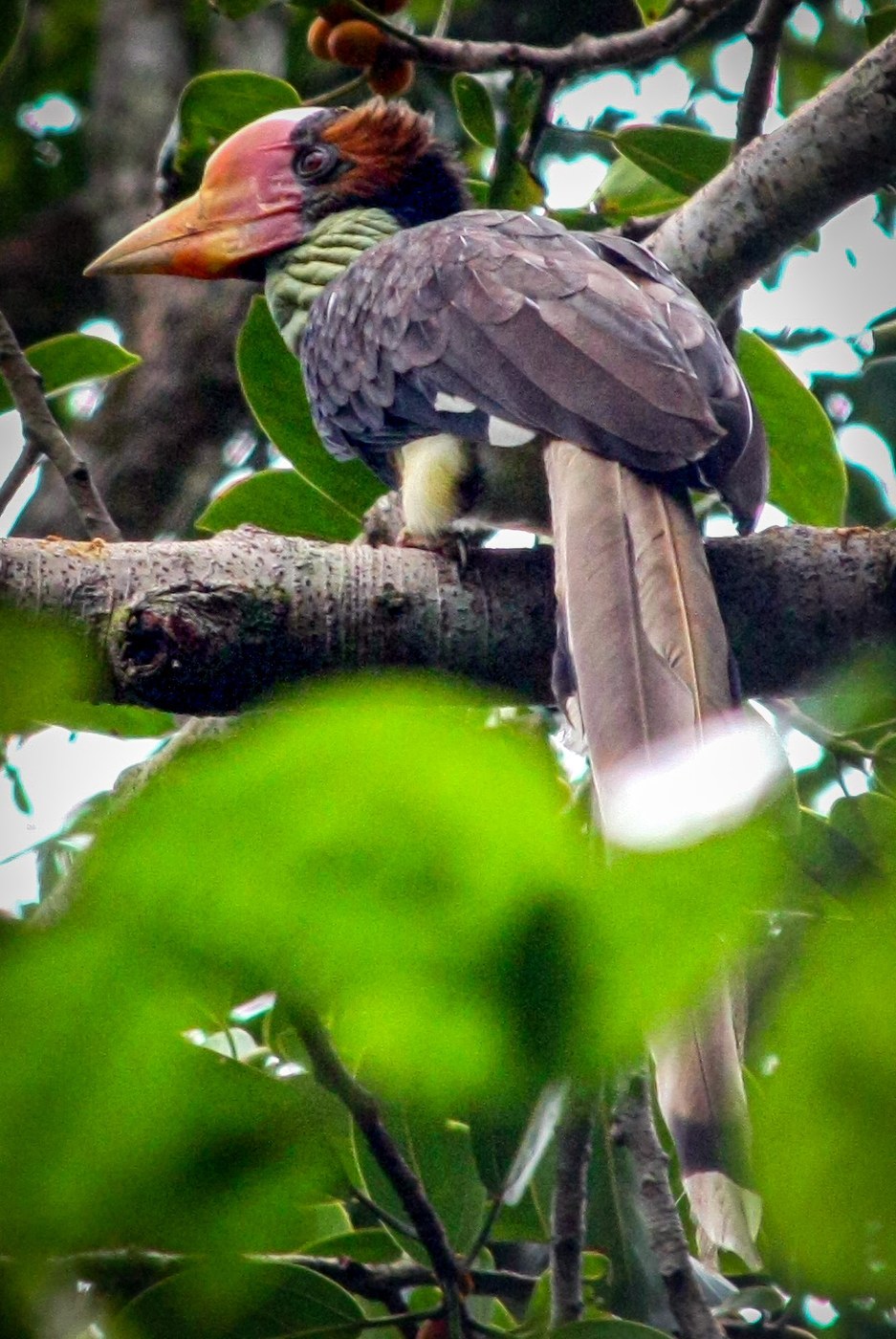
Key Field Marks
- Size & shape: One of the largest hornbills, with an exceptionally long body owing to greatly elongated central tail feathers that can nearly double its total length; heavy-bodied with broad, rounded wings.
- Plumage: Blackish body and wings, whitish belly, thighs, and outer tail feathers; the two elongated central tail feathers are white with a broad dark subterminal band, often abraded and stained yellowish/orange from preening with uropygial gland oil.
- Head & casque: Bare, wrinkled skin on the throat is red in males and pale bluish-white in females — the single best way to sex the species in the field. The huge, solid, reddish-orange-tipped casque atop a massive pale bill (unlike the hollow casques of most other hornbills) is unique to this species and the basis of its "ivory" persecution.
- Behavior: Powerful, direct flight with loud whooshing wingbeats audible from a distance; forages high in the canopy, mainly on figs, and is a key large-seed disperser in Southeast Asian rainforest.
Similar Species
- Rhinoceros Hornbill and other large hornbills: Have hollow, upturned casques and different color patterns; none show the Helmeted Hornbill's extremely long central tail streamers or its uniquely solid casque.
- No other hornbill combines the huge solid casque, bare red/bluish throat skin, and greatly elongated white-and-black central tail feathers, making adults distinctive when seen well.
Range, Habitat & Season
Resident of lowland and hill evergreen rainforest in the Thai-Malay Peninsula, Sumatra, and Borneo. Now Critically Endangered due to intense poaching for its solid casque ("hornbill ivory"), combined with habitat loss, and has been extirpated or severely reduced across much of its former range; sightings are increasingly rare and concentrated in well-protected reserves. Non-migratory, present year-round in remaining forest strongholds.
Voice
An extraordinary, far-carrying series of loud "took" or "hoop" notes that accelerate into a maniacal cackling laugh climaxing in a series of ringing, almost maniacal notes — one of the most distinctive and eerie sounds of the Southeast Asian rainforest, often heard well before the bird is seen.
Frequently asked questions
Why is the Helmeted Hornbill's casque different from other hornbills?
Unlike the hollow casques of most hornbill species, the Helmeted Hornbill's casque is solid keratin, which is prized as 'hornbill ivory' and has driven severe poaching pressure on the species.
How can I tell a male from a female Helmeted Hornbill?
Bare throat skin color is diagnostic: males have red throat skin while females have pale bluish-white throat skin.
Why is the Helmeted Hornbill so endangered?
It is Critically Endangered mainly due to targeted poaching for its solid ivory-like casque, combined with ongoing lowland rainforest loss across Sumatra, Borneo, and the Thai-Malay Peninsula.
What is distinctive about the Helmeted Hornbill's call?
It gives a series of loud hooting notes that speed up into a wild, cackling laugh, one of the most recognizable and eerie sounds of Southeast Asian rainforests.