
Heermann's Gull Identification Guide
A distinctive dark-gray Pacific coast gull with a white head, red bill, and a striking, reversed migration pattern.
Read the full Heermann's Gull encyclopedia entry →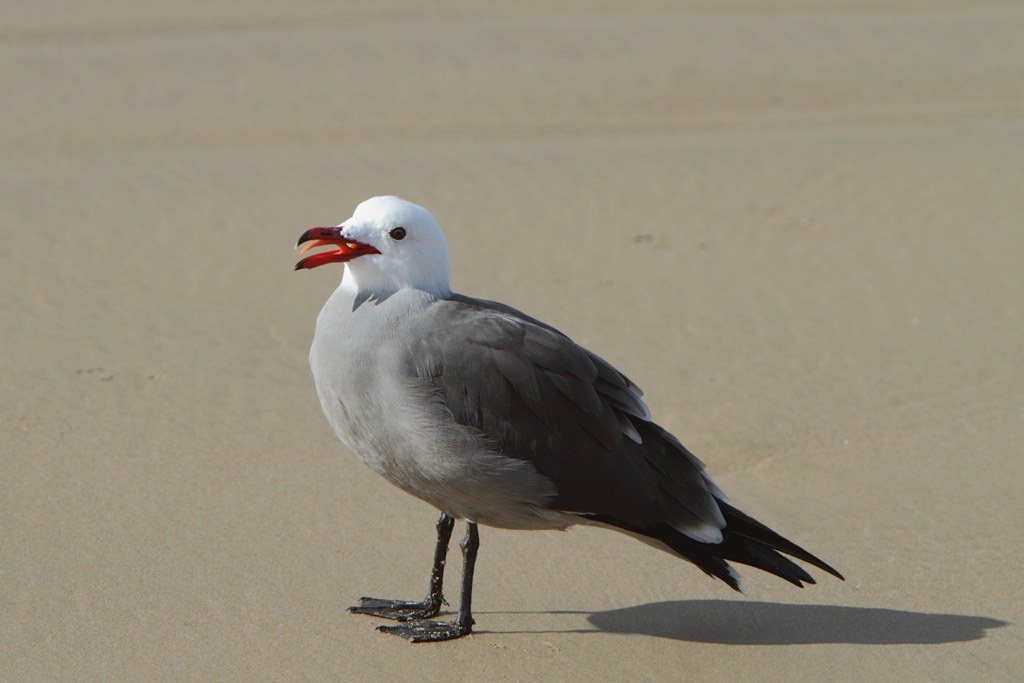
Key Field Marks
- Size & shape: A medium-sized, stocky gull with fairly long wings and a moderately heavy bill.
- Plumage (breeding adult): Overall sooty-gray body and wings, a clean white head, and a blackish tail contrasting with a pale rump — quite unlike the typical white-and-gray pattern of most North American gulls.
- Bill: Bright red-orange bill with a black tip in breeding adults, fading duller in nonbreeding birds; head can show dusky mottling in winter.
- Immatures: Uniformly dark sooty-brown overall (darkest of any regularly occurring North American gull as a juvenile), with a dark bill, gradually lightening the head and bill with age over several years.
- Behavior: Often seen loafing in large flocks on beaches, piers, and jetties along the Pacific coast; notably kleptoparasitic, frequently harassing Brown Pelicans to steal fish they catch.
Similar Species
- Other dark-backed gulls (e.g., Laughing Gull): Much smaller, more slender, with a different bill shape and pattern, and dark (not white) hood in breeding plumage.
- Immature Western/California Gull: Larger and paler brown with more mottled patterning, lacking the uniform sooty-chocolate tone of young Heermann's Gulls.
- The combination of an all-dark-gray body with a white head (adult) or uniformly sooty-brown plumage (immature) plus red-orange bill makes adults essentially unmistakable on the Pacific Coast.
Range, Habitat & Season
Breeds almost entirely on Isla Rasa in the Gulf of California, Mexico, then disperses northward after breeding — an unusual "reverse" migration — to spend the nonbreeding season along the Pacific Coast from Mexico north to British Columbia, most commonly from California through Washington in late summer through winter. Found on beaches, rocky coastlines, harbors, and estuaries; rare well inland.
Voice
A nasal, bugling "wek-wek-wek" or drawn-out mewing call, higher-pitched and more nasal than the calls of larger white-headed gulls; frequently vocal in loafing flocks and while pirating food from pelicans.
Frequently asked questions
Why is Heermann's Gull's migration unusual?
Instead of moving south for winter, most of the population breeds in Mexico's Gulf of California and then disperses north along the Pacific Coast for the nonbreeding season, essentially reversing the typical migratory direction.
How can I recognize an adult Heermann's Gull?
Look for a uniformly sooty-gray body, clean white head, dark tail with a paler rump, and a bright red-orange bill — a combination unlike any other North American gull.
Why do Heermann's Gulls follow Brown Pelicans?
They are kleptoparasites that steal fish from pelicans as the pelicans surface after a plunge-dive, snatching food right from the pouch or nearby water.
Where do almost all Heermann's Gulls breed?
The vast majority of the world population nests on a single island, Isla Rasa, in Mexico's Gulf of California.