
Hawfinch Identification Guide
A stocky, secretive European finch with an oversized, powerful bill built for cracking cherry and hornbeam seeds.
Read the full Hawfinch encyclopedia entry →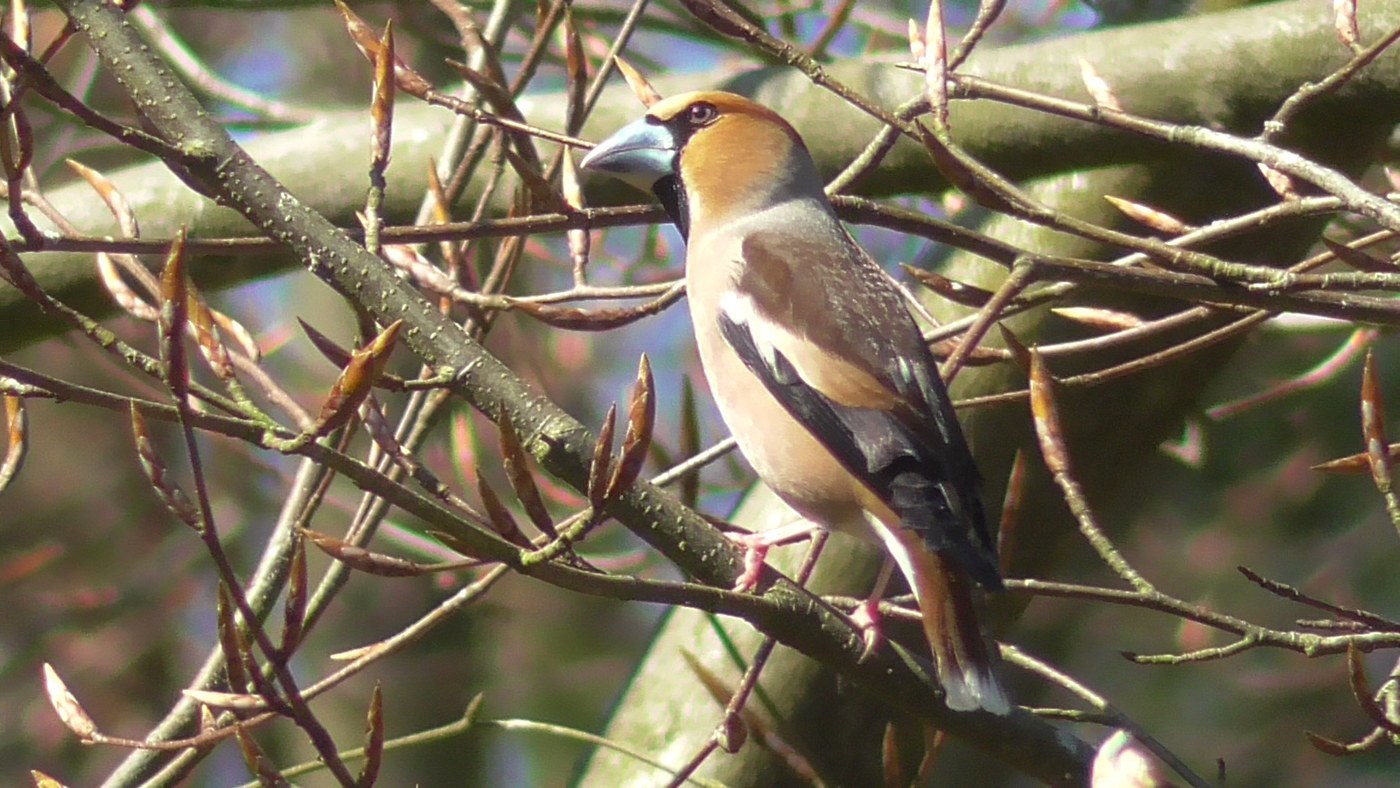
Key Field Marks
- Size & shape: A large, bull-necked, short-tailed finch, bigger and bulkier than a House Sparrow, with an unmistakably massive, wedge-shaped bill.
- Plumage: Warm orange-brown head, gray nape, and rich chestnut-brown back; underparts pinkish-buff; broad white wing bar and glossy blue-black flight feathers with an unusual squared/notched tip to the outer primaries.
- Bill: Enormous silver-gray bill in winter, turning blue-black in breeding season — proportionally one of the largest bills of any European songbird, capable of cracking cherry stones.
- Behavior: Shy and wary, usually staying high in tree canopies (favoring hornbeam, cherry, and beech) and quick to fly off; often first detected by its explosive flight call or by the sound of cracking seeds. Flight is strong, fast, and undulating, showing a short tail and broad-based wings with white wing bars and patches.
Similar Species
- Common Bullfinch: Smaller, rounder, with a small stubby black bill, black cap, and (male) rosy-pink underparts — quite different once the bill size is compared.
- Greenfinch: Smaller, more uniformly olive-green with yellow wing/tail flashes, and a much smaller conical bill.
- No other regularly occurring European finch approaches the Hawfinch's bill size, making a good look at the bill diagnostic.
Range, Habitat & Season
Widespread but patchily distributed resident and partial migrant across temperate Europe and into temperate Asia, favoring mature deciduous and mixed woodland with hornbeam, cherry, or beech, as well as orchards and large park woodlands. Northern and eastern populations move south in winter, sometimes producing local irruptions; in Britain and much of western Europe it is present year-round but notoriously hard to find due to its canopy-dwelling, shy habits.
Voice
A sharp, explosive "tzik" or "ptik" flight/contact call, often the first and only clue to its presence overhead; song is a quiet, unremarkable series of creaky, wheezy notes seldom heard.
Frequently asked questions
What is the single best field mark for a Hawfinch?
Its huge, disproportionately massive bill — silvery in winter, blue-black in summer — is unmatched by any other regular European finch.
Why are Hawfinches so hard to see?
They are shy, stay high in the canopy of mature trees, and are easily overlooked except for their sharp 'tzik' flight call or the sound of them cracking seeds.
What habitat should I search for Hawfinches?
Mature deciduous woodland with hornbeam, cherry, or beech trees, as well as old orchards and large wooded parks, are the most productive habitats.
Do Hawfinches migrate?
Populations vary — many are resident, but northern and eastern birds move south in winter, occasionally causing irruptive influxes further west.