
Hartlaub's Turaco Identification Guide
A vivid green, crested East African forest bird that flashes brilliant crimson flight feathers when it flies.
Read the full Hartlaub's Turaco encyclopedia entry →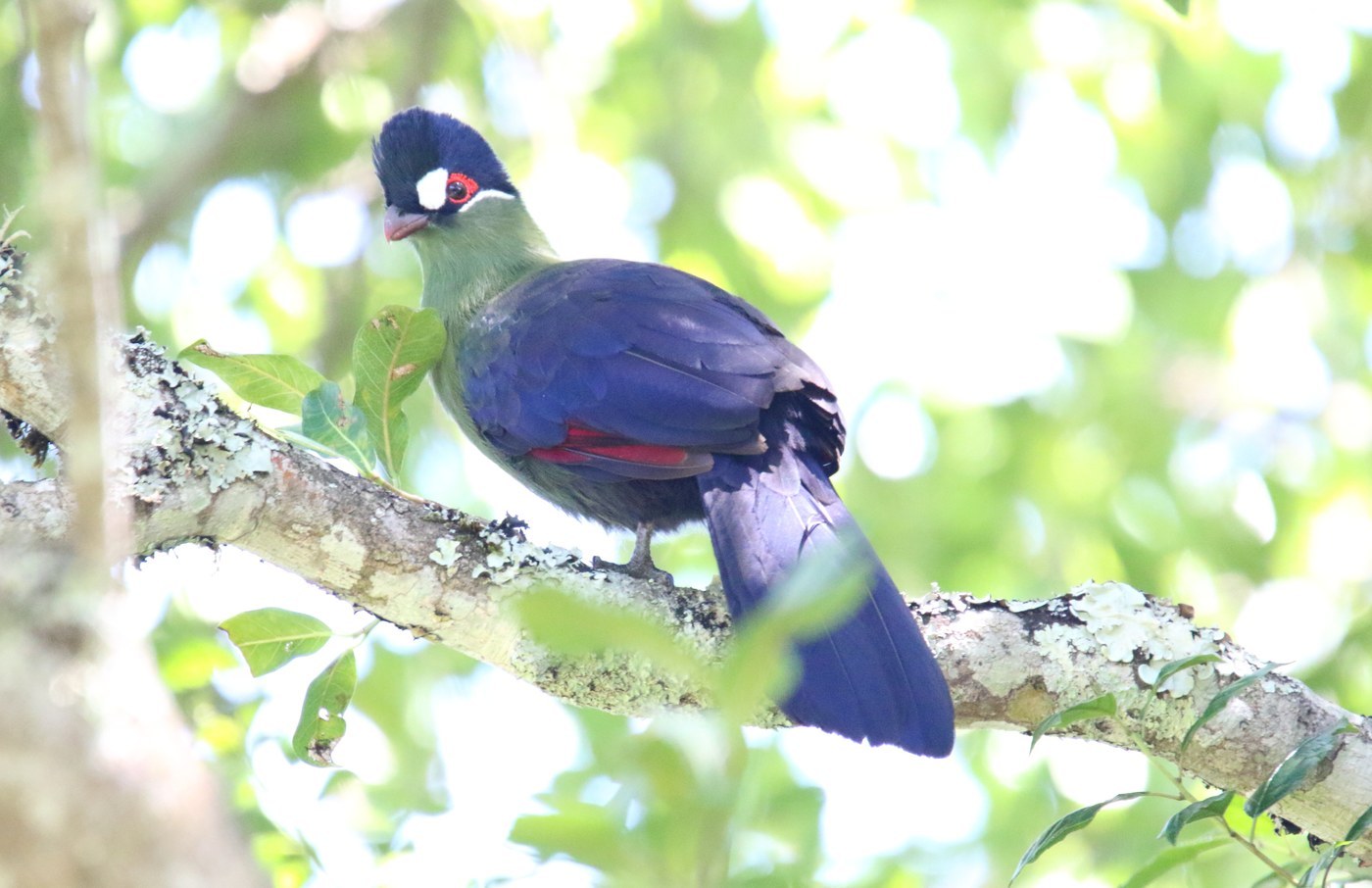
Key Field Marks
- Size & shape: A medium-large arboreal bird, roughly 40 cm (16 in) long, with a long tail, short rounded wings, and a tall, forward-curling green crest.
- Plumage: Rich emerald to bottle-green body and crest; a bold white crescent in front of the eye and a red eye-ring against dark facial skin; bright red bill in adults. In flight, the primaries flash a startling crimson-red, characteristic of true turacos (the pigment, turacin, is unique to the family).
- Bill: Stout, bright red bill, contrasting with the green face pattern and white eye markings.
- Behavior: Moves through the forest canopy and dense bush by bounding along branches rather than flying far; flights are short, heavy, and low, revealing the red wing flash. Often in pairs or small family groups, sometimes joining mixed-species canopy flocks.
Similar Species
- White-cheeked Turaco: Very similar green turaco but with a white cheek patch below/behind the eye rather than the white crescent in front of the eye; ranges are largely separate (White-cheeked further west/north in the Rift highlands).
- Great Blue Turaco: Much larger, blue-gray rather than green, with a different crest shape; unmistakable by size and color alone.
- Ross's Turaco: Lacks the white facial crescent, has an all-yellow bill and a different, more rounded crest; found further west.
Range, Habitat & Season
Resident of montane and highland forest, forest edge, and well-wooded gardens in East Africa, primarily in Kenya, Uganda, Rwanda, Burundi, and adjacent Tanzania, generally at elevations above 1,000–1,500 m. Non-migratory and present year-round; a familiar and often confiding bird in gardens and forest patches around Nairobi and similar highland towns.
Voice
A loud, far-carrying series of harsh, barking "kok-kok-kok-kok" or "kooo-koo-koo" notes, often given by multiple birds in a duet or chorus, one of the characteristic sounds of East African highland forest.
Frequently asked questions
Why does Hartlaub's Turaco flash red when it flies?
Its primary flight feathers contain turacin, a copper-based red pigment unique to turacos, which is normally hidden but flashes vividly during flight.
How do I separate Hartlaub's Turaco from the White-cheeked Turaco?
Hartlaub's shows a white crescent in front of the eye, while White-cheeked Turaco has a white patch on the cheek below the eye; their ranges also mostly do not overlap.
Where is the best place to see Hartlaub's Turaco?
Highland forests and wooded gardens in Kenya and Uganda, including sites around Nairobi, are classic and reliable locations.
Is Hartlaub's Turaco migratory?
No, it is a sedentary resident that stays within its highland forest habitat year-round.