
Harris's Hawk Identification Guide
A dark, long-tailed, sociable hawk of the arid Southwest, told by its chestnut shoulders and wing linings and white-banded tail tip.
Read the full Harris's Hawk encyclopedia entry →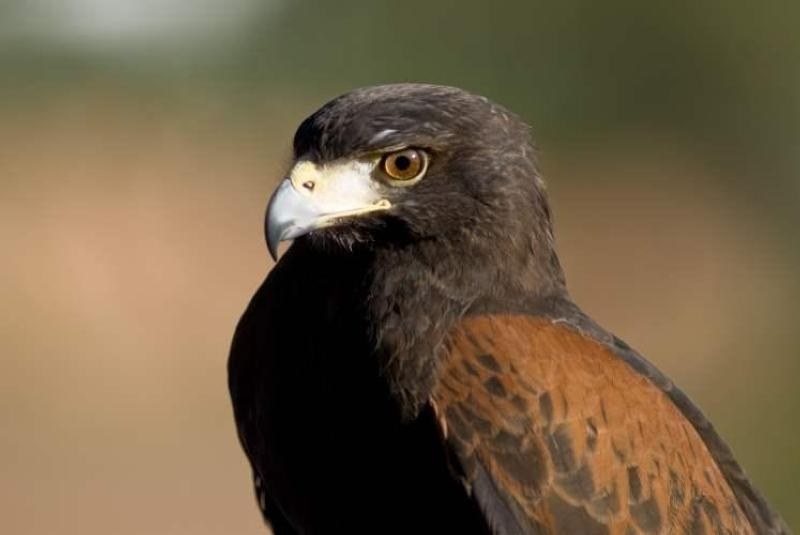
Key Field Marks
- Size & shape: A medium-large hawk, noticeably long-tailed and long-legged compared to a Red-tailed Hawk, with broad, rounded wings and a slim profile in flight.
- Plumage: Overall dark chocolate-brown body and head. Chestnut-rufous shoulders (lesser wing coverts) and chestnut thighs and wing linings are the signature marks, visible both perched and in flight.
- Tail: Blackish tail with a broad white band at the base and a crisp white terminal band — very distinctive and useful at a distance.
- Bill & legs: Stout, strongly hooked blackish bill with yellow cere; long yellow legs.
- Behavior: Highly social — often seen perched in small groups on saguaros, poles, or snags, and sometimes hunting cooperatively in packs of two to six birds, a trait almost unique among raptors. Frequently perches in an upright "totem pole" stack with other individuals.
Similar Species
- Red-tailed Hawk: Bulkier, shorter-tailed, lacks chestnut shoulders/wing linings; adult has brick-red (not white-banded) tail.
- Zone-tailed Hawk: All-dark like a Turkey Vulture with pale-banded tail from below, but lacks chestnut patches and has different tail banding pattern (multiple gray bars, not one bold white band); soars with wings in a shallow dihedral.
- Common Black Hawk: Bulkier, broader-winged, very short tail with a single broad white band, no chestnut coloring.
Range, Habitat & Season
Resident (non-migratory) across the Sonoran and Chihuahuan Desert regions of the U.S. Southwest (Arizona, New Mexico, Texas) south through Mexico and Central America into South America. Favors desert scrub with scattered saguaro cacti, mesquite bosques, and increasingly urban/suburban desert edges. Present year-round wherever found — no true migratory movement in North America.
Voice
A harsh, raspy scream or grating "irrrrr" or "cheeee-errrr," often given from a perch or during territorial interactions; also a sharp, repeated barking alarm call near the nest.
Frequently asked questions
What makes Harris's Hawk unique among North American raptors?
It is one of the very few raptors that hunts cooperatively in family groups, with several birds flushing and pursuing prey together, then sharing the kill.
How do I tell a Harris's Hawk from a Red-tailed Hawk?
Look for chestnut shoulder patches and wing linings, a slimmer long-tailed shape, and a black tail with one bold white band, versus the Red-tail's bulkier build and rusty tail.
Where is the best place to see Harris's Hawks?
Sonoran Desert habitat in southern Arizona (e.g., around Tucson and Phoenix) is one of the most reliable areas, especially where saguaros and mesquite provide perches.
Do Harris's Hawks migrate?
No, they are year-round residents throughout their desert range and do not undertake seasonal migration.