
Harpy Eagle Identification Guide
One of the largest and most powerful eagles in the world, a massive gray, black, and white raptor of Neotropical lowland rainforest, identifiable by its huge size, double crest, and enormous talons.
Read the full Harpy Eagle encyclopedia entry →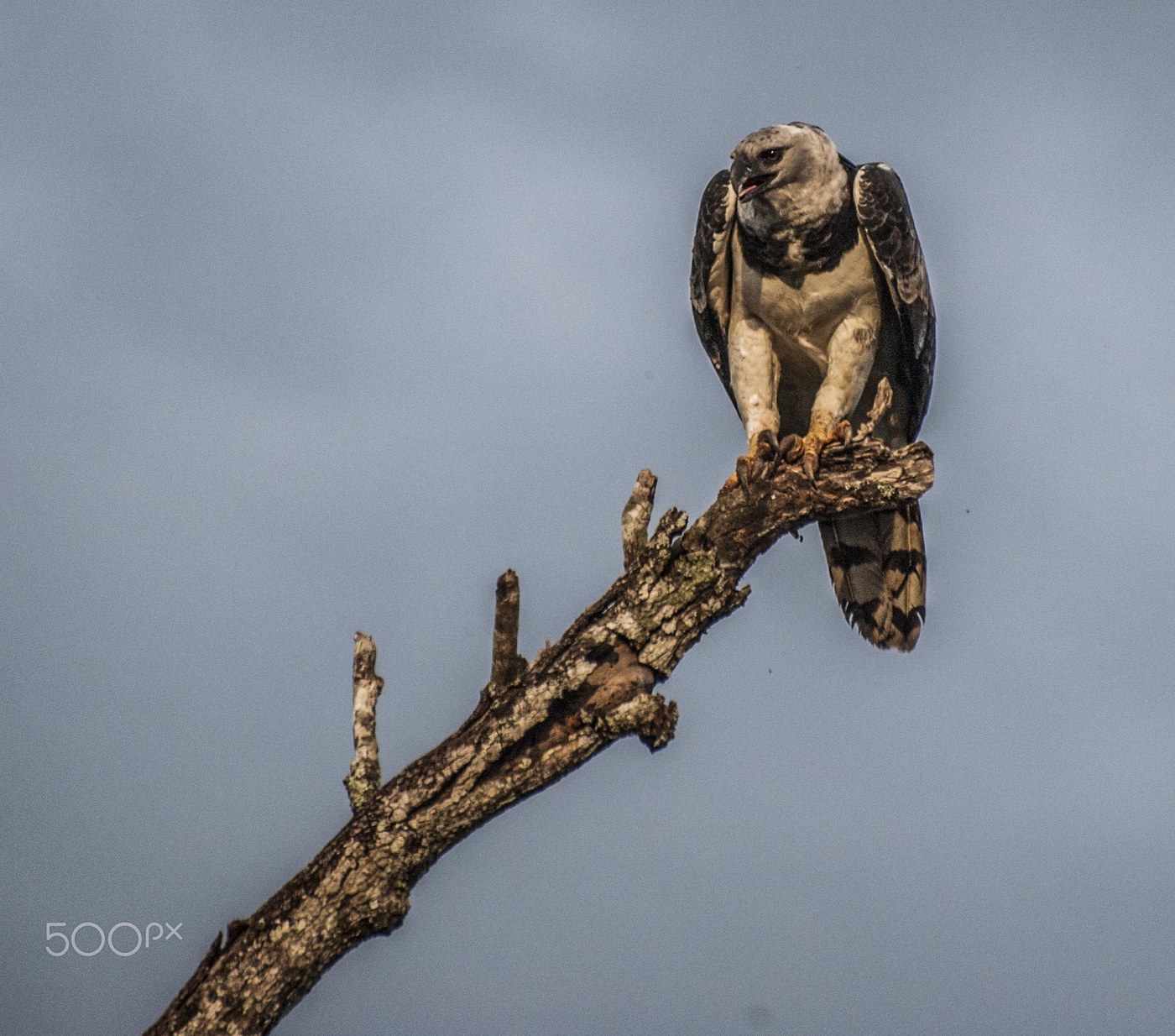
Overview
The Harpy Eagle (Harpia harpyja) is among the largest and most powerful eagles on Earth, an apex predator of the Neotropical lowland rainforest canopy from southern Mexico to northern Argentina. Its immense size, striking plumage, and formidable talons make it unmistakable wherever seen, though its reclusive canopy habits mean sightings are rare and prized.
Key Field Marks
- Size and shape: Enormous raptor, females up to 100 cm (39 in) long with a wingspan approaching 2 m (6.5 ft) and weighing up to 9 kg (20 lb); males are notably smaller. Broad, relatively short, rounded wings and a long tail are adaptations for maneuvering within dense forest canopy rather than soaring high overhead.
- Plumage: Dark slate-gray head, back, and upper breast contrast sharply with a white belly and underwing coverts; a broad blackish breast band separates the gray throat from the white belly.
- Crest: A distinctive double crest of long gray feathers that the bird raises into a prominent fan or crown shape when alert or agitated — one of the most reliable field marks at any distance.
- Legs and talons: Extremely thick, powerful yellow legs, feathered partway down, ending in massive black talons among the largest of any eagle, used to capture large canopy prey such as sloths and monkeys.
- Flight: Rarely seen soaring high; typically flies below or within the canopy with quick, powerful wingbeats interspersed with short glides, adapted for agile flight through dense forest rather than open-sky travel.
Separating It from Similar Species
- Crested Eagle: The closest look-alike in the same forests, but noticeably smaller and slimmer, with a single, more pointed crest (versus Harpy's fuller double crest), grayer overall tone, and finer barring on the flanks and thighs rather than Harpy's solid dark breast band.
- Black Hawk-Eagle and Ornate Hawk-Eagle: Both much smaller, more slender, with different crest shapes and barred rather than plain white underparts.
- No other Neotropical raptor approaches the Harpy Eagle's sheer bulk and leg thickness, making size alone often diagnostic for adults seen well.
Habitat, Range, and Season
Resident in extensive tracts of humid lowland tropical rainforest from southern Mexico through Central America and much of Amazonian and Atlantic Forest South America south to northern Argentina, though it has been extirpated from much of Central America and Mexico due to deforestation. Requires large areas of intact, mature forest for hunting and nesting and does not migrate; pairs occupy large territories year-round and nest in the tallest emergent trees.
Voice
Gives a distinctive, far-carrying, plaintive whistled call, often rendered as a series of rising "wheee-wheee-wheee" or "wheeee-ah" notes, given especially near the nest by both adults and begging young; otherwise generally silent and easy to overlook in the forest canopy.
Frequently asked questions
What is the best way to identify a Harpy Eagle in flight or at rest?
Its enormous size, thick yellow legs with massive talons, a dark gray breast band separating a pale gray throat from a white belly, and a prominent double crest that it raises when alert are the key marks.
How does Harpy Eagle differ from Crested Eagle?
Harpy Eagle is considerably larger and bulkier, with a fuller double crest and a solid dark breast band, while Crested Eagle is smaller and slimmer with a single pointed crest and finer barring on the underparts.
Where is the best chance of seeing a Harpy Eagle?
Large, intact tracts of lowland tropical rainforest in the Amazon Basin and parts of Central America (such as Darien in Panama) offer the best, though still challenging, chances, often near active nest sites.
What does a Harpy Eagle eat?
Primarily arboreal mammals such as sloths and monkeys, along with other prey like large birds and reptiles, captured with its extremely powerful talons in the forest canopy.
Does the Harpy Eagle migrate?
No, it is a non-migratory resident, with pairs maintaining large permanent territories in mature rainforest year-round.