
Harlequin Duck Identification Guide
A small, boldly patterned sea duck of turbulent coastal waters and fast mountain streams, with the male showing an intricate slate-blue, chestnut, and white harlequin pattern.
Read the full Harlequin Duck encyclopedia entry →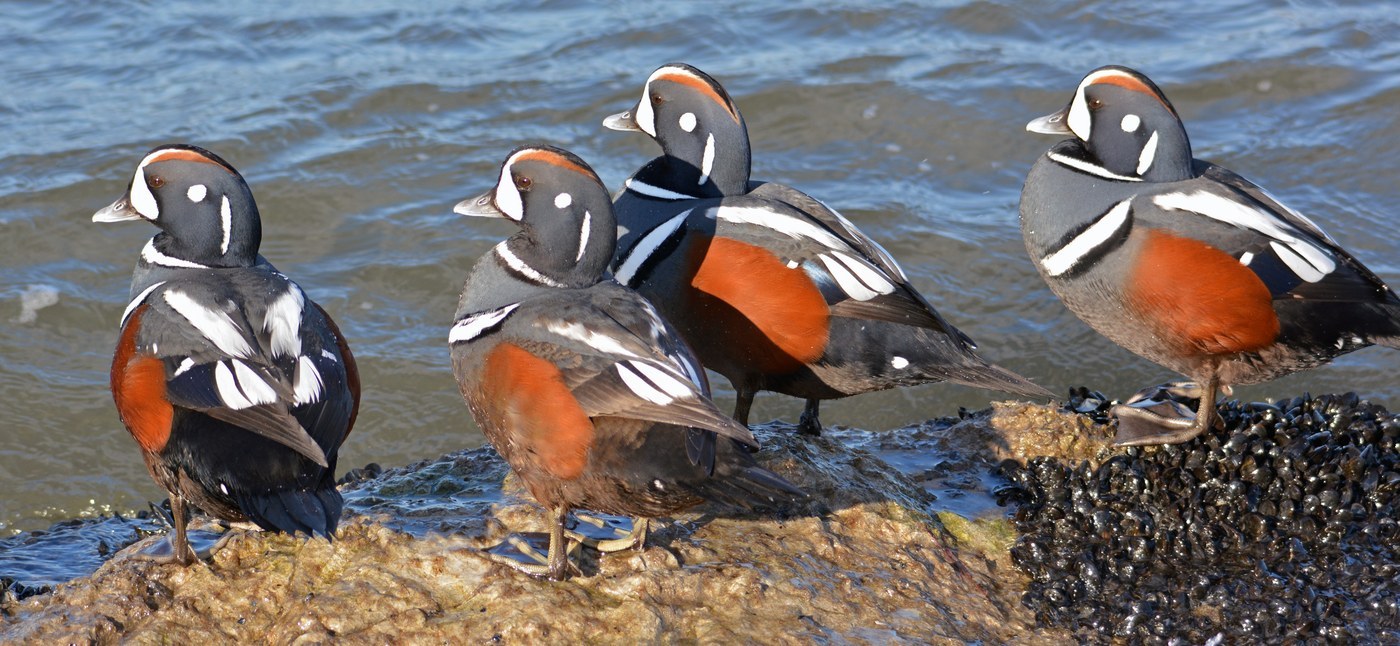
Overview
The Harlequin Duck (Histrionicus histrionicus) is a small, strikingly patterned sea duck adapted to some of the most turbulent aquatic habitats used by any waterfowl — fast-flowing mountain streams in summer and rocky, wave-battered coastlines in winter. Its bold male plumage and unusual habitat preferences make it a favorite target for birders.
Key Field Marks
- Size and shape: A small, compact diving duck about 38-45 cm (15-18 in) long, with a rounded head, small stubby bill, and a stiff, often cocked tail.
- Male plumage: Richly patterned slate-blue body with bold chestnut flanks, a white crescent in front of the eye, white spots and stripes on the head and neck, and a white patch on the side of the breast bordered in black — an unmistakable, intricate pattern once seen well.
- Female plumage: Much plainer sooty-brown overall, with three small whitish patches on the face (in front of and behind the eye, and near the bill base) — a key mark for separating females and juveniles from other small dark ducks.
- Behavior: Expert at swimming and diving in fast whitewater and heavy surf; on breeding streams, forages by diving or dabbling in rapids for aquatic insect larvae; often bobs distinctively on rough water.
Separating It from Similar Species
- Female/juvenile scoters and other sea ducks: Female Harlequin is notably smaller and daintier, with a rounder head and the diagnostic three white facial spots, distinguishing it from the more uniformly dark faces of female scoters.
- Bufflehead: Similar small size, but male Bufflehead shows a large white head patch rather than the Harlequin's intricate multicolor pattern, and females lack the three-spot face pattern.
- Male Harlequin Duck is essentially unmistakable once seen clearly, given its unique combination of colors and pattern.
Habitat, Range, and Season
Breeds along fast-flowing, clear mountain streams and rivers in the Pacific Northwest and Rocky Mountains of North America, as well as parts of eastern Canada, Greenland, and Iceland. After breeding, most populations move to rocky, surf-battered coastlines to winter, including rocky shorelines of the Pacific and Atlantic coasts, where they are often seen riding waves close to jetties and rocky points. A short-to-moderate distance migrant between mountain breeding streams and coastal wintering grounds.
Voice
Generally quiet; gives high-pitched squeaking or mouse-like whistling notes, sometimes leading to the nickname "sea mouse," most often heard from small groups on the water rather than in flight.
Frequently asked questions
What is the most distinctive feature of a male Harlequin Duck?
Its intricate combination of slate-blue body, chestnut flanks, and bold white crescents, spots, and stripes on the head and body — a pattern unlike any other duck.
How do I identify a female Harlequin Duck?
Look for a small, plain sooty-brown duck with three distinct white spots on the face — one near the bill base, one in front of the eye, and one behind the eye.
Where do Harlequin Ducks breed?
On fast-flowing, clear mountain streams and rivers, primarily in the Pacific Northwest, Rocky Mountains, and parts of eastern Canada, Greenland, and Iceland.
Where can Harlequin Ducks be seen in winter?
Along rocky, surf-exposed coastlines of the Pacific and Atlantic, often close to jetties and rocky points where they ride the waves.