
Hammond's Flycatcher Identification Guide
A small, subtly plumaged western Empidonax flycatcher best identified by voice, structure, and habitat — a classic identification challenge in mature coniferous forest.
Read the full Hammond's Flycatcher encyclopedia entry →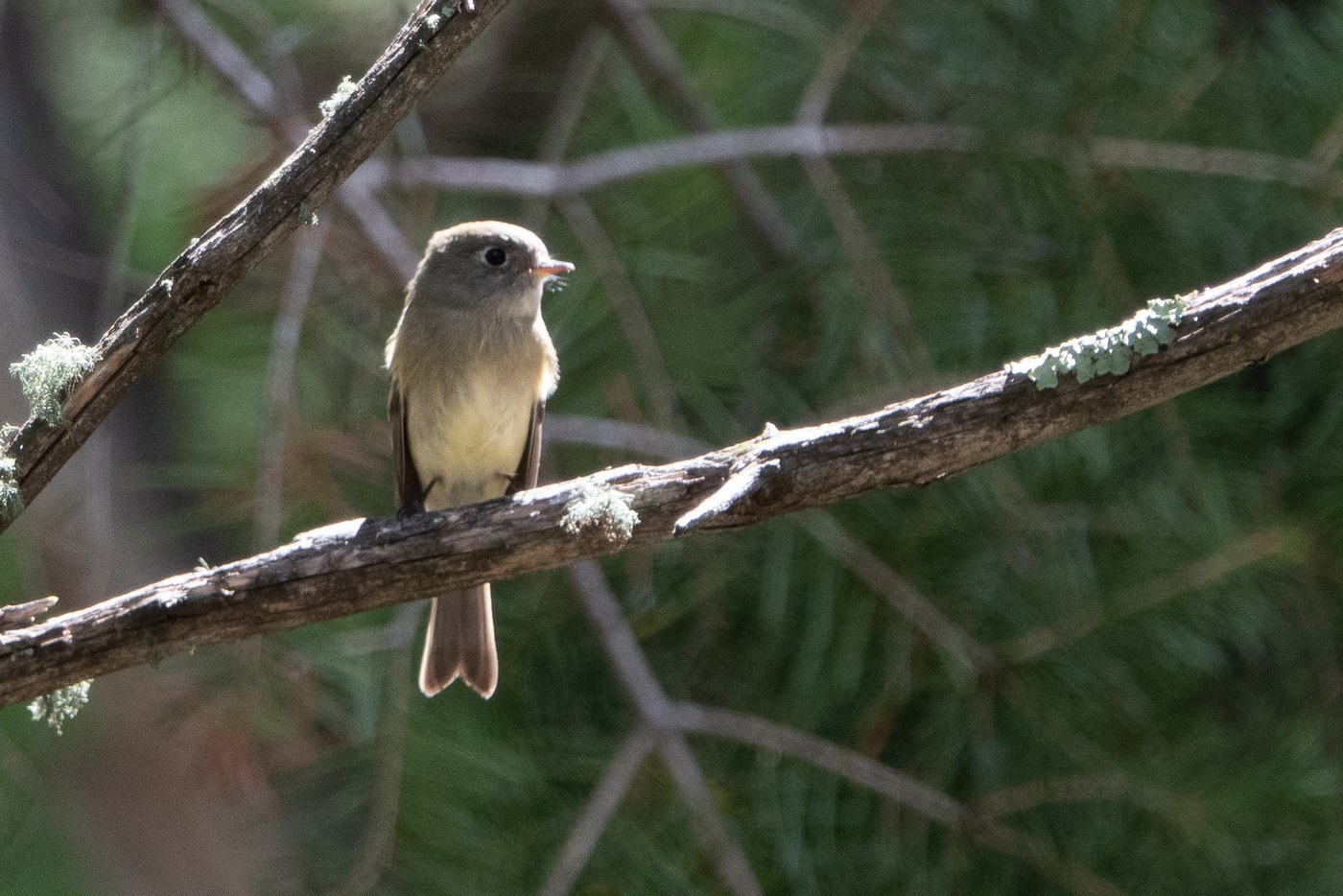
Overview
Hammond's Flycatcher (Empidonax hammondii) is a small, notoriously difficult-to-identify member of the Empidonax flycatcher genus, breeding in mature coniferous and mixed forests of western North America. Like most Empidonax species, definitive identification often relies on a combination of subtle structural features, habitat, and especially voice.
Key Field Marks
- Size and shape: One of the smaller Empidonax flycatchers, about 13-14 cm (5-5.5 in) long, with a short, fairly narrow bill, a relatively large, somewhat peaked head, and a longer primary projection (wingtip extension past the folded tertials) than most other Empidonax species — a useful structural clue.
- Plumage: Olive-gray upperparts, a gray wash across the throat and breast contrasting weakly with a pale yellowish belly, and two whitish to buffy wing bars; the overall look is subdued and grayer than the more olive-toned Pacific-slope or Willow Flycatchers.
- Eye-ring: Shows a distinct, often slightly teardrop-shaped white eye-ring that is narrowly broken or thinner behind the eye in some individuals — subtler than the bold eye-ring of Pacific-slope Flycatcher.
- Bill color: Small, mostly dark bill with only a limited pale base to the lower mandible, in contrast to species like Pacific-slope Flycatcher, which shows a more extensively pale (often orangish) lower mandible.
- Behavior: Often flicks its wings and tail simultaneously while perched, a habit shared with some other Empidonax but useful in combination with other features; forages by sallying for flying insects from a mid- to upper-canopy perch.
Separating It from Similar Species
- Dusky Flycatcher: Very similar but has a shorter primary projection, a paler, more extensively yellowish-based lower mandible, and typically favors more open, brushy habitat rather than closed-canopy forest; voice is the most reliable separator.
- Pacific-slope and Cordilleran Flycatchers: Warmer olive-yellow overall with a bolder, more prominent white or buffy eye-ring and a mostly pale (orangish) lower mandible; generally found at lower, more open elevations or riparian habitat.
- Least Flycatcher: Larger-billed, brighter white wing bars, and a shorter primary projection; often in more open woodland edge habitat and gives a very different, sharp "che-bek" call.
Habitat, Range, and Season
Breeds in mature coniferous and mixed coniferous-deciduous forest, often at mid to higher elevations, across the mountainous West from Alaska and western Canada south through the Rocky Mountains and Pacific states into parts of Mexico. It is a long-distance migrant, wintering primarily in Mexico and Central America, and passes through lowland and foothill habitats during spring and fall migration, when it can occur well outside its breeding range.
Voice
The most reliable identification tool: gives a distinctive three-part song, often rendered as "sep-trip, grrreep, seep," with a burry, buzzy quality; the call note is a soft "peek" or sharp "pit," different from the calls of Dusky and other similar Empidonax species. Voice recordings or careful listening are strongly recommended for confident identification, especially away from clearly defined breeding habitat.
Frequently asked questions
Can Hammond's Flycatcher be reliably identified by sight alone?
It is difficult — while structure (long primary projection, small dark bill, subdued gray-olive plumage) and habitat (mature closed-canopy conifer forest) help narrow it down, voice is usually needed for full confidence, especially where it overlaps with Dusky Flycatcher.
How does Hammond's Flycatcher differ from Dusky Flycatcher?
Hammond's has a longer primary projection, a smaller and darker bill, and prefers denser, taller coniferous forest, while Dusky Flycatcher has a shorter primary projection, a paler-based bill, and favors more open, shrubby habitat; their songs also differ.
What habitat should I search for breeding Hammond's Flycatchers?
Mature, often high-elevation coniferous or mixed forest with a closed canopy, across mountainous areas of western North America.
Where does Hammond's Flycatcher spend the winter?
It migrates long distances to winter primarily in Mexico and Central America, departing its montane breeding forests after the nesting season.