
Hamerkop Identification Guide
A distinctive brown African wading bird with a hammer-shaped head silhouette, famous for building the largest nests of any bird its size.
Read the full Hamerkop encyclopedia entry →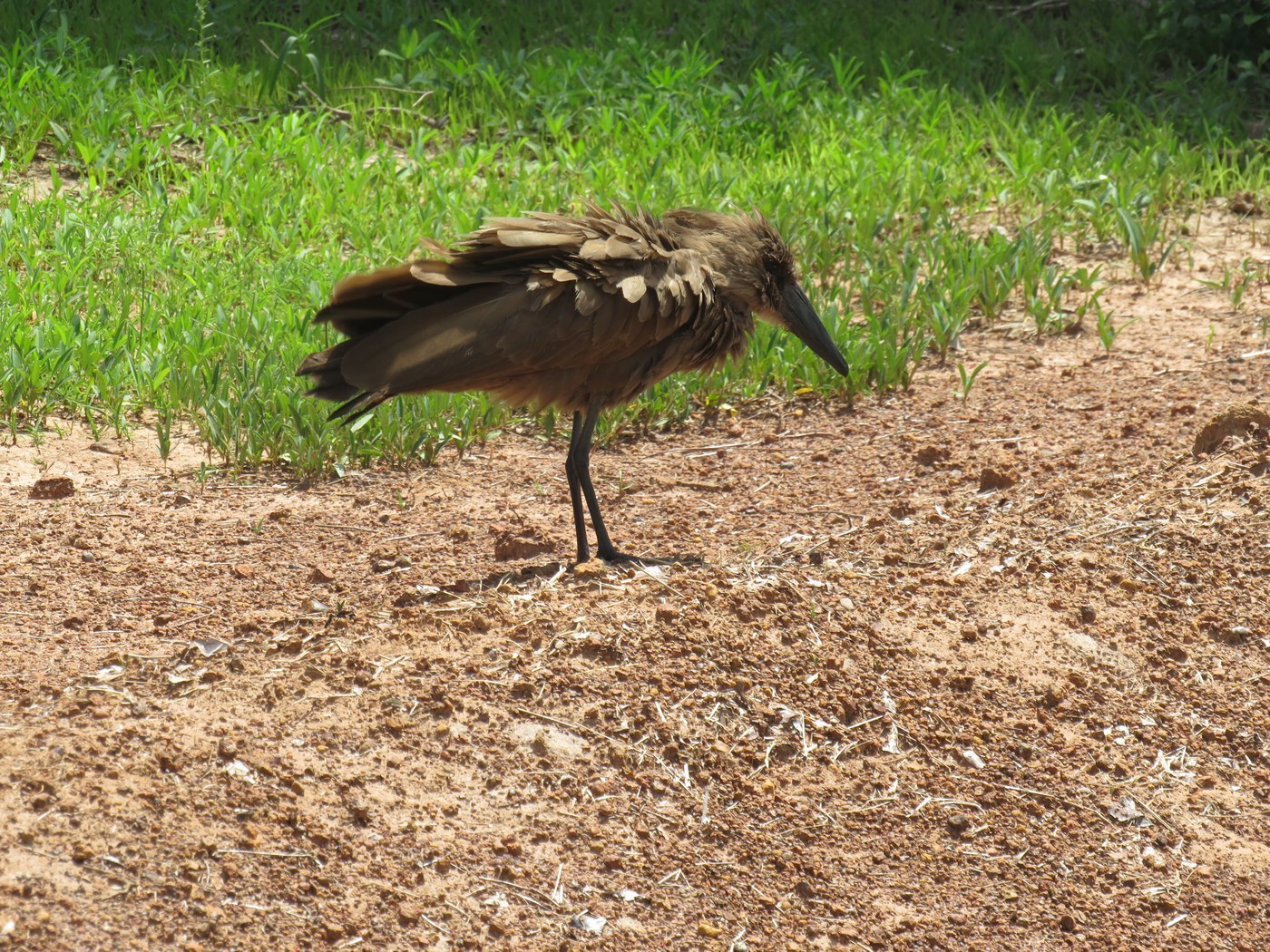
Overview
The Hamerkop (Scopus umbretta) is a medium-sized, entirely brown wading bird found across sub-Saharan Africa and parts of Madagascar and the Arabian Peninsula. Its unusual head shape and enormous stick nests make it one of the most instantly recognizable birds of African wetlands.
Key Field Marks
- Size and shape: A medium-sized bird about 56 cm (22 in) long, with a stocky body, moderately long legs, and a uniquely shaped head — a thick, backward-pointing crest combined with a long, flattened bill creates a hammer-like silhouette, especially obvious in profile, which gives the species its name.
- Plumage: Entirely dull brown overall with a faint purplish gloss on the wings and back, and no bold patterning — the head shape rather than plumage color is the key identification feature.
- Bill: Long, laterally flattened, and slightly hooked at the tip, dark grayish-brown, used for probing mud and shallow water for prey.
- Behavior: Often seen standing hunched at the edge of shallow water, walking slowly while stirring the substrate with one foot to flush prey, or foraging actively with quick jabs of the bill; frequently in pairs.
Separating It from Similar Species
- Juvenile night-herons: Similarly brown and streaky, but lack the Hamerkop's distinctive backswept crest and flattened hammerhead profile, and have a more upright, heron-like stance.
- African Openbill and other storks: Larger, with different bill shapes (Openbill has a distinctive gap between mandibles) and typically paler or more patterned plumage.
- No other African wading bird shares the Hamerkop's unmistakable head shape, making it one of the easier species to identify once the silhouette is learned.
Habitat, Range, and Season
Resident and widespread across sub-Saharan Africa, plus Madagascar and small numbers in southwestern Arabia, found along the margins of rivers, lakes, marshes, and even temporary pools, as well as irrigation channels and fish ponds. Non-migratory, present year-round, though it may move locally in response to water availability.
Voice
Gives a shrill, nasal "kek-kek-kek" call, often uttered in flight or during social interactions at the nest; also known for ritualized group displays involving mutual calling and chasing.
Notable Behavior
Hamerkops build extraordinarily large, domed stick nests — sometimes over a meter across and strong enough to support the weight of a person — with a hidden side entrance, taking weeks to construct and often reused or taken over by other species such as owls or geese.
Frequently asked questions
How did the Hamerkop get its name?
The name means 'hammerhead' in Afrikaans, referring to the bird's distinctive silhouette created by its thick, backward-pointing crest combined with a long, flattened bill.
What is unique about the Hamerkop's nest?
It builds one of the largest nests relative to body size of any bird — a massive domed structure of sticks and mud with a concealed entrance, sometimes strong enough to bear a person's weight.
Where can I find a Hamerkop?
Along the shallow edges of rivers, lakes, marshes, and even small ponds and irrigation channels across sub-Saharan Africa and Madagascar, year-round.
Is the Hamerkop related to herons or storks?
It is placed in its own family, Scopidae, though it shares ancestry with storks, herons, and pelicans within the broader wading bird lineage.