
Hairy Woodpecker Identification Guide
A widespread North American woodpecker closely resembling the smaller Downy Woodpecker, best separated by its larger size, longer bill, and lack of black bill-length spots on the outer tail feathers.
Read the full Hairy Woodpecker encyclopedia entry →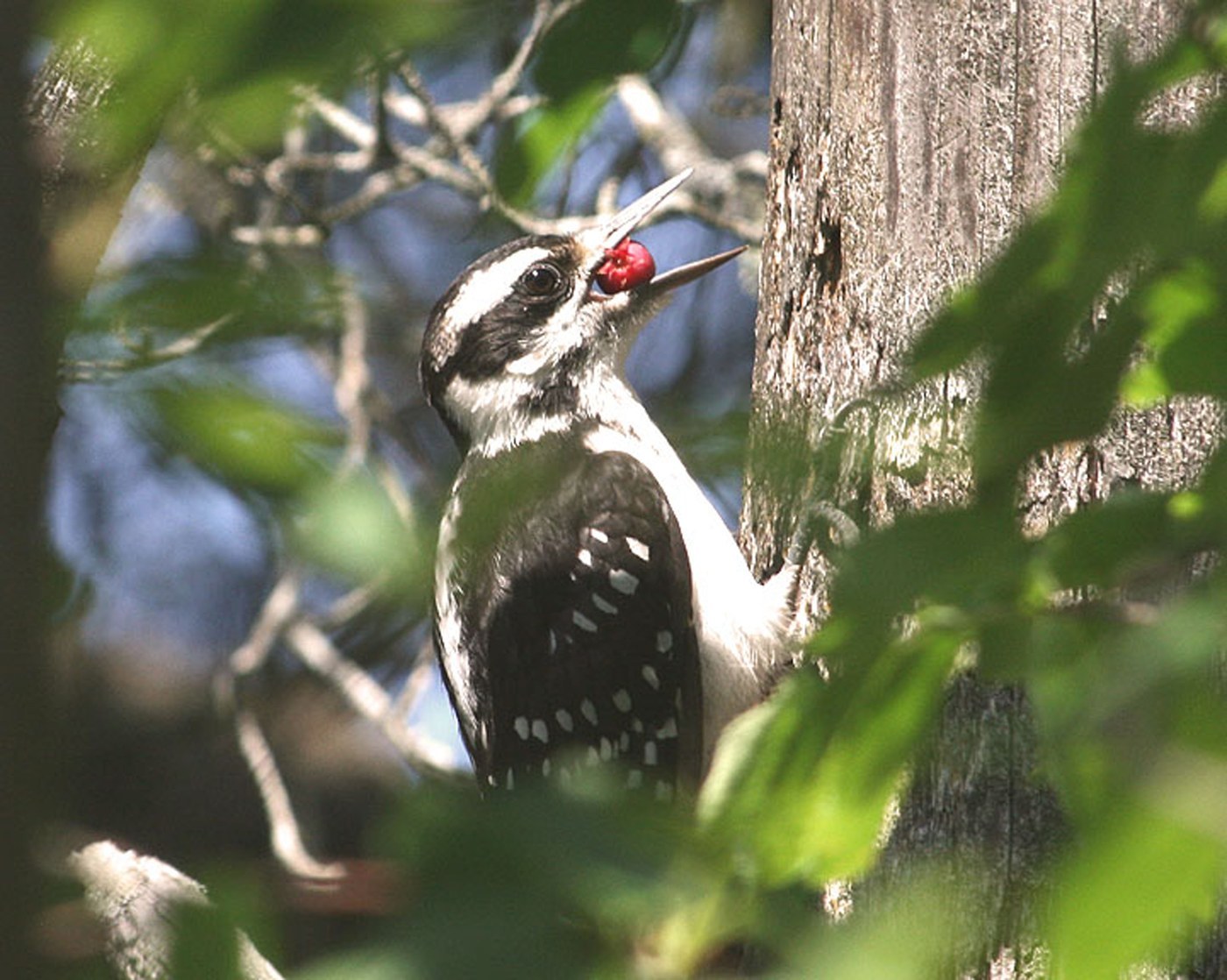
Overview
The Hairy Woodpecker (Leuconotopicus villosus, formerly Dryobates villosus or Picoides villosus) is a widespread, year-round resident found in forests across most of North America. It is the classic look-alike of the smaller Downy Woodpecker, and separating the two is one of the most common identification challenges for backyard and forest birders alike.
Key Field Marks
- Size and shape: Medium-sized woodpecker, about 18-26 cm (7-10 in) long depending on subspecies, noticeably larger and more robust than Downy Woodpecker, with a proportionally longer neck and more angular head shape.
- Bill: A key mark — the bill is long, roughly equal to the length of the head from front to back, straight, and chisel-like, versus the noticeably stubbier, shorter bill of Downy Woodpecker.
- Plumage: Black-and-white overall, with a broad white stripe down the back, black wings spotted with white, and white underparts; males show a red patch on the back of the head, absent in females.
- Tail: White outer tail feathers are plain (unspotted) in Hairy Woodpecker, versus the black-barred or spotted outer tail feathers typically shown by Downy Woodpecker — a reliable mark at close range.
- Behavior: Forages by hitching up trunks and larger branches, excavating more deeply into wood than Downy Woodpecker in search of wood-boring insect larvae; drums loudly and steadily on resonant wood or metal.
Separating It from Similar Species
- Downy Woodpecker: Smaller, with a much shorter, stubbier bill (about half the head length) and black spotting or barring on the white outer tail feathers; voice is also softer and higher-pitched.
- Red-cockaded Woodpecker (range overlap in southeastern pine forests): Shows a large white cheek patch and different habitat (mature pine); males lack a red nape patch but instead show a small red streak on the cheek in some regions.
- Three-toed and Black-backed Woodpeckers: Show barred flanks and, in males, a yellow (not red) crown patch; found mainly in boreal and montane conifer forest.
Habitat, Range, and Season
Resident year-round across most of North America, from mature deciduous and mixed forests to coniferous woodlands, parks, and wooded suburbs, ranging from Alaska and Canada south through the United States into parts of Mexico and Central America. Generally sedentary, though some northern populations may make short winter movements south.
Voice
Gives a sharp, loud "peek" call note, louder and more emphatic than Downy Woodpecker's similar but softer "pik"; also gives a fast, harsh whinnying rattle that, unlike Downy's descending rattle, tends to stay level in pitch throughout.
Frequently asked questions
What is the best way to separate Hairy Woodpecker from Downy Woodpecker?
Focus on bill length relative to head size — Hairy's bill is nearly as long as its head, while Downy's is noticeably shorter and stubbier — and check the outer tail feathers, plain white in Hairy versus spotted or barred black in Downy.
Do both male and female Hairy Woodpeckers have a red patch?
No, only males show a red patch on the back of the head; females lack any red.
Is the Hairy Woodpecker's call different from Downy Woodpecker's?
Yes, Hairy's call note and whinny are louder, sharper, and generally do not descend in pitch, while Downy's call is softer and its rattle typically drops in pitch toward the end.
What habitat is best for finding Hairy Woodpeckers?
Mature forests with larger trees, both deciduous and coniferous, though it also readily visits wooded parks and suburban yards with bird feeders, especially suet.