
Gyrfalcon Identification Guide
The largest falcon in the world, a powerful Arctic and subarctic predator that ranges in color from nearly pure white to dark slate-gray.
Read the full Gyrfalcon encyclopedia entry →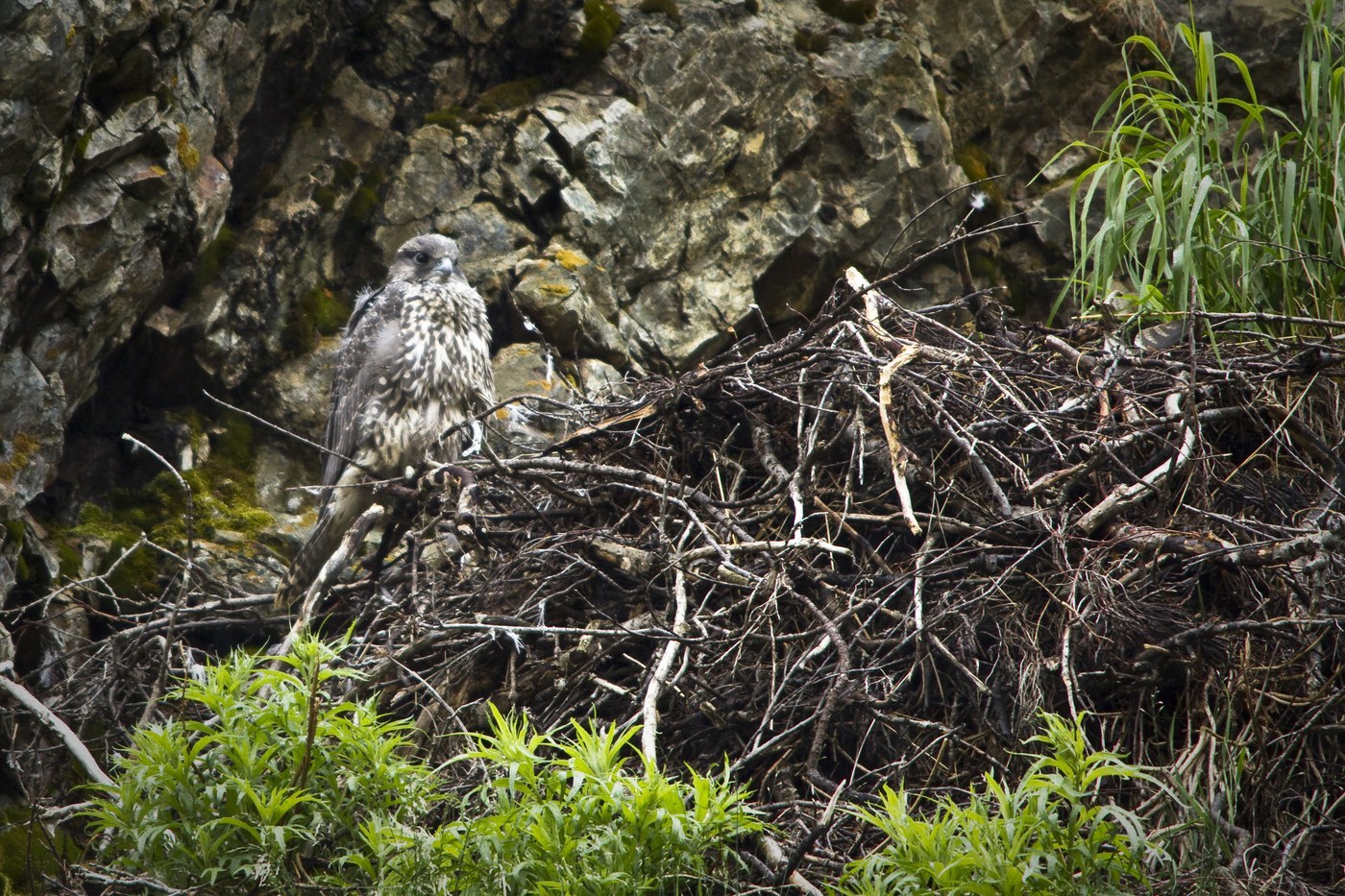
Overview
The Gyrfalcon (Falco rusticolus) is the largest and one of the most powerful falcons on Earth, a true Arctic specialist that breeds on cliffs across the northern tundra of North America, Greenland, Europe, and Asia. Its variable plumage, from ghostly white to nearly black, makes it one of the most striking raptors to encounter.
Key Field Marks
- Size and shape: Very large falcon, 51-64 cm (20-25 in) long with a wingspan up to 130 cm (51 in); notably bulkier and broader-winged than Peregrine Falcon, with a heavier body, broader-based wings, and a longer tail relative to wing length.
- Color morphs: Occurs in white, gray, and dark (nearly blackish) morphs, plus intermediates, all sharing the same structure. White-morph birds show varying amounts of dark spotting; gray-morph birds are the most common and show barred gray-brown upperparts and streaked underparts; dark-morph birds are heavily marked with sooty brown to blackish overall.
- Head pattern: Lacks the bold, contrasting dark "helmet" and thick malar stripe of Peregrine Falcon — the head is more uniformly patterned or shows only a faint mustache mark, especially in pale birds.
- Flight: Powerful, deep, rowing wingbeats with less snap than Peregrine; broader-winged silhouette and heavier build are apparent even at a distance; capable of extremely fast, direct pursuit flight when hunting.
Separating It from Similar Species
- Peregrine Falcon: Smaller, more slender, with narrower pointed wings, a strong dark helmet and thick malar stripe, and a proportionally shorter tail; Gyrfalcon's bulk, broader wings, and weaker head pattern separate the two.
- Prairie Falcon: Smaller and paler sandy-brown, with dark axillary ("armpit") patches visible in flight that Gyrfalcon lacks.
- Snowy Owl (white morph, superficial confusion in flight at a distance): Owl has a rounder head, no pointed falcon wingtips, and very different flight style with slow wingbeats.
Habitat, Range, and Season
Breeds on remote cliffs and rocky outcrops across Arctic and subarctic tundra in Alaska, northern Canada, Greenland, Scandinavia, and Siberia, preying heavily on ptarmigan and other tundra birds. Largely resident or short-distance migrant; some individuals, especially juveniles, wander south into southern Canada and the northern United States in winter, occasionally reaching further south during irruption years tied to prey cycles.
Voice
Gives a harsh, deep "kak-kak-kak" alarm call near the nest, lower-pitched and slower than the calls of Peregrine Falcon; generally silent away from breeding cliffs.
Frequently asked questions
What is the easiest way to tell a Gyrfalcon from a Peregrine Falcon?
Gyrfalcon is noticeably bulkier with broader-based wings and a longer tail, and lacks the Peregrine's bold dark helmet and thick mustache mark; overall structure is the most reliable clue at a distance.
Are all Gyrfalcons white?
No — only the white morph is largely white with dark spotting; gray-morph birds (the most common) and dark-morph birds are also common and show no white at all except on the underparts in some individuals.
Where can I see a Gyrfalcon outside the breeding season?
Winter wanderers, especially juveniles, occasionally reach southern Canada and the northern United States, favoring open coastal areas, farmland, and airports where prey such as waterfowl and shorebirds concentrate.
What does a Gyrfalcon eat?
Primarily ptarmigan on the Arctic breeding grounds, supplemented by other birds and occasionally small mammals; wintering birds often target waterfowl and shorebirds.