
Gull-billed Tern Identification Guide
A stocky, pale tern with a short, thick black bill, more often seen hawking insects over marshes and fields than plunge-diving for fish.
Read the full Gull-billed Tern encyclopedia entry →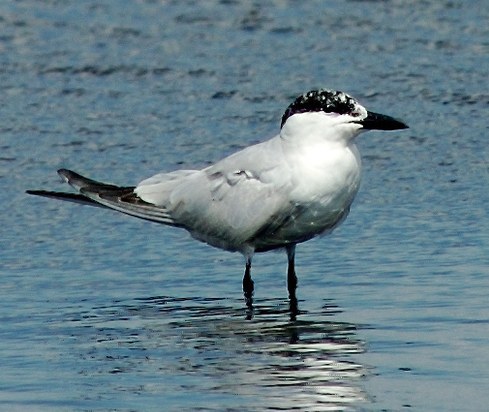
Overview
The Gull-billed Tern (Gelochelidon nilotica) is a distinctive, wide-ranging tern found on coasts and inland wetlands across much of the world. Unlike most terns, it feeds heavily on insects and small terrestrial prey caught on the wing or picked from the ground, rather than diving for fish.
Key Field Marks
- Size and shape: Medium-sized, stocky tern about 33-38 cm (13-15 in) long with broad-based wings, a relatively short, only moderately forked tail, and a heavy-bodied build compared to slimmer "sea terns."
- Bill: Short, thick, and entirely black — noticeably stubbier and gull-like compared to the long, slender, often red or orange bills of many other terns, giving the species its name.
- Plumage: Pale gray upperparts and white underparts; breeding adults have a full black cap, while nonbreeding and juvenile birds show a whitish head with a dark smudge through and behind the eye.
- Legs: Black legs, longer than in many terns, suited to its habit of walking and foraging on the ground.
- Flight and behavior: Flies with buoyant, gull-like wingbeats; frequently hawks insects in flight like a giant swallow, hovers briefly, and forages over fields, marshes, and mudflats as often as open water.
Separating It from Similar Species
- Common and Forster's Terns: Both have longer, thinner, orange-to-red bills (often with a black tip) and more deeply forked tails; Gull-billed's stout all-black bill is the best distinguishing feature.
- Sandwich Tern: Has a long, slender black bill with a yellow tip and a shaggy crest, quite different from Gull-billed's short thick bill.
- Caspian Tern: Much larger with a massive red-orange bill, easily separated by size and bill color alone.
Habitat, Range, and Season
Breeds locally on sandy or shelly coastal beaches, barrier islands, and salt marshes, as well as inland at lakes, salt flats, and agricultural wetlands across scattered populations in North America, Europe, Africa, Asia, and Australia. Northern populations are migratory, wintering along tropical and subtropical coasts; many populations elsewhere are resident or make shorter movements. Look for it over marshes, plowed fields, and mudflats as much as beaches, especially during the breeding season.
Voice
Gives a distinctive nasal, laughing "ka-way" or "kay-wek" call, harsher and more rasping than the higher-pitched calls of Common or Forster's Terns, often given in flight.
Frequently asked questions
What is the single best field mark for Gull-billed Tern?
Its short, thick, entirely black bill — much stouter than the long, often reddish or orange bills of most similar terns.
Does the Gull-billed Tern dive for fish like other terns?
Rarely — it more typically hawks flying insects, picks prey from the ground or water's surface, and forages over marshes and fields rather than plunge-diving into open water.
How can I separate a nonbreeding Gull-billed Tern from Forster's or Common Tern?
Focus on bill shape and color (short, thick, all black versus long and thin, often orange or red-based) and overall stockier body and shorter, less forked tail.
Is Gull-billed Tern found away from the coast?
Yes, it regularly forages and even breeds well inland at lakes, salt flats, and wet agricultural fields, unlike many strictly coastal terns.