
Guianan Toucanet Identification Guide
A small, mostly green toucan of Guiana Shield forests, identified by its bicolored bill and quiet, unobtrusive canopy habits.
Read the full Guianan Toucanet encyclopedia entry →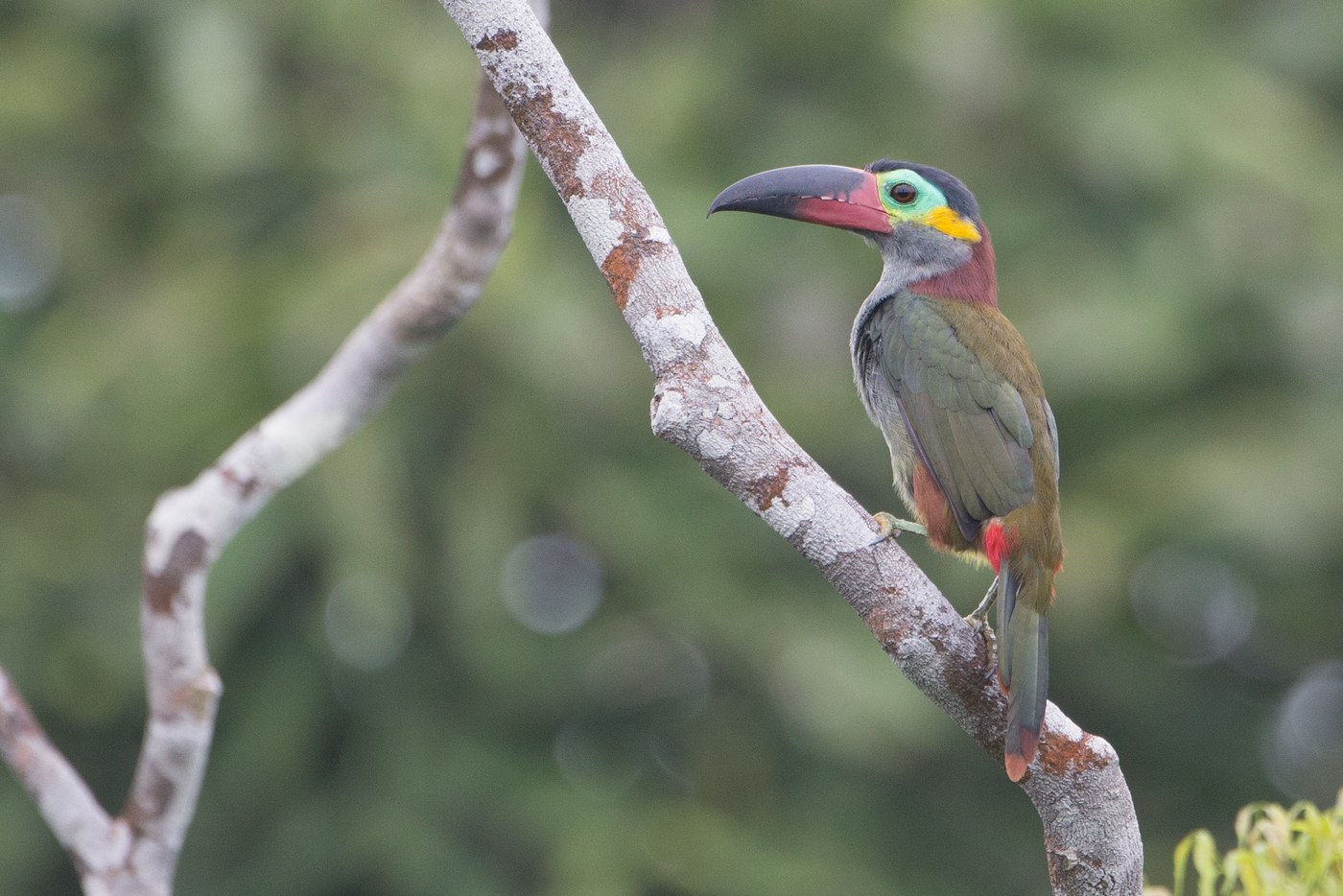
Overview
The Guianan Toucanet (Selenidera piperivora) is a small toucan of the humid lowland forests of the Guiana Shield. Like other toucanets, it is far less conspicuous than its larger toucan relatives, moving quietly through the mid-story and canopy in pairs or small family groups.
Key Field Marks
- Size and shape: A compact toucan around 30-33 cm (12-13 in) long with a proportionally large but not oversized bill compared to big toucans, and a fairly short tail.
- Bill: Bicolored — typically dark (blackish) on the upper mandible with a paler yellowish or horn-colored lower mandible and a pale base, a useful mark at close range.
- Male plumage: Mostly dark olive-green upperparts, with a black head, chestnut-tinged ear patch, and a yellowish to olive breast band grading into greenish underparts.
- Female plumage: Similar pattern but with a chestnut-brown head and nape instead of black, distinguishing the sexes in the field.
- Behavior: Forages for fruit and occasionally insects and small vertebrates in the canopy and subcanopy; often located by its distinctive frog-like calls rather than by sight.
Separating It from Similar Species
- Green Aracari and other aracaris: Larger, more boldly patterned with red or black belly bands and longer, more colorful bills; toucanets are stockier and less flashy.
- Golden-collared Toucanet (where ranges may approach): Shows a more yellowish collar and different bill coloration; range and habitat help separate the two.
- Channel-billed Toucan: Much larger overall with a heavier, more colorful bill; the size difference alone is diagnostic.
Habitat, Range, and Season
Resident in humid lowland and foothill rainforest of the Guiana Shield, including Guyana, Suriname, French Guiana, southeastern Venezuela, and adjacent northern Brazil. It stays within closed-canopy forest year-round and does not migrate, generally remaining in the mid-story to upper canopy where fruiting trees are found.
Voice
Gives a distinctive repeated, frog-like or croaking "krrk" or "creuk" note, often repeated monotonously for long periods — a key clue to locating this otherwise inconspicuous bird high in the canopy.
Frequently asked questions
How do I tell male and female Guianan Toucanets apart?
Males have a black head while females have a chestnut-brown head; both share the greenish body and bicolored bill.
What is the easiest way to detect a Guianan Toucanet in the forest?
Listen for its repetitive, frog-like croaking call given from the canopy — it is often heard well before it is seen.
How does the Guianan Toucanet differ from aracaris in the same forests?
Toucanets are stockier with less boldly patterned underparts and shorter tails compared to the slimmer, longer-tailed, more vividly banded aracaris.
What does the Guianan Toucanet eat?
Primarily fruit, supplemented occasionally with insects, small vertebrates, and eggs or nestlings of other birds.