
Guanay Cormorant Identification Guide
A glossy black-and-white seabird of the Humboldt Current, famous for forming immense breeding colonies on Peruvian and Chilean coastal islands.
Read the full Guanay Cormorant encyclopedia entry →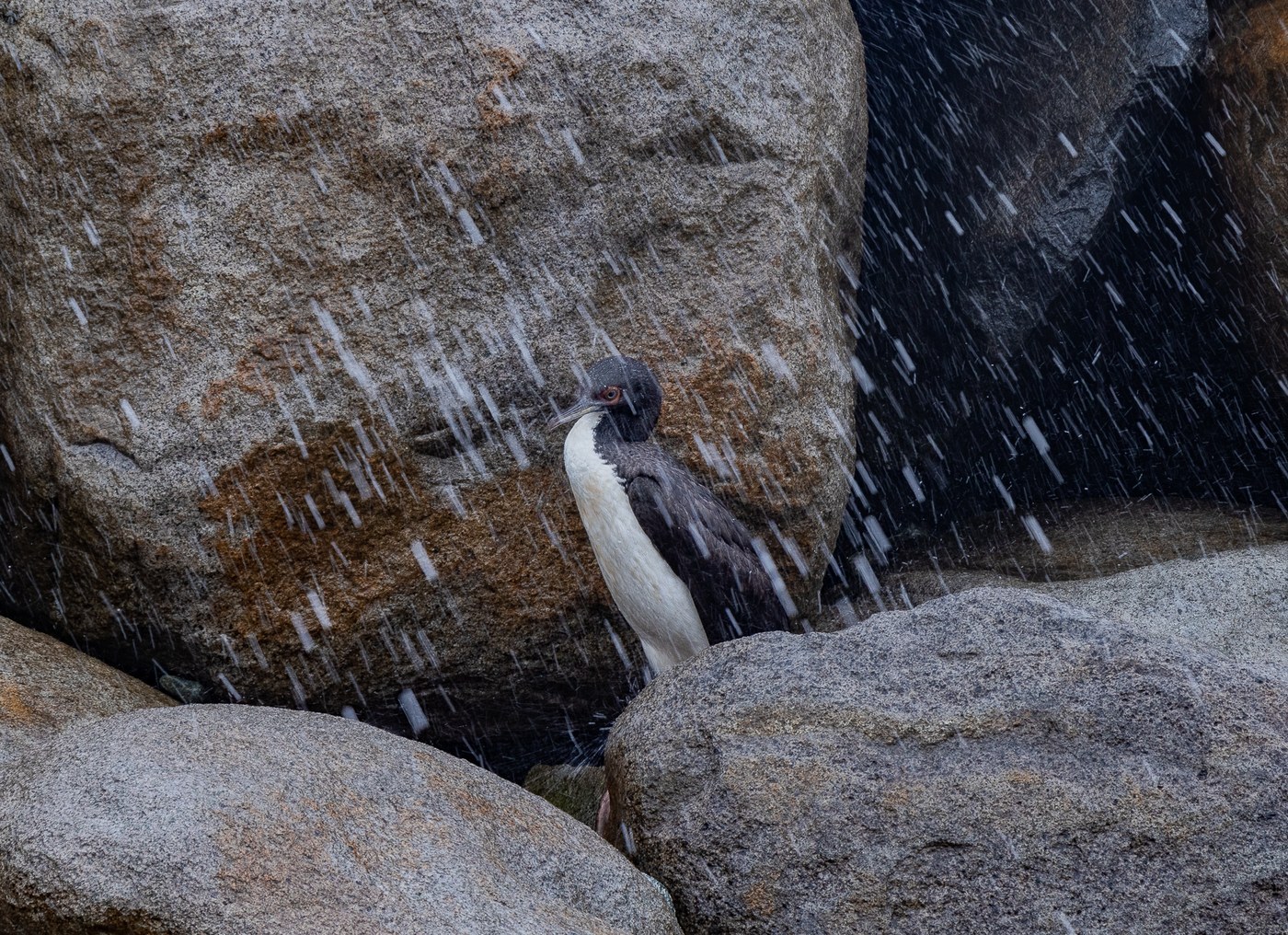
Overview
The Guanay Cormorant (Leucocarbo bougainvillii) is a medium-large seabird endemic to the cold, nutrient-rich waters of the Humboldt Current along the Pacific coast of South America. It is one of the principal producers of guano, the nitrogen-rich droppings that once fueled a major South American export industry and gave the bird its name.
Key Field Marks
- Size and shape: A stocky, thick-necked cormorant about 71-76 cm (28-30 in) long, with a moderately long, hook-tipped bill and a fairly short tail compared to other cormorants.
- Plumage: Glossy blue-black upperparts, crown, and hindneck contrast sharply with a crisp white throat, foreneck, breast, and belly — a bold two-tone pattern unlike most cormorants, which are largely uniform dark.
- Bare parts: A patch of bare pinkish-red to purplish skin around the base of the bill and eye, brighter and more colorful in breeding condition; legs and feet are pink to reddish, not black as in many related species.
- Flight: Flies in long, straight lines or V-formations low over the water, often in flocks numbering in the thousands, with steady, direct wingbeats.
Separating It from Similar Species
- Neotropic Cormorant: Entirely dark (no white underparts), smaller, and lacks the pink facial skin; found more on inland waters as well as coasts.
- Red-legged Cormorant: Slate-gray overall with a white neck patch and bright red legs, much smaller and slimmer-billed; a rocky-shore specialist rather than a colonial island-nester.
- Peruvian Booby: Also black-and-white and abundant in the same guano-island colonies, but has a heavier, pointed (not hooked) bill, cone-shaped head, and plunge-dives for fish rather than pursuit-diving from the surface.
Habitat, Range, and Season
Guanay Cormorants are resident along the coasts of Peru and Chile (with occasional wanderers to Ecuador and Argentina), rarely straying far offshore or inland. They roost and breed in enormous, densely packed colonies on rocky islands and headlands, especially the historic guano islands of Peru, and forage in cold upwelling waters close to shore. Numbers fluctuate dramatically with El Niño events, which can cause mass die-offs and colony abandonment as anchovy prey stocks collapse.
Voice
Largely silent at sea. At breeding colonies, adults give low, guttural grunts and croaks during nest-site and pair interactions; chicks give thin begging calls. Vocalizations are rarely the primary identification tool given the species' unmistakable plumage and habitat.
Frequently asked questions
What makes the Guanay Cormorant different from other cormorants?
Its sharply defined white throat, foreneck, and underparts contrasting with glossy black upperparts, combined with pink facial skin and pink legs, are distinctive; most other cormorants are uniformly dark.
Where is the best place to see Guanay Cormorants?
The guano islands and coastal headlands of Peru and northern Chile, where they form some of the largest seabird colonies in the world.
Do Guanay Cormorants migrate?
They are largely non-migratory but shift foraging locations and colony attendance in response to prey availability, especially during El Niño events.
Why is this species called 'Guanay'?
The name comes from guano, since this cormorant is historically one of the largest producers of the nutrient-rich droppings mined for fertilizer on Peruvian islands.