
Griffon Vulture Identification Guide
A huge, broad-winged Old World vulture soaring on flat, plank-like wings over mountains and open country, identified by its pale sandy-brown body, whitish downy neck ruff, and dark flight feathers.
Read the full Griffon Vulture encyclopedia entry →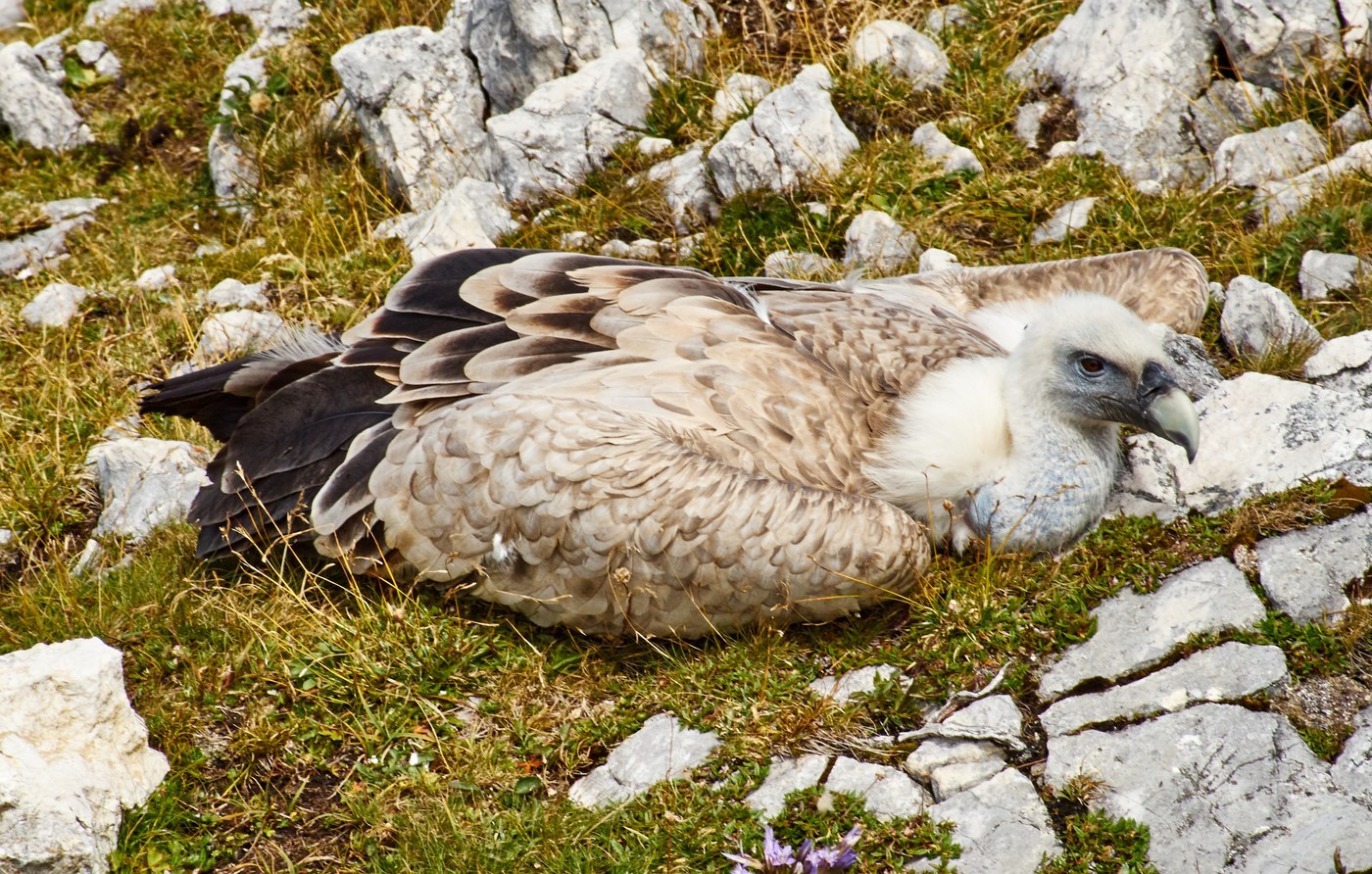
Key Field Marks
- Size & shape: Enormous raptor with a wingspan of 2.3-2.8 m (7.5-9.2 ft) and body length around 93-122 cm (37-48 in); one of the largest Old World vultures, soaring on very broad, long, parallel-edged wings held flat or in a shallow V.
- Plumage: Pale sandy-buff to tawny-brown body and wing coverts contrasting sharply with blackish flight feathers (primaries and secondaries) and tail, creating a strong two-tone pattern visible from below in flight.
- Head & neck: Small, bald, pale head (whitish-buff, skin-colored) atop a long neck, with a fluffy white or pale down ruff at the base of the neck — a diagnostic feature useful even at distance.
- Flight: Soars for hours on thermals with minimal flapping, wings held flat and fingered primaries splayed at the tips; often seen in large groups (kettles) circling together.
- Behavior: Highly social, roosting and nesting colonially on cliff ledges; locates carrion partly by watching other vultures and soaring widely over open and mountainous terrain.
Similar Species
- Eurasian Black Vulture (Cinereous Vulture): Much darker overall (blackish-brown), larger still, with broader "barn-door" wings and a wedge-shaped tail, versus the pale, two-toned Griffon Vulture.
- Egyptian Vulture: Much smaller, with white body plumage, black flight feathers, a wedge-shaped tail, and a yellow bare face, easily separated by size and shape alone.
- Rüppell's Vulture (Africa, limited range overlap in parts of the Middle East/Sahel): Darker brown with pale scaly scalloping on the body feathers, versus the more uniform tawny tone of Griffon Vulture.
Where & When to See It
- Range: Southern Europe (Spain, France, Balkans, Greece, Turkey), North Africa, and across the Middle East and central/southern Asia to the Himalayas and parts of the Indian subcontinent.
- Habitat: Mountains, gorges, cliffs, and open plains and steppe where it can find thermals for soaring and carrion (large mammal carcasses) for food; nests colonially on inaccessible cliff faces.
- Season: Largely resident in most of its range, though some populations, especially in the north, show partial migratory movements; visible year-round at established breeding colonies, with peak soaring activity in warmer months when thermals are strongest.
Voice
- Generally silent away from the nest; at breeding colonies and around carcasses gives various hisses, grunts, and croaking or growling calls during feeding disputes.
Quick Tips for Confident ID
- Look for the strong contrast between pale tawny body/coverts and blackish flight feathers from below.
- Check for the pale, fluffy neck ruff at the base of a long, mostly bald neck.
- Note the huge size and flat-winged soaring flight, typically in groups circling on thermals over mountains or cliffs.
Frequently asked questions
How do you tell a Griffon Vulture from a Black Vulture?
Griffon Vulture is paler tawny-brown with strong contrast against dark flight feathers and a pale neck ruff, while Cinereous (Black) Vulture is much darker and more uniformly blackish-brown with broader wings and a wedge-shaped tail.
Why does the Griffon Vulture have a bald head?
A bald head and neck help keep the bird clean while feeding deep inside large carcasses, since feathers would otherwise become fouled with blood and tissue.
Where can you reliably see Griffon Vultures in Europe?
Well-known strongholds include the Pyrenees and other mountain ranges in Spain, parts of France, Crete and other Greek islands, and cliffs and gorges across the Balkans and Turkey.
Do Griffon Vultures migrate?
Most populations are largely resident and sedentary around breeding cliffs, though some individuals, particularly younger or more northerly birds, may wander or show partial migratory movements.