
Greylag Goose Identification Guide
A large, bulky grey goose with an orange bill and pink legs, the wild ancestor of most domestic geese, told from other grey geese by its pale forewing and heavy pink-orange bill.
Read the full Greylag Goose encyclopedia entry →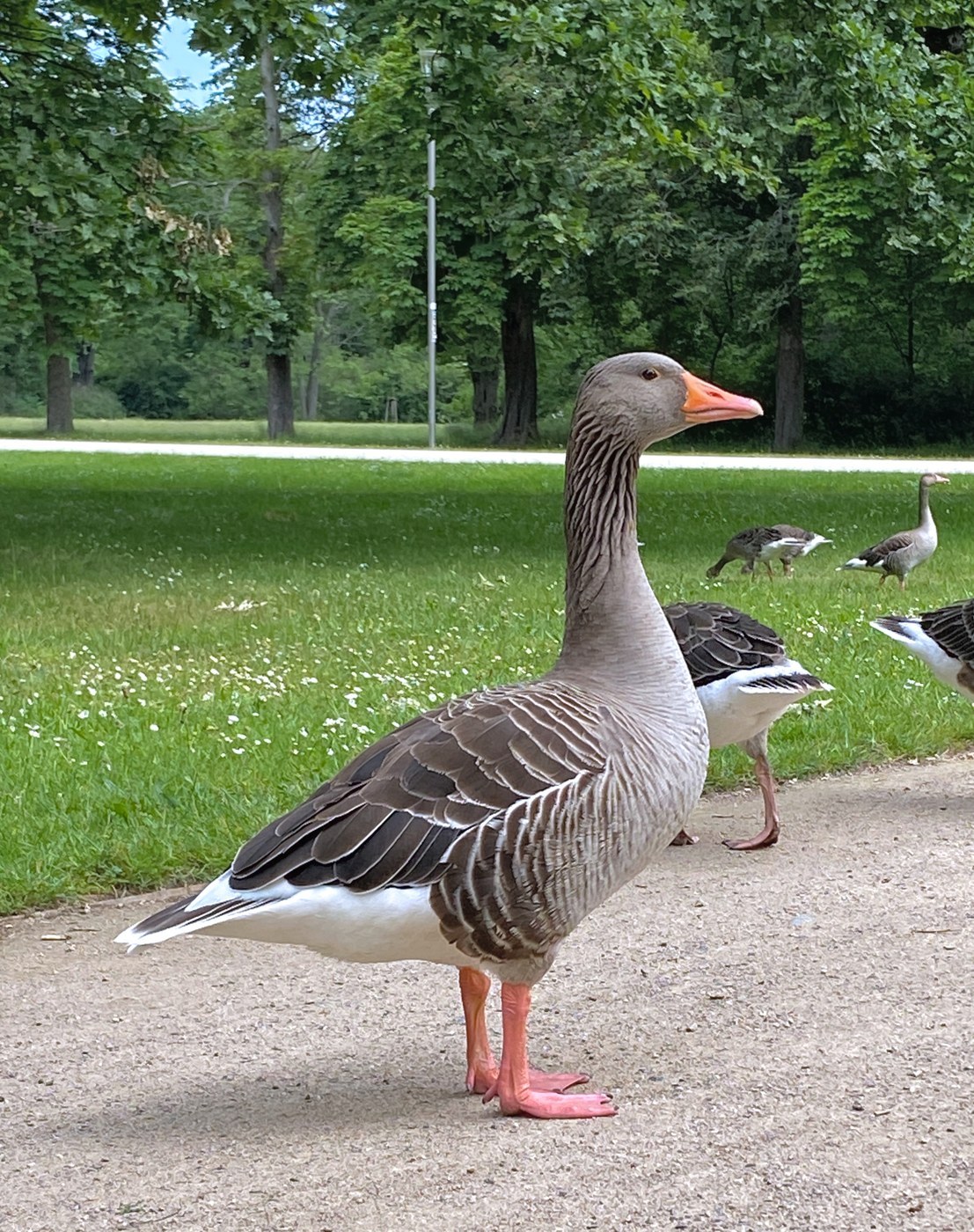
Key Field Marks
- Size & shape: A large, heavy-bodied goose, 74-84 cm (29-33 in) long, with a thick neck and bulky build — one of the largest "grey goose" species in the Western Palearctic.
- Plumage: Uniform grey-brown body with darker barring on the flanks and back, a pale grey-blue forewing panel visible both at rest (on the folded wing) and prominently in flight, and a white rear end/undertail.
- Bill: Large, heavy, orange to pink-orange bill (color varies slightly by population), a key mark separating it from similar grey geese.
- Legs: Pink to pinkish-orange legs and feet, matching or complementing the bill color.
- Behavior: Grazes on grass, grain, and agricultural crops in flocks, often mixing with other goose species; flies in V-formation or lines with slow, deep wingbeats and a loud honking chorus.
Similar Species
- White-fronted Goose: Smaller, with a white patch at the base of the bill (adults) and dark belly barring, plus a pink (not orange) bill; lacks the pale forewing panel as extensively.
- Bean Goose: Darker overall, with an orange band on an otherwise dark bill (not fully orange/pink) and orange (not pink) legs, and lacks the pale blue-grey forewing panel of Greylag.
- Pink-footed Goose: Smaller and darker-headed with a small dark bill showing a pink band, and pink (not orange) legs; overall daintier structure than the bulky Greylag.
- Domestic/feral geese: Many feral park geese are descended directly from Greylag Goose and can look identical to wild birds or show white patches from domestic breeding; behavior (tameness) and location often hint at feral origin.
Where & When to See It
- Range: Breeds across much of northern and central Europe through to Asia; the ancestral wild form of domestic geese, and now also widely re-established as feral/naturalized breeding populations in Britain and elsewhere in Western Europe.
- Habitat: Lakes, marshes, wet grassland, farmland, reservoirs, and coastal grazing marshes; adaptable to both wild wetlands and man-made park lakes.
- Season: Northern/eastern populations are migratory, wintering further south and west (including parts of Britain, France, Spain, and the Balkans); many western European populations, especially feral-origin birds, are resident year-round.
Voice
- A loud, deep, cackling honk, "aahng-ahng-ang," similar to the familiar call of domestic farmyard geese (since domestic geese descend from this species), given both on the ground and in flight.
Quick Tips for Confident ID
- Look for the heavy orange-pink bill and pink legs as primary color clues.
- Check for the pale blue-grey forewing panel, obvious both at rest and in flight.
- Remember that many "wild-looking" Greylags encountered in parks are feral or semi-domestic populations rather than truly wild migrants.
Frequently asked questions
Is the Greylag Goose the ancestor of domestic geese?
Yes, most breeds of domestic goose in Europe and beyond are descended from the wild Greylag Goose, which is why farmyard geese honks and grey-and-white plumage forms often resemble their wild ancestor.
How do you tell a Greylag Goose from a White-fronted Goose?
Greylag Goose is larger and bulkier with an all-orange to pink-orange bill and no white face patch, while White-fronted Goose is smaller, shows a white patch at the base of the bill, and has dark belly barring.
Are the Greylag Geese seen in city parks wild birds?
Many park and lake populations, especially in Britain and Western Europe, are feral or semi-domestic descendants of introduced or escaped birds rather than genuinely wild migrants, though truly wild migratory Greylags also occur.
What does a Greylag Goose eat?
It grazes mainly on grasses, sedges, waste grain, and agricultural crops such as winter cereals and stubble, often feeding in large flocks on farmland near wetlands.